Goa is abuzz with excitement as vintage bike and car owners, users, collectors and fans are decking […]
Old is Gold
October 4, 2016
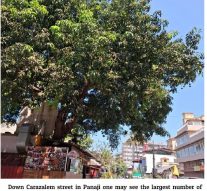
COME March and it’s impossible to take one’s eyes off the street-side mango trees in capital city Panjim. Mango trees dot the landscape in Goa everywhere in private home gardens and estates or public parks, mango trees dot street sides to the good fortune of children and adults anxious to share in the “loot” of harvesting a free green mango or two to put in a curry, or turn into Goa’s most quintessential pickle of the season – green mango miskut, which even the pavement vendors take to making and selling to their regular buyers in small plastic pouches.
A packet of say a quarter kg miskut is priced currently Rs50 or is it more now, and I have to enquire if it is too full of red chilli and what chilli have you used (Kashmiri chili or the fiery Canacona chili), what oil, what mango breed? Thin-skinned tart wild mango with small seed, tender no shell mangoes are the best. Thick-skinned flavorless mangoes with big stones within have hardly any flesh to take delight in!
So there are green mangoes and green mangoes and you have to get familiar with as many as you while buying mangoes for this, that or the other – be it pickle, relish, sherbet, jam, chutney, the piece de resistance baby mango salt water pickle called “chepnim” (my favorite replacement for olives in Goa). A little bit of tantalizing tart or sour or sour sweet can go along to make a hot day’s summer time tiffin of curd rice or any other meal come alive. Many pickles do enjoy the stamp of being super probiotic food contributing towards better digestion. Just ask the old-timers in Goa.
Then again of course you may not stuff yourself with too much pickle, salty, spicy concoctions meant to be eaten judiciously can be injurious to the wellbeing of stomach and body beautiful…if you go overboard, don’t spoil the moment, okay. But this is to say whole green mango is rich in vitamin C, the first healing vitamin of them all and other good things to say thumbs up to.
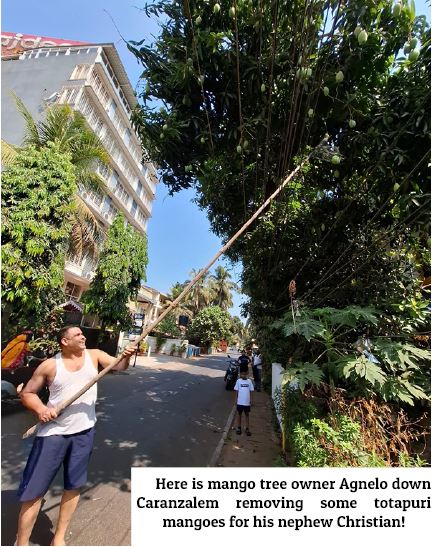
ALL over India green mangoes go into great big “baini” (ceramic jars/bottles) for storage of year-round range of pickles, and since I’m a Guju, I know my mother used to get the naturally sweeter large rather sweetish fleshed Rajapuri and naturally “khatta” Ladwa kairi to make our family favorite sun-cooked “chundo” (variously spiced up mango marmalade) quintessentially of the Gujarati community, then comes “gor kairi” and “kairi nu athanu” and etcetera. Every state in India has its own pickle. Green mango or kairi across the board means green mangoes small, medium or large and next is the issue of big or small seeds within with or without outer fibrous shell on which mango pulp clings aromatically as it ripens.
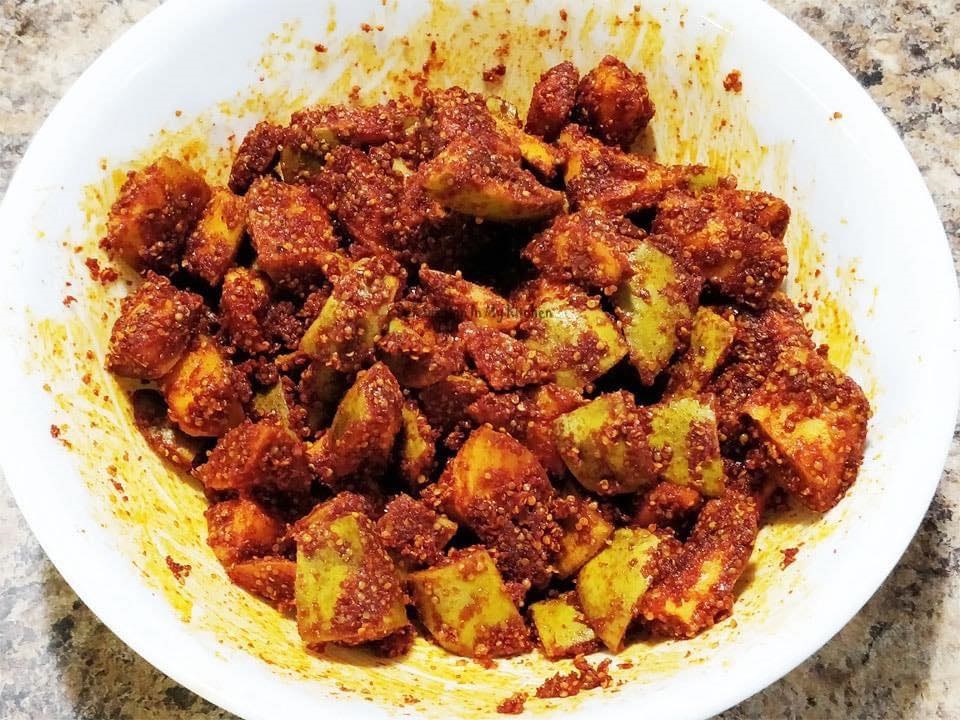
India’s variety of mangoes is formidable. Has anyone done a PhD in the use of green mangoes in Indian culinary schools north to south and east to west? Goa being a mango state with an abundance of varieties cannot but make the most of its mango trees come springtime, come summer time…it’s a traditional, cultural green and ripe mango affairs, okay. Every Goan community has its own cache of familiar mango pickles with the most humbly divine salted “chepnim” to the stuffed “bharleli” green mangoes which come with sharp hing highs in the masala stuffing; quality hing or asafetida is hard to find for it comes from the stony mountains of Afganistan or India. Hing makes all the difference between superlative and okay okay. A mango pickle swearing by its hing has a real mango lover-cum-connoisseur clientele! Enough green mango talk. On the pavement vendors veggie markets of Panjim one may see these wild or “gota” mangoes, half ripened, these make the best mango curry. Rice and mango curry everyday for summer days?

OKAY, no more green mango talk. Let me tell you about the Goa Cashew Festival happening at DB Grounds in Panaji next month from April 10 to 12, 2026. The annual 3-day festival will showcase the cashew nut tree business in Goa – cashew tree gifts in all avatar, beverages like the first fresh neero (March is for drinking the fresh juice of the ornamental looking glossy cashew apples), then urrack is here and feni or fenny which is Goa’s GI indexed spirit served up in traditional neat service or in various cocktail combos to beguile the senses.
Plus, there will be more, live band entertainment of course. Something like 50 or so stalls have enlisted – cashews, cashew spirits, cashew-related cuisine stalls, lots of self-help group stalls with something or another to do with the key leitmotif of the cashew apple fruit, cashew nut, beverages and liquor, sweets, cashew toffees…in fact, look forward to a slew of familiar ghargutti produce from the still agriculture rich village homes of Goa. Goan homes haven’t become so urbanized or plastisized yet, thank god for small mercies.
The 4th edition of the Goa Cashew Festival 2026 is being sponsored by the Goa Forest Development Corporation (GFDC) with a budget of Rs3.5 crore, plus whatever revenue is raised courtesy the stalls put up by Goan cashew business stake holders.
This is always an interesting festival seeing how cashew nuts are surely the favorite nuts of Goans. Never mind that the cashew nut tree (Anacardium occidentale) comes to us in Goa and India all the way from its native home in the northeastern Brazil and Venezuela in South America…courtesy our colonial Portuguese history. We have to thank the Portuguese for some things surely! Both Catholic and Hindu Goenkars are utterly mesmerized by the fruit of the cashew nut, which is called cashew apple, and cashew apple nuts – both apple and nuts are processed separately and both are a very labor intensive process.
Speaking at the first Goa Cashew Fest 2026 Stakeholders’ Meeting which took place at the Vivanta by Taj in Panaji on Thursday, March 6, 2026 and the press conference which followed, GFDC chairperson and MLA Deviya Rane was pretty excited about the changing prospects of Goa’s cashew business – a lot of good things are happening she said and promised more.
The Forest Department has planted new cashew plantations in 600 hectares plus areas and the seedlings are original to the Goan cashews which are much loved. The rewards will come in a couple of years also thanks to the promotional work which will be seen at the forthcoming annual Goa Cashew Festival. She shared that things have brightened up for cashew or caju farmers for they are getting Rs170 kg of caju produced instead of the old rates of Rs80 and Rs110! Well, that’s absurd of course considering the much loved superior Goan caju is now selling at Rs1,000 per kg plus, plus in the market to caju lovers.
In fact, so good is Goan caju (organically cultivated by default!) that other states like Maharashtra, Karnataka and Kerala are cheating and selling their cashew nuts as “Goan” cashew nuts in Goa and elsewhere. Tourists hunting for Goan caju are pretty trusting and unaware of all the petty cheating and adulteration going on and this even includes (according to some reports) “atta ke caju” (cashew nuts of a mix of wheat flour and cashew nut powder!)…also a lot of caju katli is now more mava choked caju katli than 100% caju grating. It is now difficult to tell real from fake anything anymore and so it is with the humble caju or cashewnut which you will find in every home in Goa…caju has a pedigreed history after all and find me a Goan who is not in love or infatuated by caju nuts.
Funny or not funny, a friend of mine in Mumbai now always tells me to get her a packet of “kaju tukda” from Goa, from the legendary Zantye’s one and only shop down 18 June Road – here the caju is always first class Goan and there’s quite a choice now – from the traditional ivory white caju, to drum roasted with skins on caju, all kinds of masala flavored caju now and some more…boxes of caju katli. The tukda tukda caju bits are easier to use in culinary preparations, economical too.
Well, this is to say look forward to the caju festival coming up in the month of April. Diviya Rane said there’s going to be a Goa Cashew Board soon to look into the nitty gritty problems of the caju plantations and once farmers realize how much revenue there is reviving caju plantations – Goa will be on top again, at least regarding caju crops, which have sadly been declining along with dying agriculture/horticulture in Goa, which is also to do with the varnishing hilly slopes…leaving drying lands behind unfit for planting anything. Nobody seems to realize that with varnishing hills, plateaus, forests, also will varnishes our springs of water for quenching thirst and growing honest farm crops.
Indeed, Goans will be forced to eat caju nuts from outside Goa and I don’t think any Goan can bear to think of that! It is true that the bad will always drive the good out of the market place with changing economics; khaas aadmi won’t suffer so much, but aam aadmi will.
One thing I like about MLA Dr Divya Rane (she has a degree biochemistry) – she is so delightfully enthusiastic about the projects she takes up, and perhaps equally innocent about ground realities. There are any number of people to clue her up of course! May her dream of rejuvenating dying cashew plantations covering something like 60 hectares in Goa come true. For we all love cashew nuts, I’m also addicted to neero in the month of March and April. Nothing like fresh cool neero or niro to cool down in hot Goa.
 LETTERS TO THE EDITOR FOR THE ISSUE DATED MARCH 07, 2026
 AMKA NAKA ‘NEW’ GOA: Our heritage is under a hammer!By Raaisa Lemos Vaz
 39A DELHI BUILDER DRIVEN!
 THE MORIBUND STATE OF THE GOAN ECONOMY! BY Arvind Pinto
 NEW HPV VACCINE TARGETS YOUNG GIRLS!By Dr RG Wiseman Pinto
 GLOBAL WAR CLOSER TO GOA!By Olav Albuquerque
 WITH THE AMI PANJEKAR PANEL!
 PRAMOD SAWANT SAYS BIG BOAT WON’T COME!
 SPLASH THE COLOURS! FILL UP YOUR PLATE! By Dr Amit Dias
 WEEKEND UPDATES
 LETTERS TO THE EDITOR FOR ISSUE DATED FEBRUARY 28, 2026
 BORKAR ENDS FAST, ST ANDRE CONVERSIONS SUSPENDED!
 GOA’S ECOLOGY DESTROYED BY 39A! By Dean D’Cruz
 A PARCHED PARADISE! By Raaisa Lemos Vaz
 KARAPUR LOCALS PROTEST RANE LAND DEAL!
Goa is abuzz with excitement as vintage bike and car owners, users, collectors and fans are decking […]