Goa is abuzz with excitement as vintage bike and car owners, users, collectors and fans are decking […]
Old is Gold
October 4, 2016
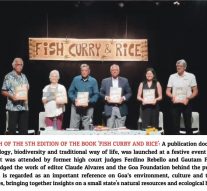
Whoever gives a damn for Goa past, present and future must make time to read and understand the implication of the narratives in this invaluable source book— which is out in its 5th edition now, but this time in a sumptuous hardcover publication priced all of Rs3,000 and worth it, considering how much we spend dining out with family and friends! What is more important? Food for body beautiful or food for mind, heart and soul? Both of course.
WE don’t come across such heavyweight books anymore. The latest 5th edition of “Fish Curry & Rice” is all of two kg plus across 400 art paper pages plus; a friend of mine upon seeing it quipped, “I wish they would distribute a portable bookstand with such heavy books! It would easier to prop up easily on dining table or wherever to read the book more easily…this 2 kg something Fish Curry and Rice book keeps falling off my hands!” Sigh. She is an ardent reader and book collector senior citizen sharing with me and I sympathize, empathize with her. Then yet another friend said maybe she’ll use the book as “weights to exercise my arm muscles which are waning, doctor’s orders are to work out.”
Well, jokes aside, I have an old relationship with the Goa Foundation’s recently out magnificent tome. It is the 5th edition and a grand one by today’s publishing standards, titled, what else but “Fish Curry and Rice.” Rings a bell? The Mario da Miranda cover illustration is the same and I wish the late much celebrated cartoonist-artist and his wife Habiba were around to appreciate it.
But to move on and first of all don’t get the idea that this is a cook book despite the title (newcomers tend to think so). Sure, there’s a chapter devoted to Goa’s standard home food which is fish curry and rice. But by and large publisher Claude Alvares’ “Fish Curry and Rice” is a metaphor of a book, a mammoth book, say a magnum opus, and it deserves to be in hardcover and art paper with all the marvelous illustrations – so what if it is priced at Rs3,000 and at least some of my friends baulked at buying it including me.
Say I have a complex love-hate relationship with books nowadays. I didn’t buy this brand new edition “Fish Curry and Rice” at its special discounted Rs2,600 rate at its second razzmatazz launch at the Kala Academy event on 14 March, 2026 (the first one at the Goa Art and Literature Festival at the International Centre Goa last month). But later on a couple of days later I ended up paying Rs3,000 to buy it for a friend who said her son-in-law in Bengaluru (Bangalore), who’s into real estate in Goa wanted it for reference homework.
Well, why not! Real estate folk need to do their homework before buying up hills, forests, rivers, paddy fields, water bodies, and any other protected lands of Goa before proceeding to build ugly matchbox skyscraper tenements or fancy swimming pool graced villas for wealthy clients seeking second and third homes away from home – to make a killing. To make a killing!

How many folk high and mighty want to make a killing in real estate in Goa in recent years! Not surprisingly a lot of niz Goenkars living peacefully in Goa are dizzy with nightmares of waking up one morning to this view outside their picture windows or balcao – the skyline obliterated forever by a clutch of tall, taller, tallest condominiums (taller than coconut trees) sneering down on them in their lovely traditional Goan homes of old. Don’t even smile. It’s no joking matter.
If our Goan powers-that-be had any sense and sensibility and really loved Goa, yes, they would put a moratorium on any further sale of Goa for the next ten years. Will any chief minister do it to be loved forever by the people of Goa? Goa needs a chief minister who will do it no matter which high command says what in Delhi or wherever!
BUT to continue with my critique of “Fish Curry and Rice,” a copy of which I finally got in my hands courtesy sweet appeals to influential friend Dean D’Cruz, he bought it for me and not just because I promised to return it once I’m done with it — I’m not collecting books any more in my precarious financial old age; I can’t even take care of my own private library of books collected over three-quarters of a lifetime in Bombay and Goa). “Fish Curry and Rice” is some kind of an encyclopedia of Goa, India’s paradisiacal smallest state, what it was, currently is and may be in the near future. Not worth living in things don’t fall into place for the better!
I mean, in time to come, will anybody recognize Goa as Goa anymore and pine to come here for beach holidays, trekking holidays, marriages to remember in its already too many starry garden resorts? Well, “Fish Curry and Rice” – 5th edition — is courtesy Goa Foundation’s iconic cause célèbre couple Norma and Claude Alvares, familiar names in Goa and Goa’s environmental journey – advocates both, passionate about Goa’s life-giving, life-sustaining environment…they have done some memorable work in matters legal and otherwise in finally putting together this exhaustive, useful, exciting book, albeit a tome if I may say so.
The book details life and living through the eyes of niz Goenkar people, from where Goa is coming from – here’re the narratives we need to hear and respect, from tribal, Christian-Catholic, Hindu Goa, Bhandari Samaj, Gaud Saraswat Brahmin people, long time settlers of Goa who’ve lived here, died here, through the thick and thin of whatever happened in the state’s colonial history, and some more.
“Fish Curry & Rice” is an omnibudsman of a book tracing the history of Goa, dwelling on environmental liberties taken leading to its detriment – the ad hoc mining, all the battles won and lost by the people affected by the tragedies of lost fields, homes, livelihoods – and the heroes who fought a stupid kind of insensitive, senseless industrialization. Anyone works so hard to kill the golden goose laying the golden eggs of El Dorado Goa, golden Goa or “amka bhangarache Goem?” The victories small and big, the challenges which still exist and are acquiring frightening mega status now – who can stop Goa from going the high-rise Mumbai way! The nitty gritty details are here in this book and sadness fills the soul.
Yes, gleaning through it in bits and pieces so far, I wonder if give or take a few more decades, will there be any Goa left for Goans to love? Will there be any hills and plateaus left, any rivers left, any forests left, any sanctuaries left, any paddy fields left, fruit orchards, coconut tree coastal belt with sand dunes – in a nut shell and with poignancy, any fish curry and rice left worth eating to be healthy, happy and alive to enjoy life in peace?
IS Goa’s government of the day so deaf, dumb and blind and utterly at the mercy of how many fortunes its politicians aspire to by selling a people’s motherland? That too by manipulating perfectly sane regional plans for the long term good of Goa? So much anger, ire and stupidity has flowed under the bridges of the years of post-Liberation Goa, courtesy mere ignorance or cunning, willful arrogance of politicians in power to do whatever they wish in collusion with millionaire-billionaire-trillionaire businessmen with little integrity or conscience.
What are governments for if they do not consult their own people of what kind of a Goa they want to live in? One in which they may still breathe the air of freshness, drink the potable water of uncontaminated natural springs, wells and rivers, eat fish curry and rice of their own fertile land not toxic with waste? Reflected in the growing numbers of sick and unhappy – diabetes, heart disease, cancer, study the growing statistics. Take away clean air, clean water, clean food from a people and they will become a sickly, constantly depressed – mentally ill angry society! Goa could be the Blue Zone state of India if its government so wishes, failing which if the people so wish and are willing to fight the good fight for a good future.
Facts, figures, graphs of studies done by some very distinguished researchers Goans and non-Goans – not to forget town planners, judges, scores of activists who’ve grown old and frail fighting court cases for the larger good of saving whatever is left of a paradise called Goa – you will find it well documented, recounted, illustrated graphically with meticulous detail, here in “Fish Curry & Rice.”
Everyone in love with Goa must find time for this book. And so must everyone seeking second home or a swimming pool adorned super luxurious villa in Goa! Seeking a “paradise” to live in is fine, but to be a party to its degeneration year by year is not – especially when we see how governments of the day seek short cuts with stars in their eyes at the thought of fortunes to be tucked away in personal accounts (at public cost). See phenomenal economic growth by hook or by crook, even at the expense of primary infrastructural growth — in the context of the ground realities of a small state, with vulnerable eco-systems evolved over time immemorial.
Ask the age old question: What must come first? The cart or the horse? In Goa’s case in this analogy the horses have almost all fled the stables and what’s left in the cart? Is Goa still worth saving, is it still worth fighting for, and who will carry on the good fight? I swear I wish there was a more economical paperback edition of “Fish Curry and Rice” so that more young folk may buy and read it, for this as much their future as anyone else wishing to live in Goa.
Of course, the libraries will stock this veritable bible of Goa’s past and present day dilemmas (anticipating future ones)…needless to reiterate that “Fish Curry and Rice” is a valuable document of a book reminding us what Goa was yesterday, is today and may be tomorrow if nobody gives a damn. Think about all this and don’t just think.
LONG ago when I’d first come from Bombay for trekking holidays in Goa in the 1970s and 1980s, I’d gone to the Goa Foundation’s book shop called The Other Bookshop, climbed up rickety steps in Mapusa and in the dusty bookshop purchased the first or second edition of “Fish Curry and Rice.” It gave me exciting insight into a Goa I loved and still do for old times sake. I don’t know where this old copy of mine has disappeared from my book shelf, the hubby has a habit of giving away books if someone comes visiting him, even when they’re not his to give away, and many are my quarrels with him…but that’s another story.
On that note it’s avjo for I’m a Guju in Goa, selamat datang in Malay for old connections, poite verem for I’m married to a Tambram, au revoir because I love the French language, and arrivedecci, hasta la vista, vachun yeta here for now. Be a friend of Goa, not an enemy. Humanity can neither eat nor go to bed with money — even if you think you can buy everything and everyone with money in today’s world engaged in reckless, eerie, self-destructive, toxic warfare.
A LAND WORTH FIGHTING FOR!
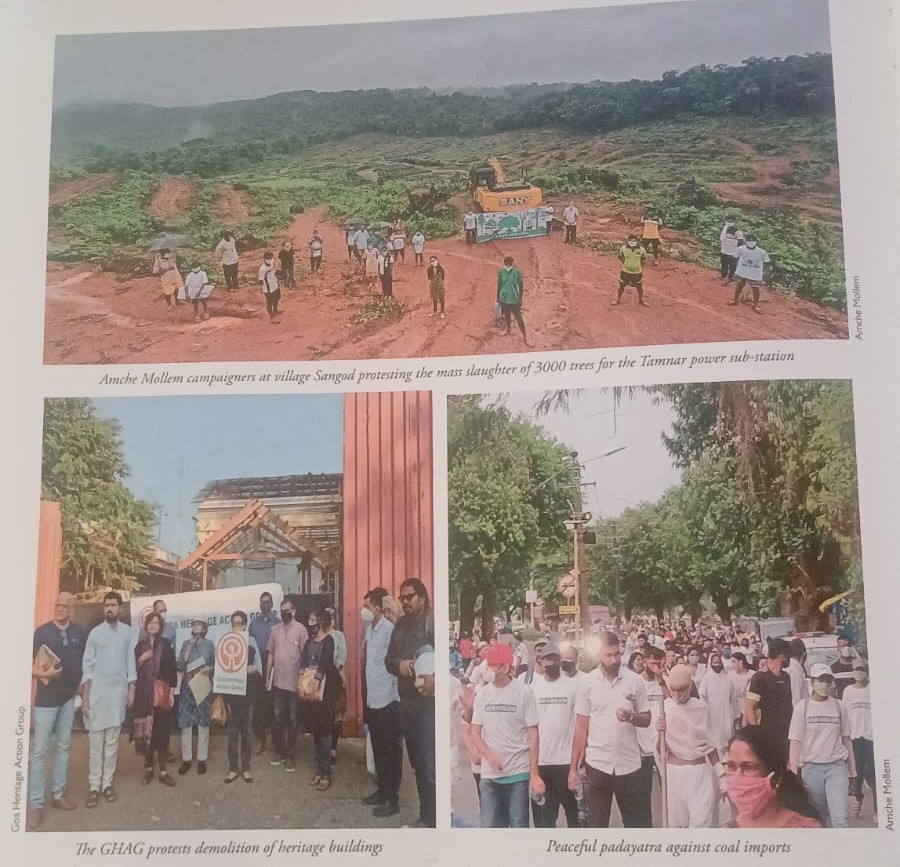
Citizens have forcefully resisted the degradation of Goa. Not for nothing that that this smallest of India’s states has the largest number of recorded and unrecorded environment battles. This final chapter lays out the four corners of the battlefield: civil society organizations, followed by the judiciary (mostly the High Court of Bombay at Goa) and Public Interest Litigation, and some official institutions like the Goa Biodiversity Board and the State Wetlands Authority which have kept the flag of environmental conservation flying high. Huge protests against unwanted development have arisen among from the village communities, including the Gawdas and Velips. If this resistance had not been there, Goa would most likely have ended up like a Mumbai slum way back in the nineties itself. If the resistance survives and grows — as it threatens to do – Goa may still survive and shine. Nature, Mother Nature, is always there to assist us in putting back the pieces.
The responses of several sets of actors (often called `stake holders’) to the environment crisis facing Goa – legislature, government, judiciary, media and civil society, represented most vocally by Non-Governmental Organizations (NGOs), the church, and public-spirited individuals – need to be carefully and critically examined.
The Government enacts laws through the Assembly and then creates statutory bodies to implement them. There are several laws enacted in the country, and also by the state of Goa, to protect the natural and social environment. Some like the Environment Protection Act, 1986, the Water Act, 1974, the Air Act, 1981, and the Forest Conservation Act, 1980 are central acts, but they do delegate powers to State government institutions to act. Others are simply local laws, like the Goa Anti-Spitting and Anti-Smoking Act; the Goa Preservation of Trees Act; the Goa Non-Biodegradable Garbage Act; the Protection of Tourist Places Act, etc.
If these laws are seriously implemented, many of Goa’s environmental problems would be mitigated. Most of the time, the implementing agencies are weak, indifferent, unwilling or simply corrupt, and collude with the environmental offenders in league with elected politicians.
Judges of the Bombay High Court at Goa have been more zealous about implementing environment laws than the executive and the legislature. The Goa bench of the High Court has always functioned consciously as a green bench despite the arrival of the National Green Tribunal (which functions from Pune). If the High Court had not intervened when it did, Goa would have been in a worse state than it is in today. But even the judiciary cannot be expected to work miracles if the executive is too far gone.
The Goa legislature has not played any significant role in the protection of Goa’s environment. On the contrary it has often passed laws that seek to relax and disembowel environmental norms. When the Cidade de Goa was directed to demolish an illegal building on the beach in a judgment issued by the apex court, the legislature bent backwards to amend the law retrospectively from 1894 to save the hotel. When the High Court ordered a monsoon ban on fishing, the legislature attempted to overrule it.
However, the most lousy laws the Assembly has passed are in relation to town planning. These laws have had the effect of killing the Town and Country Planning (TCP) Act altogether.
The Goa Assembly first inserted amendment section 16B to the TCP Act in 2018. It killed this amendment in 2023, after the High Court had stalled its operation for 4 years. In its place, it brought in the amendment of section 17(2). While this was on the statute book, it brought in another amendment in the form of section 39A. The purpose of all these amendments has been has been uniform: enable real estate to flourish by empowering a government with needless and dangerous powers to change the zoning of individual plots from ecology-sensitive status to settlement or commerce. It is only because of the High Court that the TCP Act and RP 21 have survived.
The Assembly does have one positive role, however: legislators are able to get replies from various government departments on several critical aspects of government functioning. The information provided in Assembly replies is of enormous use to citizens.
The Goan media (the fourth estate) has played a larger-than-life role in reporting environmental issues. Some journalists are now mostly known as environmental journalists: the environment, indeed, is safe with them. Their role of informing society of environmental battles is irreplaceable and priceless.
The NGOs have been probably the most vocal and the most effective institution of civil society to seek redressal of environment wrongs. If they had not existed and done their bit, it is doubtful whether the judiciary alone would have been able to intervene and cure some of the serious issues afflicting Goa’s environment. The successful story of Du Pont’s Nylon 6,6 projects being driven out of Goa is known the world over. The most recent galvanization of citizens and citizen’s groups under the banner of “Enough is Enough!” initiated by retired former judge, Ferdino Rebello, indicates that large numbers of people will be available in the months and years ahead to join the brigade of green rakhandars. Civil society is determined to ensure that Goa survives for its future generations.
 LETTER TO THE EDITOR FOR THE ISSUE DATED MARCH 21, 2026
 LOOK BACK IN ANGER, LOOK AHEAD WITH RESOLVE!By Gautam Patel
 OUR WOUNDED MANDOVI RIVER MAI! By Raaisa Lemos Vaz
 GARDEN SUBURB TO MONSTER TOWERS…Chembur then and now!
 PROTESTS PART OF GOAN DNA!
 OF IT IS GUDI PADWA…
 MIRABAG DAM WORK HALTED!
 THE WAR AGAINST TB Yes, we can end TB… By Dr Amit Dias
 70 ILLEGAL STRUCTURES USURP PRIME BEACH SPOTS FOR ILLICIT AIMS!By Dr Olav Albuquerque
 WEEKEND UPDATES
 LETTERS TO THE EDITOR FOR ISSUE DATED MARCH 14, 2026
 TOWERING INFERNOS OF GOA COMING!By Raaisa Lemos Vaz
 MIRABAG GIFTED TO ADANI!
 DEPOSITS REFUND SCAM!WHO BENEFITS FROM THE RS 10.. By Misbah Quadri
 THE COST OF GST COMPLIANCE IN INDIA!By Arvind Pinto
Goa is abuzz with excitement as vintage bike and car owners, users, collectors and fans are decking […]