Goa is abuzz with excitement as vintage bike and car owners, users, collectors and fans are decking […]
Old is Gold
October 4, 2016
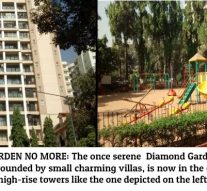
Here is an overview of how a once sleepy backward suburb grew by leaps and bounds once development and people came home to stay…
CHEMBUR in Mumbai today is one of the prime Eastern distant suburbs in terms of residential housing because of its connectivity. To south Mumbai — it is connected by a freeway – to the Western suburbs – by the Chembur-Santacruz Link road, to the Navi Mumbai — by the Vashi highway, to the Navi Mumbai Airport, Panvel and beyond by the Atal Setu – the bridge that snakes across the ocean. Yet in the ‘50s the only connection to Chembur was a train that early hour ran from Kurla to Mankhurd. In those days, the last shuttle from Chembur to Kurla was at 5 pm; should one have the misfortune of missing the last train, one had to walk to Kurla or spend the night in the wild that was once Chembur.
After the first World War, with the Colonial Bombay Government, seeking to disperse the growing population in and around the Bombay Fort, it was decided to develop the suburbs on both the eastern and western flanks of the city. Until then Sion fort was the last outpost on the eastern flank; from where the entire area was swamps, from the Thane creek. A solitary railway line ran from Kurla to Chembur, then on to Govandi and finally to Mankhurd. This was the end of the city and primarily the rail line for the garbage train that dumped the city waste at the landfill from Govandi to Mankhurd.
Trombay Island was better known, since there was a Portuguese settlement here, with a church together with a chapel on the hill; that has now been cordoned off by the Atomic Energy, during the time that this land was acquired for the nuclear reactor.
With the Bombay government decision to develop Chembur, what was then called the “garden city,” the wilds of Chembur were converted into a settlement zone, many of those who were settled in the Bombay, decided to move northwards. One of the pioneers of the Cooperative movement, Mr FAC Rebello, who was working in the accountant’s office, together with a few leading town Catholics decided to come together to form the St Anthony’s Homes Cooperative Society, to petition for land to build houses. Today the St. Anthony’s Homes Cooperative Society has around 90 plots in the heart of Chembur.
HERITAGE GAOTHAN
CHEMBUR also had a “gaothan” which was the original Chembur village. This is a heritage part of the suburb, with narrow lanes, traditional houses and historic family temples. Much of these traditional structures are being grabbed by the builder’s lobby!
DEVELOPMENT OF HOUSING COLONIES
IN the ‘50s, Chembur slowly developed into an industrial suburb, with the creation of two oil refineries, Stanvac and Burmah Shell Oil Storage & Distribution Company. In 1956, India’s first nuclear reactor Apsara was constructed at Trombay and later expanded to two more reactors. While the reactors were built, facing the sea and protected by the Mandala or Trombay Hill. On the leeward side of the hill, government built a huge colony for the atomic energy staff and officers. Subsequently in 1964, the government set up the Rashtriya Chemical & Fertilizer Corporation of India. The pollution from these industrial units in the 70s and 80s was so strong, that Chembur was once called the “gas chamber of the city.” While measures have been taken to control the emission of these plants, there are occasions when one wakes up in the morning to smell these gases!
HOUSING NEEDS
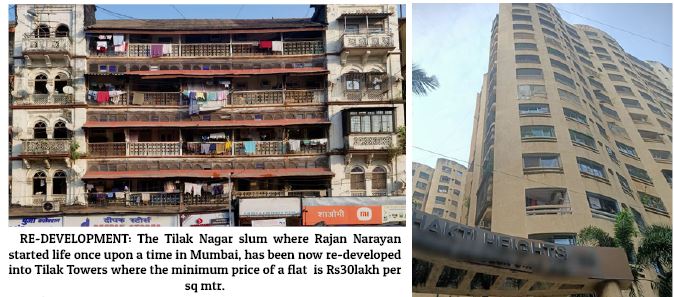
THE operation of these plants brought in personnel from different parts of the country to work in these plants, creating the need for residential housing. In the early ‘50s Burmah Shell Company, decided to provide company housing for its staff, and acquired a substantial plot of land east of the Kurla-Chembur railway line to build Shell Colony, a complex of 300 to 350 two storied residential colony. Over the 70s and 80s these houses that were for employees were later available for sale to outsiders .On the western side of the railway tracks, in 1965, to provide affordable housing to lower middle class families, the Bombay Housing Board, started another cluster housing scheme name Tilak Nagar, after Lokmanya Tilak. The price of these flats were modest: a one BHK unit was sold for Rs 8,000 to Rs12,000 while the two BHK flats were being sold for Rs15,000 to Rs18,000. These valuations were in terms of salaries in the `60s and were bought mainly by the working class, who were drawn to the industrial units around Chembur.
Similarly, another middle class housing called Subash Nagar, was constructed for workers adjacent to the Chembur railway station. These colonies provided the working class houses in close proximity to their industrial units.
THE TRANSFORMATION
OVER the decades, Chembur has been transformed from being a middle class industrial workers housing settlement to a rather elite suburb. How did this happen? With the expansion of the city into the mainland, Navi Mumbai was created. The first city was Vashi and over the decades the contours spread up to Panvel. With the extension of the railway line and extension of the roadway, Chembur became the gateway to Navi Mumbai. Connectivity is the key, and Chembur is connected to South Mumbai thanks to the Eastern Freeway that connects the suburb to P D’Mello road; while the Chembur-Santacruz link road, and the Everest Nagar connector links Chembur to the western part of the city, the Western Express and BKC respectively.
Besides, there is a monorail connectivity that goes up to Jacob Circle and the expressway to Sion that connects to the city. With connectivity, Chembur has become an ideal location for those seeking the comfort of a suburb while being within easy travel time to the business district of south Mumbai or the BKC, the financial centre of the city.
This population push towards Chembur has resulted in the massive redevelopment of what was once termed as the “garden suburb” of the city. In the ‘50s and ‘60s buildings in Chembur were restricted to only two stories for two main reasons. Being in the vicinity of the Atomic Energy and the fear of radiation limited both building height and extensive buildings. Further, Chembur was within the flight path of aircrafts descending down to Santa Cruz and Sahar airport. Builders had to obtain permission from the Airport Authority of India to construct over a certain height. Subsequently towards the ‘80s these height restrictions were lifted and builders in Chembur were allowed to build up to eight storied buildings.
Today, developers in Chembur are allowed to build up to 20 stories or more subject to a no objection certificate from the Airport Authority of India. Further with a Floor Space Index (FSI) of 1.33 to 200 which can be increased to 4 by the purchase of FSI builders are now raising towers literally to the sky! Today with the average property prices in Chembur ranging from Rs35,000 to Rs40,000 per square foot, it would be around Rs30,000 in places like Tilak Nagar, Shell Colony and Subash colony; builders and developers are literally laughing all the way to the bank! And most of these sky scrapers come with amenities such as podium parking, club houses, some have swimming pools, and play areas for children. With the nouveau riche descending upon Chembur, places of entertainment have also expanded to cater to their taste. Clubs such as Chembur Gymkhana on the 16th Road, the Royal Presidency Golf Club, Green Acres, and Sindhi Society clubs cater to a variety of games, and eating places. To give you just one example, the entry fee for the Chembur Gymkhana is Rs25 lakh for life membership. These clubs do provide entertainment by way of sports, eating cafeterias and restaurants, as also community and cultural socials.
ELITE SUBURB NOW
TODAY, Chembur is indeed an elite suburb. This affluence is seen in the swanky cars that zip down the main avenues. The suburb has fancy restaurants, pub, bars where music and liquor flow well into the night. The spas, parlours and coiffeurs speak of the affluence of the denizens. Chembur is a most sought after suburb to live in Mumbai!
 LETTER TO THE EDITOR FOR THE ISSUE DATED MARCH 21, 2026
 LOOK BACK IN ANGER, LOOK AHEAD WITH RESOLVE!By Gautam Patel
 OUR WOUNDED MANDOVI RIVER MAI! By Raaisa Lemos Vaz
 PROTESTS PART OF GOAN DNA!
 `FISH CURRY AND RICE’ FOR GOANS
 OF IT IS GUDI PADWA…
 MIRABAG DAM WORK HALTED!
 THE WAR AGAINST TB Yes, we can end TB… By Dr Amit Dias
 70 ILLEGAL STRUCTURES USURP PRIME BEACH SPOTS FOR ILLICIT AIMS!By Dr Olav Albuquerque
 WEEKEND UPDATES
 LETTERS TO THE EDITOR FOR ISSUE DATED MARCH 14, 2026
 TOWERING INFERNOS OF GOA COMING!By Raaisa Lemos Vaz
 MIRABAG GIFTED TO ADANI!
 DEPOSITS REFUND SCAM!WHO BENEFITS FROM THE RS 10.. By Misbah Quadri
 THE COST OF GST COMPLIANCE IN INDIA!By Arvind Pinto
Goa is abuzz with excitement as vintage bike and car owners, users, collectors and fans are decking […]