Goa is abuzz with excitement as vintage bike and car owners, users, collectors and fans are decking […]
Old is Gold
October 4, 2016

THIS is to say hail to the much loved in most Hindu homes wholesome stuffed chappati or roti, or just sweet “puran poli. ” Come Gudi Padwa which is the Maharashtrian new year, you will find it in most homes, hot and melting with molten fragrant desi ghee laced atop it. Puran poli is an all-time traditional favorite treat of varying sweetness which is as wholesome as you want it to be.
Welcome puran poli, my dears, it’s one of my favorite sweet unleavened roti or chappati, especially when generously made…sumptuous, velvety, delectable sweet “puran” stuffed into the dough and rolled out till almost bursting point by the time it is cooked on the iron pan. Every Hindu home makes its own kind of puran poli, even the Goan Hindu homes, and there may be some slight variation but the result is mostly agreeable.
When there’s puran poli at home it usually means today is a special day …the poli is the dough and the puran is the stuffing within it before it is rolled out and cooked as usual on the tava. The stuffing or puran is usually of cooked tur dal (pigeon peas) which is sweetened with jaggery, sometimes sugar, and flavored with green cardamom, nutmeg maybe…always laced with hot desi ghee.
The puran poli is the queen of all kind of unleavened bread or roti in Indian homes although the puran poli is reserved for festive occasions. I recall my mother making the Guju avatar of puran poli for lunch every time some important visitors were coming home for lunch or for someone’s special birthday.
The Guju puran poli is a luscious affair of 100% wholesome wheat flour and my mother’s puran stuffing would be of the usual cooked mashed tur dal sweetened with cardamom as well as “valyari” (aniseed), the puran poli was something mysteriously yummilicious. We would eat one or two puran poli dipped in savoury tart buttermilk “kadi” which was the usual accompaniment. Sweet puran poli, tart delicate thin buttermilk kadi nourished with lots of chopped green coriander in it. Sunday lunch maybe!
IN Goa too these days one may find puran poli at various gharghutee outlets on a regular or occasional basis. There are self-help group women’s co-operatives which cater to a demand for freshly made home-cooked food and puran poli is almost routinely retailed. Puran poli prices can be terribly high now and move from Rs20 to Rs50 (for very large ones which presumably two may share and cost factor is in the pure ghee used to lace the puran poli). Sometimes the poli dough may have a combo ratio of whole wheat flour and gram flour (besan) for may be finer flavor.
Needless to say the more economical puran poli the dough would be done in refined flour/maida and these would be fine poli, light and fluffier, chewier upon cooling…terrible puran poli. There are several puran poli versions of course and some from Belgaum sweetshops can be delicious with their stuffing of jaggery and semolina filling; the puran poli may be done in oil and each large roti is folded in quarters, have a crispier, drier, texture, yes, like a “biscuit” affair. Then if travelling in Karnataka you may come across these really fat puran poli like a confection – crumbly and with raisins, dry fruit or tutti frutti stuffed in it.
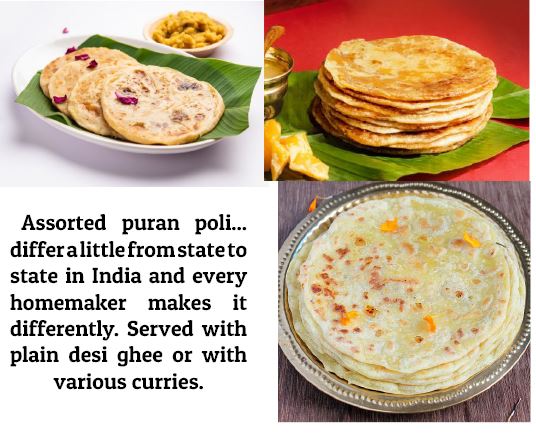
Go north, south, east or west – you will find some kind of puran poli in Indian homes as well as in the local sweet or farsan/mithai shops. One may eat a puran poli with a little razzmatazz mango pickle, be happy with a tablespoon of fresh green mango miskut or miskoot! I must confess I have a sneaky affection for the sweet puran poli avatar of our country. Super food in my book!
Make puran poli at home if you like (if you are deft at using a rolling pin), it takes a little hard work but the oohs of delight will make your heart gladden. These days I’m eating my puran poli with the Bengali “panch puran” tomato chutney or green mint chutney…if you’re buying the Gharghutee puran puri, these are the most superlative as the most ex in town Panaji.
OKAY, no more about puran poli. In these suddenly summer hot days when the heat just keeps building up well into the night I see so many recipes for curd rice and ambil or ambali presentations over social media sites. Both these rice-curd/buttermilk concoctions are said to the ultimate super food to sooth tummy woes and boost vitality. It’s interesting that in quite a few Indian traditions down south India and West Bengal, soaking cooked rice in water and leaving it to ferment a bit overnight is the done thing for probiotic nourishment…add water or buttermilk or curd, mix up in the morning and eat up. Ambrosial breakfast fare for the rest of the day and of course one may jazz this up with sliced “chepnim” mango in Goa or even miskut. But most recipes say one must add chopped onion, green chilies, bunch of curry leaves in the rice and do a tempering in oil, mustard seeds, hing. Stir up and relish. I like to add black salt in my curd rice concoctions and do my tempering or tadka in ghee…black salt or “sanchar” always lends a piquant flavor which is nice.
The real probiotic super food of them all in this category is this drink made out of soaked, ground and fermented ragi or nachne (finger millet) – instead of rice make it millet which is so much more enriched with protein values and non-gluten in nature. This is the real “ambali” as it is called down south India. People who switch from wheat and rice to millet porridges or millet roti rave about how so many good things have happened to them. For one thing they don’t get hungry so often quickly and they lose weight. Moral of the story is cut your carb foods in all forms and insulin resistance becomes a thing of the past…no rice, no fryums, no sweets, no refined flour confections, no mithai, no baked breads. Take to only millets, beans, peas, green salads and raita and “ambali” of course! It works wonders.
One of these days I will go totally off carbs, I promise, for a new lease of life; these days I can’t even pass the six-minute walk test…and woe is me, indeed. Let me share a recipe for millet ambali here for you to do.
Ambali is a nutritious fermented probiotic drink made by cooking millet flourlike ragi finger millet into a porridge, cooking it, and fermenting it overnight. It is commonly mixed with buttermilk, onions, an spices for a cooling summer drink. This gut-healthy drink is rich in calcium and iron.
TAKE two to three tbs of ragi flour or finger millet; 1.5 to 2 cups water; half to three quarters buttermilk or curd whisked, salt to taste. Optional ingredients are finely chopped onion, green chili, ginger, curry leaves, coriander leaves, roasted cumin powder.
To make prepare the paste in a bowl mix the ragi flour with a little water to make a smooth paste, ensuring there are no lumps. Cook the ambali by bringing 1 cup of water to a boil in a heavy-bottomed pan. Add the ragi paste and stir constantly to prevent sticking. Cook for three to four minutes until you get a thick smooth glossy paste and the raw smell disappears. Cool and ferment by allowing the mixture to cool completely. For traditional fermentation, transfer to to an earthen pot, cover with a cloth and let it sit overnight or for six to eight hours. Add buttermilk and seasoning the next morning, stir in the buttermilk to reach a thin, drinkable consistency. Add chopped onions, green chilies, coriander, curry leaves, ginger and cumin powder. Serve at room temperature of chilled if you like on the rocks, I do. Using an earthen pot for fermentation enhances probiotic growth. You may use other little millet rava by soaking and cooking them for ten or fifteen minutes instead of flour.
 LETTER TO THE EDITOR FOR THE ISSUE DATED MARCH 21, 2026
 LOOK BACK IN ANGER, LOOK AHEAD WITH RESOLVE!By Gautam Patel
 OUR WOUNDED MANDOVI RIVER MAI! By Raaisa Lemos Vaz
 GARDEN SUBURB TO MONSTER TOWERS…Chembur then and now!
 PROTESTS PART OF GOAN DNA!
 `FISH CURRY AND RICE’ FOR GOANS
 MIRABAG DAM WORK HALTED!
 THE WAR AGAINST TB Yes, we can end TB… By Dr Amit Dias
 70 ILLEGAL STRUCTURES USURP PRIME BEACH SPOTS FOR ILLICIT AIMS!By Dr Olav Albuquerque
 WEEKEND UPDATES
 LETTERS TO THE EDITOR FOR ISSUE DATED MARCH 14, 2026
 TOWERING INFERNOS OF GOA COMING!By Raaisa Lemos Vaz
 MIRABAG GIFTED TO ADANI!
 DEPOSITS REFUND SCAM!WHO BENEFITS FROM THE RS 10.. By Misbah Quadri
 THE COST OF GST COMPLIANCE IN INDIA!By Arvind Pinto
Goa is abuzz with excitement as vintage bike and car owners, users, collectors and fans are decking […]