Goa is abuzz with excitement as vintage bike and car owners, users, collectors and fans are decking […]
Old is Gold
October 4, 2016
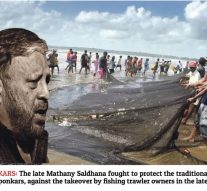
Goans have always protested against threats to the unique and distinct identity of Goa. They have fought against projects that pose a threat to the delicate ecology of the state. Whether it is the battle against trawlers which threatened lives of ramponkars or Zuari Fertilizer plant using arsenic or the Nylon 6.6 project in Keri or the Konkan Railway which insisted on being built in the hinterland or the Goa Bachao Abhiyan agitation 20 years ago in 2006…we pay homage to the activist movements of Goa.
THE first mass protest in Goa that I was associated with was the ramponkar movement in the mid-70s. A Protestant activist body led by Bishop George Ninan was concerned about trawlers displaying the traditional fishermen’s fishing boats. Mathany Saldanha had launched a state-wide movement in support of the ramponkar, traditional fishermen of Goa. The traditional fish folk flung huge nets called rampon in the sea at low tide and pulled in the catch of fish to shore. Hard work as it required, 20 plus people pull in the loaded fishing nets; but the trawlers were killing the local fishing business.
I brought a group of journalists from Bombay (Mumbai), including the late Darryl D’Monte who was then assistant editor in “The Times of India” in Bombay, to Goa. We were given a guided tour of all the fishing villages and literally taken for a ride by a mercenary journalist on one of the huge fishing trawlers which were threatening to displace the ramponkar.
The local fisherfolk’s voices were not being heard by the then chief minister, Shashikala Kakodkar. I recall a meeting with Shashikala Kakodkar, who was as shrill as the fisherwomen we encountered. “They don’t deserve any sympathy. Look at all the gold that the fisherwomen wear. They have more gold than I have!” That was the querulous response of the second chief minister of Goa, daughter of first chief minister Dayanand Bandodkar. The fisher women wore a lot of gold which represented their savings, for in those days few trusted the banks.
Buy Shashikala Kakodkar redeemed herself later a little by the action she took against Zuari Fertilizers. The mega fertilizer unit set up by the Birla Group initially used arsenic as one of the ingredients in the pesticides they manufactured. There was a hue and cry about the creeks and the Zuari river turning poisonous because of the arsenic and dead fish floating up in the river waters.
Mathany along with the late professor Sergio Carvalho led the agitation against the Zuari plant. This was long before Norma and Claude Alvares re-located in Goa and started their Goa Foundation. The Shashikala government shut down the Zuari factory and forced them to drop arsenic as a raw materials in the fertilizers manufactured. This was perhaps the first victory of activists against a corporate group.
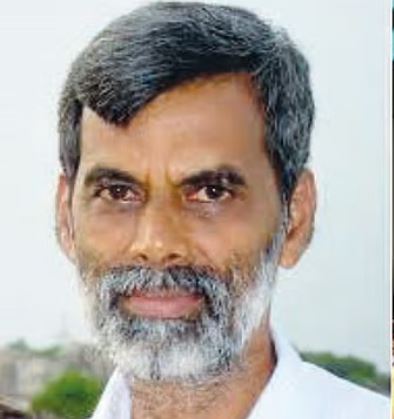
SOON after in the mid-80s the Dupont chemicals giant from the US decided to set up a very highly polluting Nylon 66 plant in Goa in association with the Thapper Group from Calcutta. A medical doctor, a local GP from Ponda, Dr Dattaram Dessai, launched a major agitation against the project which was to be located in Keri in Ponda taluka.
The Dupont center hired heavyweight public relations agency headed by Roger Pereira to buy up the local media and silence the voices of dissent. The “Ohearaldo” which I was editing then had lent full support to Dr Dattaram Dessai. Roger Pereira, accompanied by senior executives of Dupont, met me at the now defunct Martin’s Beach Corner in Caranzalen. They offered me a free all expenses paid holiday to the United States of America under the guise of my visiting Dupont facilities. On offer was a trip to Disneyland and Las Vegas. I told Roger thank-you, I’m not interested.
The protest intensified after the then Pratapsingh Rane government ordered a police firing on the agitators. An activist, Nilesh, was killed. The agitation intensified and Nylon 66 had to wind up and make a quick exit out of Goa.
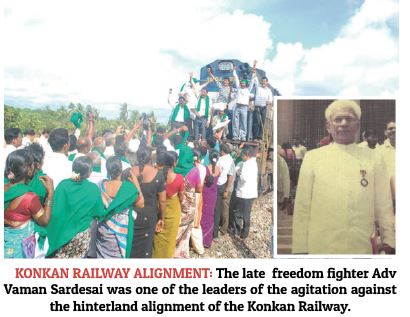
In the 80s, the Konkan Railway Corporation was formed. It was virtually a private company run by K Shridharan. They planned to build a railway line across the Konkan from Mumbai to Cochin which was the home town of Shridharan. One of the senior managers, Raja Rao, started the work of surveying the route in Goa. There was a lot of concern over the Konkan Railway disturbing the fragile economy of Goa. The route passed through some of the most eco-sensitive parts of Goa. A movement was launched by Vaman Sardessai, the freedom fighter who was the first director of Goa Tourism after Liberation. During the Portuguese Portuguese occupation Vaman, along with Libby, ran an underground radio station from Londa on the border of Goa-Karnataka.
I recall meetings at the Municipal garden flat of Vaman, conveniently located next to the Kamat Hotel from where the endless cups of tea came. I travelled all around Goa with the team which was fighting the Konkan railway alignment. The alternative alignment suggested was that the Konkan Railway should avoid the hinterland and connect all the urban areas of Goa which urgently needed a transport system. This was rejected arrogantly by the Konkan Railway bosses. I bought convertible bonds issued by the Konkan Railway and filed a case against them for destroying the ecology of Goa. I fought the case myself but in this case matter the Centre and the State were aligned. Maharashtra and Kerala, who were the major beneficiaries, also put pressure on the Centre and the then chief minister Pratapsingh Raoji Rane. Konkan Railway had its way, bringing to Goa lakhs of migrants. Even now if you go to the Karmali station you will see hundreds of migrants arriving every day for a piece of Goa.
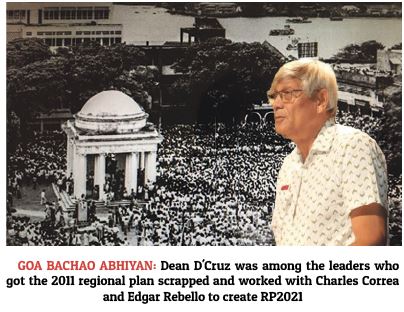
THEN came the Goa Bachao Abhiyan. Manohar Parrikar had made the most expensive compromise with opportunistic Taleigao MLA Babush Monserrate. As a price for Babush’s support to his minority government Parrikar handed over the crucial Town & Country Planning Department to Babush Monseratte. Babush Babush drew up the 2011 regional plan and the map were spread out at the Monseratte mansion at Taleigao and builders not only from Goa, could come with their pastels and colors the map any way they wanted. They could wipe out all the greens of agriculture, horticulture and forests, turn them into the dull colour of concrete.
A small meeting was held at the Don Bosco oratory by a small group of activists. I recall that Dean D’Cruz, Reboni Saha, Lata and Arvind Bhatikar, were present along with Sabina Martins and also Dr Oscar Rebello. Sorry, but Claude and Norma were not part of the GBA as it is being projected nowadays. Indeed, it was I who suggested the name of Dr Oscar Rebello to be the convenor of the GBA.
Babush Monserrate withdrew support to Manohar Parrikar, leading to the collapse of the first BJP government. Meanwhile, Digambar Kamat was the number 2 in the Parrikar government, he defected to the Congress which was elected to power in 2006. Digambar Kamat scrapped RP 2011 and set up a committee under Charles Correia and Edgar Rebeiro to formulate RP 2021. Dean and his team of architects went all around Goa explaining what 2011 would do to the villages of Goa. When the committee to formulate RP 2021 was set up, teams of activists went to every village and got inputs for a local driven regional plan taking into account the carrying capacity of each village. It was decided that in rural areas the FAR would be limited to 60% of the plot area, or roughly the height of a coconut tree (as is the real estate rule in Hawaii or so I am told). This is the regional plan which has been subverted by Vishwajeet Rane and Pramod Sawant. It has been brought on record that over 15 MLAs themselves have applied for a change of zone under Section 39A of the TCP act.
THERE are many other selfless activists who have taken up the cause of Goa’s unique ecology at various times. There was Florian Lobo, a former marine engineer, who launched endless protests against the looters and plunderers. He even contested the Taleigao assembly elections against Babush Monserrate in 2006. Among the speakers at the rally held in a paddy field opposite the mansion of Babush Monserrate were the Bhatikars and Rajan Narayan. The Master of Ceremonies was Babita Angle, wife of Dilip Sardessai, now the secretary of Goa Forward.
There were several other activists like Ramesh Gauns and Nirmal Kulkarni, not excluding Rajendra Kelkar, the school teacher who is still fighting to save the tiger habit. There are activists like Captain Venzy Rodrigues, south Goa Member of Parliament, who fought against mining pollution and the conversion of the MPT into a dirty cargo port importing coal from the Adani mines in Australia. Venzy along with Edwin and Diana Pinto are still fighting the double-tracking of the Southwestern railway, not for the benefit of the locals or tourists but for ensuring high speed transport of coal from the Mormugoa port to the industrial zones of the Jindals in neighbouring Karnataka.
There are scores of other village-level activists far beyond the veterans felicitated at the release of the fifth edition of the book “Fish Curry and Rice” at the Kala Academy in Panjim on Saturday, March 18. This included priests like Father Bismarck who died tragically, allegedly killed because he took on the builders in old Goa who were reportedly supported by Pandurang Madkaikar. There is also Father Bolmax Pereira, another priest involved in the agitation against the double-tracking of SWR.
Goan activists have by and large succeeded when they came together to protest in one voice. They forced successive governments from the time of Shashikala Kakodkar to Pratapsingh Rane to Manohar Parrikar to Digambar Parrikar and now taking on Pramod Sawant in the latest Enough is Enough agitation against 39A of the TCP act which threatens to convert Goa into a concrete jungle.
Incidentally, fish curry and rice, is a fine metaphor for Goa. As Justice Ferdino Rebello so lucidly pointed out fish represents our water bodies which give Goans their daily “nustem” or seafood. Curry represents the coconut trees of the landscape which is a part of the horticulture legacy of Goa and rice, of course, the evergreen watery paddy fields. These are all part of the natural cycle of life since time immemorial in Goa. The rain which comes down from the hills and the hills forming springs, ponds and rivers. Fish curry and rice is the heart and essence of Goa.
POSTSCRIPT: Justice Gautam Patel, a former judge of the Bombay high court reveals, that while he was posted in Goa he took his wife and sister and her kids to the Miramar beach on the first day of his first posting to live and work in Goa. Bang in front of him on the beach he was horrified to see the “Lucky 7” casino washed ashore, sitting bang on the lovely pristine sands of Miramar beach. As luck would have it the matter was posted for hearing before him in the high court and Justice Patel ruled that the “Lucky 7” should be moved out before the arrival of the monsoon that year. I only hope that the bench of the Bombay high court in Goa will take a similar decision to move all the six casino vessels out of the Mandovi river when the Enough is Enough petition is filed later this month. Will the judges pay heed to their former colleague, Justice Ferdino, for the larger good of Goa?
 LETTER TO THE EDITOR FOR THE ISSUE DATED MARCH 21, 2026
 LOOK BACK IN ANGER, LOOK AHEAD WITH RESOLVE!By Gautam Patel
 OUR WOUNDED MANDOVI RIVER MAI! By Raaisa Lemos Vaz
 GARDEN SUBURB TO MONSTER TOWERS…Chembur then and now!
 `FISH CURRY AND RICE’ FOR GOANS
 OF IT IS GUDI PADWA…
 MIRABAG DAM WORK HALTED!
 THE WAR AGAINST TB Yes, we can end TB… By Dr Amit Dias
 70 ILLEGAL STRUCTURES USURP PRIME BEACH SPOTS FOR ILLICIT AIMS!By Dr Olav Albuquerque
 WEEKEND UPDATES
 LETTERS TO THE EDITOR FOR ISSUE DATED MARCH 14, 2026
 TOWERING INFERNOS OF GOA COMING!By Raaisa Lemos Vaz
 MIRABAG GIFTED TO ADANI!
 DEPOSITS REFUND SCAM!WHO BENEFITS FROM THE RS 10.. By Misbah Quadri
 THE COST OF GST COMPLIANCE IN INDIA!By Arvind Pinto
Goa is abuzz with excitement as vintage bike and car owners, users, collectors and fans are decking […]