Goa is abuzz with excitement as vintage bike and car owners, users, collectors and fans are decking […]
Old is Gold
October 4, 2016
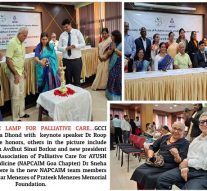
SINCE I always says Seniors First instead of last, it was worth catching up with the talk given by noted speaker Dr Roop Gursahani (neurologist and Head of Neurology, Hinduja Hospital, Mumbai) on the subject of “End of Life Care in India After the Harish Rana Verdict” on Saturday, April 4, 2026. It was organized by the National Association of Palliative Care for AYUSH & Integrative Medicine (NAPCAIM, Goa chapter) at the Goa Chamber of Commerce 3rd floor hall.
Chief guest was the GCCI president Pratima Dhond and guest of honor Advocate Anirudh Avdhut Sinai Borkar, special invitees were Mimi and Cesar Menezes of the Prateek Menezes Memorial Foundation who’re indeed very special persons who take an interest in all matters to do with the needs of an aging population. Mimi share a bit with me that as life goes on and we become unproductive, then perhaps it’s time to hand one’s life over to palliative caregivers…it got me thinking about what is palliative care really? And what comes before it? Where does healthcare begin for seniors?
With one in five Indians crossing over to their senior years we should think in terms of public and private hospitals exclusively for seniors’ health problems – once treatment is over in a hospital it makes sense to move to a geriatrics department or if one so lucky to a happy sanitorium offering good water, good air, good food, naturopathy therapies to revive and rejuvenate and above all the good humor of staff who can perform the miracle sought better than any amount of drugs pumped into body beautiful.
What is palliative care? Really end-of-life care and the decisions to be made when a patient is in trauma, young or old, usually rusticating away on hold in an ICU in a hospital…simply waiting for the end. There are the hard realities facing the family, the heartaches, often the stress of raising funds, keeping a patient alive but oftentimes he or she is in a vegetative state. As one of the speakers at the event noted modern medicine is so good today that it has mastered the fine art of keeping patients alive endlessly in a coma!
There are also the horror narratives of patients being tortured in what doctors full well know are terminal cases but with the healthcare industry so finely monetized, I’m sorry to say the reality can be very different (my own father suffered at the hands of doctors determined to treat him till the very end before saying take him home and make him comfortable). Most most patients if they are all there express the sentiment of “Tell me how bad I am? Please don’t let them torture me! Let me go.” Yet medical teams in hospital after hospital will keep a patient “alive” in ICU for a few more days, indefinitely…they won’t release the body before all the bills are paid. In the end we weep because the patient is gone and also the frugal funds lost in vain — depending on the financial background of a family. All of us have stories to tell in this matter.
Well, all this and more horror stories I can recount here but won’t. Dr Roop Gursahani and advocate Anirudh Borkar spoke about the legal aspects of dying out of turn – read about the history making cases of Harish Rana and before that the Aruna Shanbhag case where hospital staff insisted in keeping their nursing colleague alive by force-feeding (for years after she suffered a stroke and was paralysed and in a coma – after a lower class ward boy raped her brutally in a public hospital basement room). Both are very interesting cases. In the Rana cause the young patient’s parents pleaded that if their son could speak he would have asked for mercy killing.
In India we’re always many years behind the times but finally it is legal tender and in certain tragic situations one may making a living will, asking medical folk to pull the plug or so to speak for a patient. No hanging around in hospital ICUs. Most of us want to live as long as we are all there but when we are not all there or less and less…what then? Palliative care enters when life is handed over to caretakers at home or at a hospice. Goa has a Shanti Avedna at Loutalim which the Menezes family helped family friend Dr Lusito to set up after they lost their young six-year-old son Prateek to blood cancer; it was touching to see his father Cesar sharing a bit about the case at the function and how he and Mimi had sought for the right caretaking for their little son in a coma for three months or so….
IN THIS respect they were happy to support the NAPCAIM Goa chapter to train caregivers who look after patients in need of palliative care. In this respect the new president of NAPCAIM Goa chapter Dr Sneha Bhagat shared that today it is hard to find trained caretakers, they may be even “sweepers” in a hospital situation! Various agencies provide “trained” caretakers but many are untrained or badly trained in patient care. I will endorse Dr Sneha’s sentiment for I have personally seen how one may pay Rs2,000 plus for a caretaker for a patient in hospital or home (24 hours, meals provided) and yet it’s often a sorry narrative. Abroad, public hospital staff take care of a patient’s needs fully, but this is not so in India when relatives have to take care of their patient around the clock while in a hospital ward, or trust a paid caretaker trained or half-trained or not trained at all.
At the GMC there’s no system in place whereby caretakers are vouched for accountability and rates fixed – it’s a free for all in wards where patients can be at the mercy of their caretaker; ask around, you will hear some terrible stories of use and abuse.
In this respect the services of the National Association of Palliative Care for AYUSH and Integrative Medicine is welcome. I did ask Dr Gursahani where geriatrics care ends and palliative care begins and about the extreme cruel monetization of the healthcare industry, he said people are still figuring it out…they hope to redress this.
In the meantime the organization has got Rs10 lakh grant from the government of Goa to put into place an AYUSH-based system to train caretakers on palliative issues. They have been holding several community outreach camps in this respect and seek support from all for a brighter future for patients of all denomination, palliative care has to be patient-centric.
All this and much more which will keep for another day. There is so much to healthcare for everyone across society and I do wish for both exclusive hospitals and sanitoriums for seniors as they cope with the last of life for which presumably the first was made. We grow old and older, worrying more and more about being in our 70s, 80s, 90s…able to cope less and less with the needs of staying alive with dignity. And on the other hand we see countries in the West and Japan which has such a huge population of happy centenarians (living what is called Blue Zone lifestyles)! When will we ever be able to make quality healthcare utterly free and first class in India – beginning with our senior citizens?
AT THE MANIPAL HOSPITAL, PANJIM
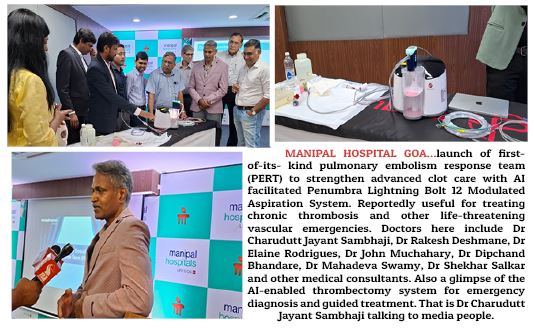
THEN comes a bit of interesting news from the Manipal Hospital in Panjim and Goa. In keeping with its tradition of getting the latest medical equipment first they now have what is called a Penumbra Lightning Bolt 12 Modulated Aspiration System designed for rapid, catheter-based clot removal. This is an advanced large-bore aspiration platform designed for rapid, catheter-based clot removal and it requires a multidisciplinary team for immediate clinical diagnosis, stabilization and recovery.
So we have the PERT team of doctors attending to pulmonary embolism cases. The team has been performing Western India’s first pulmonary artery mechanical thrombectomy (second in the country) in a young patient with acute chronic pulmonary embolism. The team also successfully carried out a deep vein thrombosis thrombectomy in an elderly patient with advanced malignancy – such patients are high-risk patients, but apparently the new equipment (which is AI technology based) entails minimally invasive interventions and is useful in treating life-threatening vascular conditions.
PERT stands for Pulmonary Embolism Response Team and Manipal Hospital and such a team is the first of its kind in Goa, call it a multidisciplinary initiative designed to enable quick diagnosis to save pulmonary embolism cases – reportedly, pulmonary embolism is a leading cause of sudden and preventable death…these are emergencies where every minute is critical. The PERT team brings specialists from interventional radiology, pulmonary medicine, critical care, emergency medicine, cardiothoracic surgery and hematology doctors …together to resolve a case.
What is deep vein thrombosis? This refers to the formation of a blood clot in the deep veins, most commonly in the lower limbs. When extensive, particularly in the iliofemoral veins that drain blood from the pelvis and thigh, it can severely obstruct venous return, causing swelling, pain, and increasing the risk of clots traveling to the lungs. It can happen in elderly patients with advanced cancer…and patients present in hospital emergencies.
Amongst the doctors present at the press conference to present the new Cath Lab equipment of Penumbra Lightning Bolt 12 Modulated Aspiration System were Dr Charudutt Jayant Sambhaji, consultant- endovascular surgery and interventional radiology, Dr Rakesh Deshmane, consultant- CTVS, Dr Elaine Rodrigues, consultant-critical care and anesthesiology, Dr John Muchahary, consultant – interventional pulmonology, Dr Dalia Dipchand Bhandare, consultant –anesthesiology, Dr Mahadeva Swamy BC, consultant – hemato-oncology and SMT, and Dr Shekhar Salkar, senior consultant-surgical oncology.
When asked about embolisms Dr Charudutt shared something about clots and embolism formation – believe it or not, he said, they get maximum cases in the hot months of March, April and yes patients can get into trouble because of simple things like dehydration, not drinking enough water! Another thing, he shared, we tend to tell our seniors, whom we do love, not to move around the house too much to get into trouble…stay in one place to be safe.
Sorry, my dears, hydration and moving is the key to staying alive no matter how old you are. I must go back and talk some more to Dr Charudutt Sambhaji for he is a fund of interesting insight! So this is to say if you’re a senior don’t forget to drink water and don’t sit around too long in your favorite armchair or rocking chair. Think about all this and never despair. On that note it’s avjo, poiteverem, selamat datang, au revoir, arrivedecci, hasta la vista and vachun yeta here for now.
— By Tara Narayan
 LETTER TO THE EDITOR FOR ISSUE DATED APRIL 11, 2026
 DOUBLE ENGINE GOA GOVERNMENT DANCES TO ADANI TUNES!
 WHO IS FIXING THE SKY? The billionaires, the cops in SUVs, and the missing trees! By Raaisa Lemos Vaz
 UPHEAVAL OF THE SUSEGAAD!By Sumaiya Khan
 THE POWER AND THE POLITICS OF MINING IN GOA!By Arvind Pinto
 DEVA VANI DHRUPAD: Alchemy of Sound, Silence and Sanctity!By Prema Viswanathan
 AT LEAST HOSPITALS CAN OFFER MILLET ROTI AND KICHADI!
 GODI MEDIA TRUMPS TRUTH IN WAR & PEACE!
 World Health Day 2026: TOGETHER FOR HEALTH – STAND WITH SCIENCE! By Dr Amit Dias, MD
 FCRA AMENDMENT WILL ENABLE GOVT TO TAKE OVER PROPERTIES!By Olav Albuquerque
 WEEKEND UPDATESLETTERS TO THE EDITOR FOR ISSUE DATED APRIL 04, 2026
 REAL ESTATE BARONS OF GOA!
 THE SLOW VANISHING OF GOA’S GOLDEN BEACHES! By Raaisa Lemos Vaz
 WHO IS EXTRACTING GOA’S GROUND WATER? By Supriya Vohra
Goa is abuzz with excitement as vintage bike and car owners, users, collectors and fans are decking […]