Goa is abuzz with excitement as vintage bike and car owners, users, collectors and fans are decking […]
Old is Gold
October 4, 2016
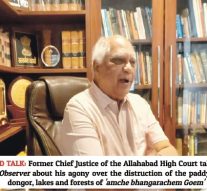
After walking into the sunset, former chief justice of the Allahabad High Court and politician Ferdino Rebello entered the battle to save Goa from any further destruction and undo the “wrongs” done to the State. And, this is not the intrepid jurist’s first outing as a leader of a people’s movement. Along with several others, he had led the Konkani language agitation, which peaked in the eighties, to carve a distinct identity for the coastal State.
So, when he saw Goa’s identity was being threatened again, he couldn’t play fiddle while his State burned. He got together with several other eminent Goans, drew up a 10-point charter and called a public meeting (early this week on Tuesday) with a cry of ‘Anik Sonso Nezo’ (cannot tolerate this anymore) that rang across Institute Menezes Braganza Hall, spilled into adjoining rooms, rolled down the stairs and floated to the Azad Maidan to spark a revolution.
Here, in his conversation with Goan Observer’s Praveena Sharma, Justice Rebello unravels what the movement is all about
Was the response to the your public meeting to issue a clarion call to Save Goa on January 6 (Monday) beyond your expectation? How does it reaffirm your resolve and boost your confidence to address the issues hounding Goa?
When we started out, we were working with only a small group of activists. But once the TV channels and the press started covering it, we got good feedback. Now, the turnout at our public meeting was beyond our expectations. It does boost us confidence because it gives us hope that the people are with us. And, it is not the people only at the top. My gardener is as enthused and similar feeling is echoing across the State.
Do you think it is sustainable? How do you plan to sustain it?
The 10-point charter of demand we have given are not political demands. They are not economic demands or a blueprint. All of them are based on laws of Goa and assurances. Of these, two assurances were given by chief ministers. The rest are sustainable development, which is part of the law of our land. Now, I am posing a question. We fought for the State. I was the part of the fight. Why did we fight? We fought for the identity as a State for the Konkani-speaking people, who are spread in small pockets of Maharashtra and Karnataka while Goa has the largest number of them. We wanted a place where Konkani-speaking people could say that this is our State. It’s not that we don’t want others to come (to Goa). Everybody is welcome. We do not want to displace our populations. Today’s development is purely for investment and speculative growth. They are not for industries or information technology (IT) parks that will generate jobs and benefit Goans. The only economic benefits are fees paid during the planning process, development fees and annual house tax. They put strain on our resources – water, electricity, roads, sewerage system, etc – which are deteriorating our quality of life. Our subsoil is also getting polluted. What are we getting? Why are our land, hills, fields, and orchards being put up for sale? How would you look at it If you are displaced from your own home.
These issues have been around for some time now without any resolution. There have also been assurances from the people in power but nothing much has come out of it. Are you aware of what you’re up against?
The chief minister is saying we are looking into the problems and that if people want it, we will consider it. What does that mean? It means that the word has gone (out) that this is something different. Believe me, I do not want to construct anything. I do not want to take somebody’s money. Thankfully, I get a good pension. Also, I have been working as an arbitrator. So, I am self-sufficient. I don’t require anybody to sustain me. My only interest in this is (the future of our) State. I think that, perhaps, has resonated with the people (of Goa).
The entity you are fighting today is different from what it was in 2006 or before that, in the sense that it is colossal and autocratic with little or no respect for the law or the opinion of people. Do you think you will be able to take it on?
(Late Prime Minister Indira) Mrs Gandhi was also powerful but Jayprakash Narayan’s (politician and activist known for leading the mid-1970s opposition to overthrow Indira Gandhi’s regime) movement challenged her clout.
Is this (people’s movement in Goa) that kind of movement?
It will have to take that kind of shape if things are going to be set right. None of our demand is not doable. They are all doable and in the interest of people of Goa. Now, I have not raised this yesterday. Nor have I articulated. Do we want all the bad things of Thailand to come to Goa? How much more are we going to suffer? Nobody is articulating this. But I am now articulating it. Are we going to convert Goa into Thailand, with all its vice. When I use the word morality, behind my mind is one of these aspects which I have not articulated. It’s totally unregulated. There’s no control. I uphold the right of a dancing girl. But there must be some laws for that.
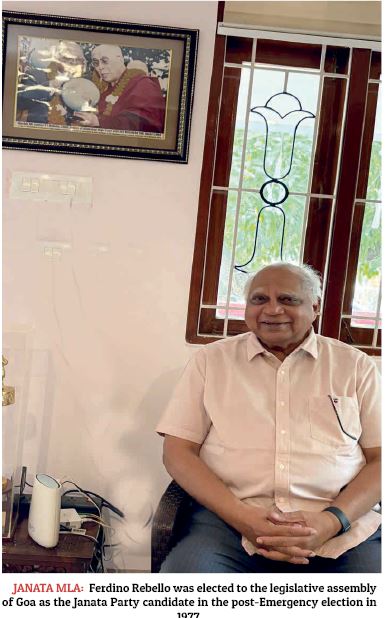
Do you see the demand charter extended with more points added to it? How do you define your movement?
No, I call this minimum point charter. I don’t say it is the end of everything but this is a minimum point charter, which is doable. If 90% of it is done then many wrongs (in Goa) can be undone. Then I can rest. It’s not that I will not help. I cannot participate in every issue but my legal advice is always available. Like in the case of Chimbel village, where I am trying to see how I can help them.
How are you contributing to this movement?
I’ve said I will be the fulcrum to bring everybody together. Then, let the people take it over.
Do you foresee any danger of the movement getting politicised?
Let us be frank about it. No movement has succeeded without participation of political parties. Whether it’s the JP movement or the Konkani language movement in Goa, it would not have succeeded without the support of political parties because they are the only ones who are organised. Even the JP’s mass movement had the support of the opposition parties. It is the workers on ground who do the work. So, we cannot keep them out of it.
What kind of organisational structure do you see emerging for the movement?
Today, it is a very small group. But we meet every day, brainstorm and try to expand. At one point in time, we thought we can’t take anybody political but we will analyse it step by step. Activists have been fighting by themselves. Activists are not ground workers. They can share ideas and thoughts but they are not the ones who can bring in the people. And, all of them are now supporting the cause. All opposition parties have said that they are supporting these issues. Now, they may support it for their own political survival or whatever else it is. That’s another issue. Let us see to what extent we can go. If the government does not accept the demand charter, then we will see how we will go forward. The first step I am taking is meeting the chief minister (Pramod Sawant) today (Wednesday) and raising one of the issues.
You spoke about your organised movement for Konkani. That was in 85. Now, we are in 2026 and it was in 2025 when your first (online) post appeared. What was the turning point for you in this case?
For the last nine months, there have been people calling me and I have been articulating these views. But Arambol (episode) made me think. I have been talking even to the BJP people. Some of them are my juniors, who were in my chamber. Many of them are not comfortable about what is happening (in Goa). People are talking but nobody is willing to come out and say anything. Why shouldn’t people fight for their own culture and heritage? Thousands of years, these hills have been there. Hills are the place where the water accumulates and cracks during the non-monsoon period. The springs come from there. It’s where our children go in the summers for all kinds of berries. Suddenly, they are not for them but for somebody else because of zone change. Then, I heard about Sancoale, which I did not involve myself with because I can’t be everywhere. Also, those people did not come to me for any legal help so the question did not arise. Perhaps, what I am doing today with the chief minister (raise the section 17A issue), it may indirectly help them.
For the removal of casinos from Mandovi river, you are pitted against a very powerful lobby. For long, it has defied any solution. Do you think you can get them off Mandovi river?
There is a legal principle of Public Trust Doctrine. The government is meant to be the trustee of river for the public. Rivers can be used for navigation but it can’t be used for anchoring of an activity which we call res extra commercium or sin activity. Let us see; it (the charter point of removal of casinos from the Mandovi river) got deafening cheers from people at the public meeting.
Can the casinos on Mandovi River be legally challenged?
There is an Article 19(1)(g) in the Indian constitution that guarantees citizens the fundamental right of freedom to practice any profession or carry on any occupation, trade, or business. This (Casino business) is not a fundamental right. This is what is called res extra commercium like alcohol. Trading in alcohol is not a fundamental right of a citizen. It is at the pleasure of the government. This (casino) is also at the pleasure of the government. And the government can revoke that pleasure.
If the government doesn’t act, can they be removed by a court order?
Unfortunately, it depends upon the bench. For this, I would like to give an example. I had fought a case for orphan children in Cuncolim. There was a circular for them to leave after they reached the age of 18 years. They came to me. My first question was where do they go because the orphanage had been their home. They had no relatives. They had not been taught any trade. So, at least some rehabilitation should be given to them. The first bench dismissed the petition after hearing me for over an hour. I filed another petition with some other bench and was granted relief. So, I have always said it is not your rights which matter but who hears your matter is what matters. Here again, what would count who sits and hears your matter, not your rights.
How are you going about getting a special status for Goa through introduction of private member bill?
I assume, perhaps, they can’t do it in this session because there is no time to table it (private member bill for special status for Goa). But in the Budget session, it can be taken up. I will help them draft it.
Only once Goa gets complete special status, the land revenue code can be pushed…
I had a fresh look at the law (Goa Restriction on Transfer of Agricultural Land Bill enacted in 2023 by Goa government). There is a law for paddy fields but it has lethal riders. After saying you cannot convert paddy field there are some ‘subjects- to’. You can sell it only to agriculturalists but there are some exceptions. Like for industry, there is something like ‘if they can generate jobs’. But for others there is a long list (of exceptions). That’s what is being used to convert the paddy fields. That is what I am trying to fight for. Now, it’s not only for paddy fields but also for orchards. I will also help in drafting legislation for the amendment to the TCP Act.
 LETTER TO THE EDITOR FOR ISSUE DATED APRIL 11, 2026
 DOUBLE ENGINE GOA GOVERNMENT DANCES TO ADANI TUNES!
 WHO IS FIXING THE SKY? The billionaires, the cops in SUVs, and the missing trees! By Raaisa Lemos Vaz
 UPHEAVAL OF THE SUSEGAAD!By Sumaiya Khan
 THE POWER AND THE POLITICS OF MINING IN GOA!By Arvind Pinto
 DEVA VANI DHRUPAD: Alchemy of Sound, Silence and Sanctity!By Prema Viswanathan
 AT LEAST HOSPITALS CAN OFFER MILLET ROTI AND KICHADI!
 WHEN DO WE NEED PALLIATIVE CARE?
 GODI MEDIA TRUMPS TRUTH IN WAR & PEACE!
 World Health Day 2026: TOGETHER FOR HEALTH – STAND WITH SCIENCE! By Dr Amit Dias, MD
 FCRA AMENDMENT WILL ENABLE GOVT TO TAKE OVER PROPERTIES!By Olav Albuquerque
 WEEKEND UPDATESLETTERS TO THE EDITOR FOR ISSUE DATED APRIL 04, 2026
 REAL ESTATE BARONS OF GOA!
 THE SLOW VANISHING OF GOA’S GOLDEN BEACHES! By Raaisa Lemos Vaz
Goa is abuzz with excitement as vintage bike and car owners, users, collectors and fans are decking […]