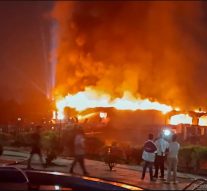
The Jan Vishwas Bill which was passed by the Legislative Assembly in the winter session seeks to decriminalise the offence of illegal constructions. Which means they will be considered a civil and not a criminal offence.
By Adv Carlos Alvares, MLA Aldona
Bill with a clear aim to allow everyone involved in Birch by Romeo Lane to escape punishment under law:
a) The Bill makes this Amendment effective from 2nd December, 2025 and this is important for us to note this date more particularly because this law makes amendments importantly to:
a) The Goa Excise Act;
b) The Goa Fire Force Act;
c) Goa Land Revenue Code, 1968
d) Goa Panchayat Raj Act, 1994
- all of which are attracted in Birch Fire Tragedy & the consequence of sealing other premises & with an apprehension that this amendment’s effective date will give an escape route to all the defaulters.
II. Additional factual aspect:
a) Section (1)(2) of Bill: provides that this Bill is deemed to have come into force on 2nd December, 2025 this will give Birch by Romeo Lane & others total freedom from penalty.
b) Now see the Gazette dated 9 December, 2025:
(i) Notification says that it was promulgated by the Governor on 2.12.2025;
(ii) But the Gazette is published on 9-Dec-2025
c) The argument will be that the promulgation was done by the Governor on 2nd December, 2025 & hence the enforcement date is 2nd December, 2025.
III. Constitutional protection against retrospective application of penal law.
(i) Art. 20(1) of the Constitution provides as under:
“20. (1) No person shall be convicted of any offence except for violation of a law in force at the time of the commission of the Act charged as an offence, nor be subjected to a penalty greater than that which might have been inflicted under the law in force at the time of the commission of the offence.”
Hence it is evident that a person can be punished for a law in force at the time of the commission of the offence and not for a law not in force at that time. This means that there is no person can be punished for nor subjected to a penalty by a law made applicable retrospectively.
(ii) It should be noted that whilst the law does not allow person to be punished for an offence which was not an offence at the time it was committed, nor can he be subjected to a sentence which is greater than the sentence which was applicable at the relevant point of time. But the above provision does not prohibit this Court, to award a lesser punishment in a befitting case, when this Court is of the opinion that a lesser punishment may be awarded since the new law on the penal provision provides a lesser punishment i.e. lesser than what was actually applicable at the relevant time.
(iii) In A.K. Sarkar & Co. v. State of W.B., (2024) 10 SCC 727, the Supreme Court held:
- Article 20(1) of the Constitution of India reads as under:
“20. Protection in respect of conviction for offences.—(1) No person shall be convicted of any offence except for violation of a law in force at the time of the commission of the act charged as an offence, nor be subjected to a penalty greater than that which might have been inflicted under the law in force at the time of the commission of the offence.”
The above provision has been interpretated several times by this Court and broadly the mandate here is that a person cannot be punished for an offence which was not an offence at the time it was committed, nor can he be subjected to a sentence which is greater than the sentence which was applicable at the relevant point of time. All the same, the above provision does not prohibit this Court, to award a lesser punishment in a befitting case, when this Court is of the opinion that a lesser punishment may be awarded since the new law on the penal provision provides a lesser punishment i.e. lesser than what was actually applicable at the relevant time. The prohibition contained in Article 20 of the Constitution of India is on subjecting a person to a higher punishment than which was applicable for that crime at the time of the commission of the crime. There is no prohibition, for this Court to impose a lesser punishment which is now applicable for the same crime.
IV. Law enforceable only when it is published:
(i) For any law to be effective, it needs to be published. Laws cannot be made and kept in the drawer and people expected to guess the law and then be penalized for such unpublished law.
(ii) In Harla v. State of Rajasthan, 1951 SCC 936, the Supreme Court interalia held as under: - We do not know what laws were operative in Jaipur regarding the coming into force of an enactment in that State. We were not shown any, nor was our attention drawn to any custom which could be said to govern the matter. In the absence of any special law or custom, we are of opinion that it would be against the principles of natural justice to permit the subjects of a State to be punished or penalised by laws of which they had no knowledge and of which they could not even with the exercise of reasonable diligence have acquired any knowledge.
- Natural justice requires that before a law can become operative it must be promulgated or published. It must be broadcast in some recognisable way so that all men may know what it is; or, at the very least, there must be some special rule or regulation or customary channel by or through which such knowledge can be acquired with the exercise of due and reasonable diligence. The thought that a decision reached in the secret recesses of a chamber to which the public have no access and to which even their accredited representatives have no access and of which they can normally know nothing, can nevertheless affect their lives, liberty and property by the mere passing of a resolution without anything more is abhorrent to civilised man. It shocks his conscience. In the absence therefore of any law, rule, regulation or custom, we hold that a law cannot come into being in this way. Promulgation or publication of some reasonable sort is essential.
(iii) Also in Gulf Goans Hotels Company Limited v/s Union of India & ors (2014) 10 SCC 673, the Supreme Court interalia held as under: - It is also essential that what is claimed to be a law must be notified or made public in order to bind the citizen. In Harla v. State of Rajasthan [1951 SCC 936 : AIR 1951 SC 467 : 1952 Cri LJ 54] while dealing with the vires of the Jaipur Opium Act, which was enacted by a resolution passed by the Council of Ministers, though never published in the Gazette, this Court had observed: (AIR p. 468, para 8)
“8. … Natural justice requires that before a law can become operative it must be promulgated or published. It must be broadcast in some recognisable way so that all men may know what it is, or, at the very least, there must be some special rule or regulation or customary channel by or through which such knowledge can be acquired with the exercise of due and reasonable diligence. The thought that a decision reached in the secret recesses of a chamber to which the public have no access and to which even their accredited representatives have no access and of which they can normally know nothing, can nevertheless affect their lives, liberty and property by the mere passing of a resolution without anything more, is abhorrent to civilised man.” - The Court in Harla v. State of Rajasthan [1951 SCC 936 : AIR 1951 SC 467 : 1952 Cri LJ 54] noticed the decision in Johnson v. Sargant & Sons [(1918) 1 KB 101 : 87 LJ KB 122] and particularly the following: (AIR pp. 468-69, para 11)
“11. The principle underlying this question has been judicially considered in England. For example, on a somewhat lower plane, it was held in Johnson v. Sargant & Sons [(1918) 1 KB 101 : 87 LJ KB 122] , that an order of the Food Controller under the Beans, Peas and Pulse (Requisition) Order, 1917, does not become operative until it is made known to the public, and the difference between an Order of that kind and an Act of the British Parliament is stressed. The difference is obvious. Acts of the British Parliament are publicly enacted. The debates are open to the public and the Acts are passed by the accredited representatives of the people who in theory can be trusted to see that their constituents know what has been done. They also receive wide publicity in papers and, now, over the wireless. Not so Royal Proclamations and Orders of a Food Controller and so forth. There must therefore be promulgation and publication in their cases. The mode of publication can vary; what is a good method in one country may not necessarily be the best in another. But reasonable publication of some sort there must be.” - It will not be necessary to notice the long line of decisions reiterating the aforesaid view. So far as the mode of publication is concerned, it has been consistently held by this Court that such mode must be as prescribed by the statute. In the event the statute does not contain any prescription and even under the subordinate legislation there is silence in the matter, the legislation will take effect only when it is published through the customarily recognised official channel, namely, the Official Gazette (B.K. Srinivasan v. State of Karnataka) [(1987) 1 SCC 658] . Admittedly, the “guidelines” were not gazetted.
V. How do these people get out?
(i) State will prosecute them under penal provisions which have not been in force as on 2 December, 2025 (but which came into force on 9th December, 2025);
(ii) They will file Petitions for quashing the proceedings on ground that they cannot be prosecuted for an offence which was in force or greater than that which was in force as on date of commission of the offence. The Petitions will be allowed and the prosecution will be quashed qua these offences.

 LETTERS TO THE EDITOR FOR THE ISSUE DATED MARCH 07, 2026
 AMKA NAKA ‘NEW’ GOA: Our heritage is under a hammer!By Raaisa Lemos Vaz
 39A DELHI BUILDER DRIVEN!
 THE MORIBUND STATE OF THE GOAN ECONOMY! BY Arvind Pinto
 NEW HPV VACCINE TARGETS YOUNG GIRLS!By Dr RG Wiseman Pinto
 GLOBAL WAR CLOSER TO GOA!By Olav Albuquerque
 IF IT’S GREEN MANGO SEASON…
 WITH THE AMI PANJEKAR PANEL!
 PRAMOD SAWANT SAYS BIG BOAT WON’T COME!
 SPLASH THE COLOURS! FILL UP YOUR PLATE! By Dr Amit Dias
 WEEKEND UPDATES
 LETTERS TO THE EDITOR FOR ISSUE DATED FEBRUARY 28, 2026
 BORKAR ENDS FAST, ST ANDRE CONVERSIONS SUSPENDED!
 GOA’S ECOLOGY DESTROYED BY 39A! By Dean D’Cruz
 A PARCHED PARADISE! By Raaisa Lemos Vaz