Goa is abuzz with excitement as vintage bike and car owners, users, collectors and fans are decking […]
Old is Gold
October 4, 2016
By Prema Viswanathan
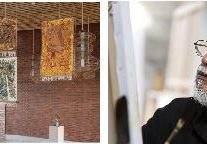
Few artists are as inseparable from the cultural imagination of Bengaluru as S.G. Vasudev. His presence is palpable as you bid goodbye to the city: the monumental silk tapestries at Kempegowda International Airport’s Terminal 2 Departures stand as quiet yet eloquent sentinels, signalling Bengaluru’s arrival as a significant art hub. And yet, for all his stature and visibility, Vasudev remains disarmingly modest — more concerned with the health of the artistic ecosystem than with burnishing his own formidable reputation. “If the art community is strong, individual artists will also flourish,” he says. “We grow only when we grow together.”
I first encountered him in Bombay in 1990, while interviewing him for The Independent, a Times Group publication. What struck me then — and continues to do so now — was his passionate conviction that artists from South India were not receiving the exposure they deserved within the national art discourse. “So much important work has been happening in the South, but it rarely enters the national conversation,” he told me then. “We need a more democratic space, where geography does not decide visibility.” Things have changed somewhat in the past 35 years, but not as transformatively as he would like.
Equally striking is Vasudev’s deep awareness of artistic lineage and local legacy. When I relocated to Bengaluru in 2018, I developed a closer bond with him through his wife Ammu Joseph, a fellow journalist and friend from my Bombay days, who has proved to be his anchor and cheerleader. It was he who first drew my attention to the late Rumale Chennabasaviah, whose luminous works captured the fragile beauty of Bengaluru’s flora long before the city’s glass-and-concrete transformation. He speaks with similar reverence of K. Venkatappa, another towering figure in Karnataka’s modern art history. “We cannot build the future of art by forgetting those who shaped its foundations,” Vasudev says. “Knowing where you come from gives you the confidence to move forward.”
It is therefore fitting that one of the three recent exhibitions at the newly renovated Venkatappa Art Gallery in Bengaluru should be Vasudev’s. Curated by Time and Space Gallery, the compact show functions as a microcosm of his vast oeuvre, traversing media and motifs, and inevitably recalls the sweeping retrospective of his lifetime’s work, titled Inner Resonance, held at the National Gallery of Modern Art (NGMA) in the city in 2018.
FORMATIVE ROOTS: FAMILY, TRAINING, AND ARTISTIC COMMUNITY
The emotional and intellectual wellsprings of Vasudev’s art run deep. Creativity was woven into the fabric of his family life — his great-grandfather, uncle, and mother all nurtured his artistic inclinations, his mother being an amateur artist herself. Yet choosing art as a profession was not without resistance. Like many of his generation, he faced pressure to pursue a more “respectable” and lucrative career. “There was always the question: what will you live on?” he recalls with a smile. “But once you decide that art is not a hobby but your life, you find a way.”
His years at the Government College of Fine Arts, Madras, under the mentorship of K.C.S. Paniker, proved transformative. Paniker was instrumental in shaping what came to be known as the Madras Art Movement — an effort to forge a modern Indian visual language rooted in indigenous traditions rather than European academic models. From Paniker, Vasudev absorbed the primacy of the line and an openness to narrative, myth and symbolism that would become hallmarks of his mature style. “Paniker taught us that modernity does not mean abandoning our own cultural memory,” Vasudev says. “It means reinterpreting it in our own time.”
Equally formative was Cholamandal Artists’ Village, the pioneering artists’ commune on the outskirts of Chennai he co-founded, envisioned as an oasis for creative self-expression and collective living. Much like Santiniketan in an earlier era, Cholamandal fostered an art fraternity that blurred the boundaries between individual practice and shared cultural mission. It was here that Vasudev’s lifelong belief in the interface between art and craft took firm root.
Paniker encouraged young artists to work with craftspeople, to learn ceramic processes, metalwork, batik, and weaving — not as decorative adjuncts but as integral artistic languages. This philosophy later found powerful expression in Vasudev’s copper reliefs and silk tapestries, where the osmosis between form and content becomes palpably tactile. At his NGMA retrospective, the master weaver who collaborated on his tapestries was present, engaging directly with visitors. “For me, the weaver is not executing my idea — he is my co-creator,” Vasudev says. “Art and craft must speak to each other, otherwise both become poorer.”
TRADITION AS SPRINGBOARD, NOT SHACKLES
Vasudev’s relationship with tradition is nuanced and dynamic. He embodies to me Nandalal Bose’s metaphor of tradition as the shell of a seed — necessary for protection in the early stages, but one that must eventually crack for growth to occur. “If you only protect the shell, the seed will never become a tree,” said Nandalal. “At some point, you have to break free, while still remembering where you began.” This is exactly what Vasudev does.
Technically, his mastery spans painting, copper, collage and tapestry, yet a distinctive “linear impulse” binds all these media together. The line, learned and internalised under Paniker’s tutelage, remains the underpinning of his art — rhythmic, sinuous, and unmistakably his own, making a Vasudev instantly recognisable across formats. “The line is like breath for me,” he reflects. “Everything begins and ends there.”
MYTH, MUSIC, AND THE THEATRE OF LIFE
Myth and fantasy occupy a central place in Vasudev’s imaginative universe. Joseph Campbell once described myths as the world’s dreams, articulated through symbolic forms. Vasudev’s work draws deeply from Indian mythic reservoirs, but always translated into a contemporary idiom, never illustrative, never nostalgic. “Myth is not about the past,” he says. “It is about human experience that repeats itself in every age.”
Equally influential are Indian classical music, Kannada literature, cinema and theatre — art forms he sees not as separate silos but as interrelated modes of expression. He was the art director for Pattabhirama Reddy’s iconic film Samskara, based on the pathbreaking novel by UR Ananthamurthy, and has long been drawn to the poetry of A.K. Ramanujan, even designing the cover for a book of his poems. Some of his drawings were inspired by Ramanujan’s poetry. “All the arts are connected,” he insists. “When I listen to music or read poetry, it changes the way I paint.”
Nature, too, is not mere backdrop but primordial force in his work. The celebrated Vriksha (Tree of Life) series, developed over decades, is central to his concept of what he calls “indigenous modernism.” “The tree is birth, shelter, memory, and death — everything is contained there,” he says. In the early canvases, thickly encrusted paint makes the tree appear to erupt physically from the surface, embodying fertility and generative energy. Over time, this motif evolves into more sombre meditations on life and death, mirroring both personal transitions and ecological anxieties.
From here emerge the Maithuna series — explorations of erotic union as cosmic harmony, the coming together of Prakriti and Purusha, not only in human couples but echoed in birds, animals and celestial forms. In later Humanscapes and Earthscapes, the compositions grow darker, more labyrinthine, reflecting what Vasudev calls the “theatre of life” — a stage where beauty, violence, desire and decay coexist in uneasy proximity. Art cannot always be comforting, he believes. Sometimes it must also disturb.
REINVENTION IN THE TIME OF THE PANDEMIC
That Vasudev continues to reinvent himself well into his later years is evident in the remarkable collage series he created during the pandemic — his first sustained engagement with this medium. Confined, like so many others, to domestic spaces, he turned inward, rummaging through decades of memorabilia and memory. “I was surrounded by fragments of my own past,” he says. “The collages became a way of having a conversation with those memories.”
Shards of earlier works reappear, rearranged with playful immediacy and poignant freshness. Many of these works foreground the fragile relationship between human beings and nature — a connection the pandemic forced us to confront with renewed urgency. “We suddenly realised how vulnerable we are,” Vasudev reflects. “And how badly we have damaged the world that sustains us.”
ART AS PUBLIC ENGAGEMENT
Perhaps most remarkable is Vasudev’s sustained commitment to making art accessible beyond elite gallery circuits. His brainchild, the monthly Art Park — held on the first Sunday of every month — allows young and senior local artists to exhibit and sell their work directly to the public at affordable prices. Now well into its 90-plus editions, it has become a vital platform for emerging talent and an informal meeting ground between artists and audiences. “Art should not remain locked inside white walls,” he says. “People must feel it belongs to them.”
He also believes strongly in the role of state institutions in nurturing culture and has been actively involved with the NGMA in Bengaluru. His efforts extend to education as well. The Fine Arts Department at Bangalore University owes its very existence to his relentless pursuit of successive vice-chancellors and registrars over several years. “If we don’t invest in education, we cannot complain about the future,” he says simply.
The Ananya Drishya initiative, another of his endeavours, supports young visual artists while collaborating with cultural institutions to bring quality programmes to the city’s public — part of his larger mission to combat mediocrity and institutional apathy, and to bring genuine talent to the forefront.
THE ARTIST AS CUSTODIAN
S.G. Vasudev’s achievement lies not only in the sheer range and depth of his artistic output, but in the rare synthesis he embodies — of tradition and innovation, art and craft, individual vision and collective responsibility. Rooted firmly in the soil of local culture yet constantly reaching for universal resonances, his work reminds us that modernity need not be a rupture from the past, but can grow organically from it, like the Vriksha itself — branching outward, nourished by deep, invisible roots.
 LETTERS TO THE EDITOR FOR THE ISSUE DATED MARCH 07, 2026
 AMKA NAKA ‘NEW’ GOA: Our heritage is under a hammer!By Raaisa Lemos Vaz
 39A DELHI BUILDER DRIVEN!
 THE MORIBUND STATE OF THE GOAN ECONOMY! BY Arvind Pinto
 NEW HPV VACCINE TARGETS YOUNG GIRLS!By Dr RG Wiseman Pinto
 GLOBAL WAR CLOSER TO GOA!By Olav Albuquerque
 IF IT’S GREEN MANGO SEASON…
 WITH THE AMI PANJEKAR PANEL!
 PRAMOD SAWANT SAYS BIG BOAT WON’T COME!
 SPLASH THE COLOURS! FILL UP YOUR PLATE! By Dr Amit Dias
 WEEKEND UPDATES
 LETTERS TO THE EDITOR FOR ISSUE DATED FEBRUARY 28, 2026
 BORKAR ENDS FAST, ST ANDRE CONVERSIONS SUSPENDED!
 GOA’S ECOLOGY DESTROYED BY 39A! By Dean D’Cruz
 A PARCHED PARADISE! By Raaisa Lemos Vaz
Goa is abuzz with excitement as vintage bike and car owners, users, collectors and fans are decking […]