Goa is abuzz with excitement as vintage bike and car owners, users, collectors and fans are decking […]
Old is Gold
October 4, 2016

The new Deltin Royale which will be parked near Verem is a 112-mtr long and will have a built up area of 65,000 sq feet spread across seven floors, installing a 1,000 gambling stations
A GIGANTIC 100-meter long casino vessel is expected to impose an unbearable burden on the already oppressed Mandovi river soon. In what is claimed to be a replacement for the existing Deltin Royale owned by Jaydev Modi, the new casino vessel will have a built up gambling areas of 65,000 sq ft spread over eight floors.
Even while Goans are waking up to the concretization of Goa’s paddy fields and khazan lands, they seem to be oblivious of the colonization of the Mandovi river by the casino lobby. The new Deltin Royale casino will reportedly host over 2,000 gamblers at any one time, it will reportedly have a 1,000 gaming stations. As Justice Ferdino Rebello has pointed out there was a time when young boys and girls used to swim across the river Mandovi from Betim to the Panjim river banks; forget about humans swimming, not even fish can survive the toxic waste being created and discharged by the six casino vessels into the Mandovi river.
No one of course, including the print and the electronic media, paid any attention to the protest organized eminent citizens of Panjim like Valmiki Naik and Patricia Pinto against the new mega floating gambling platform. Indeed, the river Mandovi had to be specially dredged to accommodate the anchors to host the new stationary gigantic Casino Royale vessel.
CASINO STORY
CASINOS first entered the river Mandovi way back in 2000 when Francisco Sardinha was the chief minister of Goa. The first casino reportedly was approved by the then home minister LK Advani at the instance Sunder Advani, the owner of Ramada Hotel in south Goa. For a long period of time the Caravala was the only casino vessel in the river Mandovi river. It was the late ManoharParrikar who threw the river open to the Jaydev Modi promoted publicly listed High Street Entertainment Ltd.
Over a period of time Jaydev Modi, who enjoyed political patronage at the highest levels in Goa and New Delhi, brought in three large casinos, before a ban was imposed on new casinos in river Mandovi. I distinctly recall Jaydev Modi sitting at the first row when Manohar Parrikar returned as chief minister after the 2011 elections to the Goa assembly.
Since around 2017, in the face of public fury, a ban was imposed on additional casino vessels. Deltin, the parent company, decided to replace the smaller casino vessels with much larger vessels. Deltin has publicly acknowledged that new Casino Royale will be three times bigger than the existing vessel it is replacing.
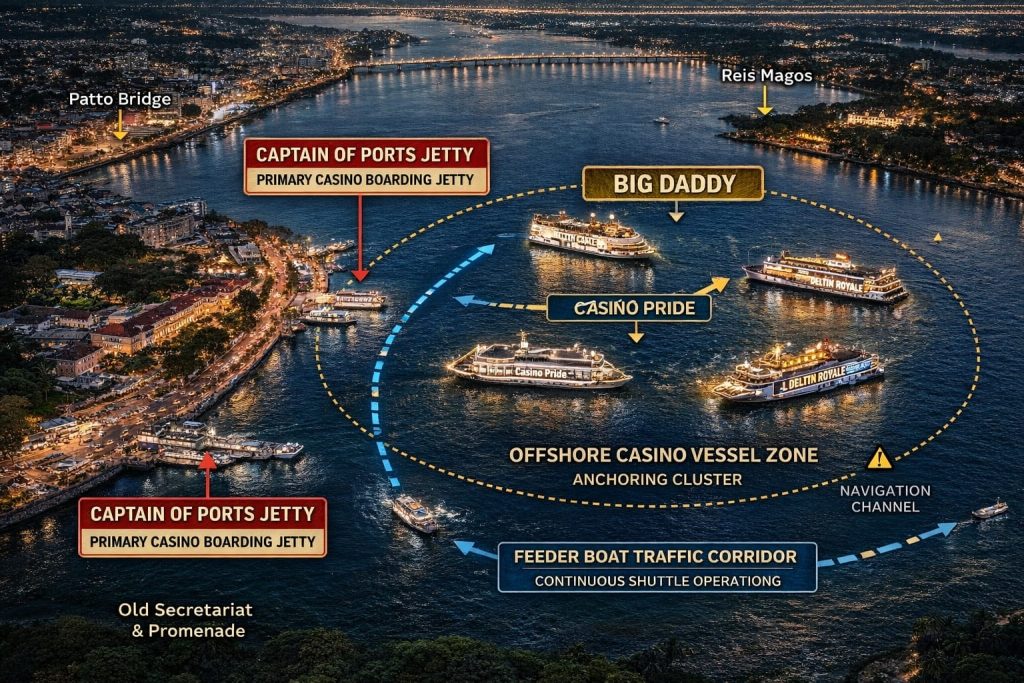
As of now there are three Deltin vessels in the river Mandovi in the stretch between Betim and Miramar beach. In addition there are two vessels belonging to the Delhi-based Rana group going by the name Pride Casino. There is also the Big Daddy, reportedly owned by the controversial former home minister of Haryana, Gopal Kanda. Gopal Kanda, who owned an airline, was accused of molesting one of his air hostesses by the district court if Haryana, and he spent some time in jail, although he was finally acquitted in a Supreme Court appeal.
GROWING DEMAND
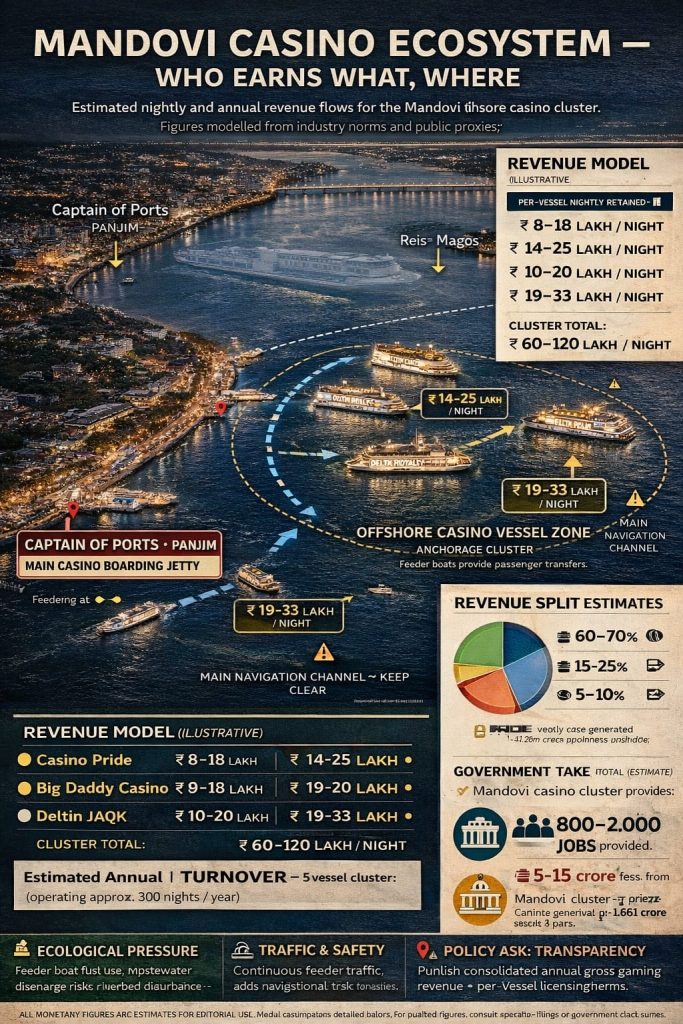
WE understand that the offshore casinos attract as many as 15,000 gamblers a day or five lakh punters a month. On an annualized basis the number of gamblers visiting the offshore and onshore casinos is estimated to exceed 60 lakh footfall, which is four times the population of Panjim city alone. Everyone seems to have a vested interest in the casinos led by the Goa government. It is on record that the Goa government gets an income of Rs1,600 crore over a five year period from license and entry fees.
Besides, the casinos also pay an entertainment tax. But, strangely, while there is GST on every item from chalk to cheese there is no GST on gambling. The Goa government gets less than 16% of the earnings of the casino operators while in Macau and Las Vegas, the big gambling hubs, is that 40% of the turnover is paid by way of royalties to the respective governments; the Chinese in Macau and the US government in Las Vegas.
Clearly, the state government is losing out, but perhaps the larger part goes to the politicians in Goa and Delhim who are party to the invasion of the river Mandovi by the gambling mafia. For politicians in Delhi and in Goa the casinos are ideal vehicles for laundering money. It is not surprising that in the cases filed by the Enforcement Directorate against Arvind Kejriwal and Aam Aadmi party leaders over the Delhi liquor scam, there have been claims that a significant part of over Rs300 crore was used through havala transactions for the 2018 assembly elections in Goa where the AAP contested 20 seats.
The popularity of the casinos in Goa probably stems from the fact that Goa is one of the very few places in the country where live gambling is officially permitted. Live gambling is distinguished from electronic gaming machines which are set up in the onshore casinos, which located mostly in the 5-star resorts and hotels in the state. In the live casinos there are roulette wheels and Black Jack card game tables which are manned by, or actually “womened” by young women from the north-eastern states of India.
The casinos reportedly provide employment to as many as 60,000 people, though the majority of them are from outside Goa. We do not know if Goan youth are shy of working in the casinos as this involves involves long, grueling 12-hour shifts. Indeed, even the kitchen chefs employed in the casinos, which are open for breakfast, lunch and dinner, are from outside Goa.
CASINOS ARE TOURISM
THE government of Goa claims that the casinos are part of the infrastructure of tourism in the state. It also claims that casinos immensely benefit the local tourism economy. All tourist gamblers visiting Goa and willing to spend a minimum of Rs5lakh, are provided free accommodation in 5-star hotels in Panjim and surrounding areas. Not only the starred hotels but even GTDC’s Miramar Residency and Panjim Residency, have been virtually leased out to the casinos managements.
In addition, the casinos provide thriving business opportunities to the many fleets of tourist taxis. These are the feeder boats which take the gambling amateurs tourists and hardcore professional gamblers, to and fro from the riverside jetties to the casino vessels parked midstream in the river. These boats are run by Goan staff though the casinos are owned by outsider companies – the boats are owned by Goans too.
The Goan casinos are very different from the casinos in Macau, as they are also entertainment hubs providing live entertainment to gamblers amateur and professionals. A large number of domestic tourists, particularly from the upper middle class, and wealthy class, come to gamble in the casinos and are not seeking sun, sea and sand holidays. Everyone no matter how rich dreams of winning fortunes and casinos feed these dreams, or nightmares.
THE National Institute of Oceanography has put out a lot of studies indicating the damage to the ecology of the Mandovi river because of the casinos parked or anchored to the river bed. Besides the discharge of effluent sewage into the river there is also the question of the casinos affecting the river’s marine life. The casinos are now making it dangerous for anyone wishing to go swimming in the river Mandovi waters, Ponjekars can no longer do it without courting disease and tragedy.
CHEEK-BY-JOWL CASINOS
THE offshore casinos are not even spaced out, all are jammed up close to each other on a narrow stretch from the old Mandovi Hotel (now closed) river front to the Miramar beach. The casinos have been allowed to build illegal jetties for their customers all along the Mandovi river here in Panjim and its an ugly scene. It would be not an exaggeration to claim that the river Mandovi river has been taken over the offshore casino industry. Casinos everywhere in the world also become a hub for prostitution, drugs and every other kind of vice and so Goa is no different now. We have personally witnessed the gambling high rollers accompanied by call girls in the casinos. There are also hawala agents lurking in the restaurant areas of the casinos.
If a high stake gambler exhausts his funds the hawala dealer will extend credit immediately after checking the customers’ credentials. There was a time when some casinos even installed ATM machines on board the vessels. All casinos on shore and off shore are programmed such that the house always wins. It has been acknowledged that the pay out in most casinos in Goa is less than 30 percent daily. Which means that casinos are an extremely profitable business. It is estimated that the turnover of the onshore and offshore casinos in Goa could be as high as Rs20,000 crore annually .
HOPEFULLY, the people of Goa will support Panjim residents in removing the casino vessels from the river Mandovi river. The Enough is Enough movement launched by Justice Ferdino Rebello has issued an ultimatum to the Goa government to remove the casinos from the river Mandovi within six months.
 LETTER TO THE EDITOR FOR THE ISSUE DATED MARCH 28, 2026
 GOA’S GILDED HIGH RISE SLUMS!By Raaisa Lemos Vaz
 DIRTY TOWERS OF GOA!
 UNCLEAN WATER, CARRIER OF DISEASE! By Dr Amit Dias, MD
 LOOKING BACK AT GOA IN 60S! By Arvind Pinto
 THE ROAD WE STILL WALK: CONFRONTING CASTE ON VAIKOM’S ANNIVERSARY! By Prema Viswanathan
 WILL THE NEW ADVOCATES PROTECTION BILL STOP ATTACKS ON LAWYERS?By Dr Olav Albuquerque
 ABHINANDAN LODHA CONQUERS BICHOLIM
 IT’S `NIMBU-SODA’ SEASON!
 `Our Rights: Essays on Law, Justice and the Constitution’ by Dr Justice F I Rebello WHAT ARE YOUR RIGHTS?Most of us don’t even know!
 WEEKEND UPDATES
 LETTER TO THE EDITOR FOR THE ISSUE DATED MARCH 21, 2026
 LOOK BACK IN ANGER, LOOK AHEAD WITH RESOLVE!By Gautam Patel
 OUR WOUNDED MANDOVI RIVER MAI! By Raaisa Lemos Vaz
 GARDEN SUBURB TO MONSTER TOWERS…Chembur then and now!
Goa is abuzz with excitement as vintage bike and car owners, users, collectors and fans are decking […]