Goa is abuzz with excitement as vintage bike and car owners, users, collectors and fans are decking […]
Old is Gold
October 4, 2016
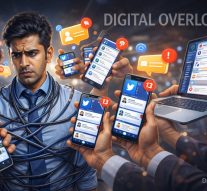
IN TODAY’S hyper-connected world, “I am busy” has quietly become the most socially acceptable lie of the digital age. Busy scrolling, busy replying, busy reacting. A simple phone vibration now overrides conversation, concentration, and even common sense. Silence makes us uneasy; boredom has vanished and real friends are replaced by reel friends. While technology has connected us like never before, it has also fragmented our attention, strained our emotions, and fatigued our minds. We are living in an era of digital overload and Artificial Intelligence —and it is time we all learn how to take a BRAIN DETOX.
What is Digital Overload?
DIGITAL overload refers to a state in which the human brain is exposed to excessive digital stimuli — constant notifications, endless social media feeds, emails, messages, news alerts, videos, and virtual meetings—beyond its capacity to process meaningfully. Unlike physical fatigue, digital overload is subtle. It creeps in quietly, disguising itself as productivity and connectivity.
The human brain evolved to handle intermittent information, not a continuous stream of fragmented inputs. Today, we consume in a single day more information than our ancestors processed in weeks. Every time you switch tasks, your brain pays a price – a metabolic price.
Why Is this Happening?
SEVERAL forces converge to fuel digital overload:
Work-from-home, online education, and 24/7 accessibility have erased the natural boundaries between work, rest, and leisure. The brain never truly “logs off”.
Social comparison and the fear of being left behind socially or professionally compel us to stay constantly plugged in.
Pandemics, wars, economic uncertainty, and climate anxiety push people to compulsively consume news, often worsening stress rather than reducing uncertainty. COVID taught us that webinars and work from home are possible for the common man as a result, we are faced with a digital overload that our brain was not prepared for.
The Impact on Humans: Mind, Body, and Society
The consequences of digital overload are no longer anecdotal; they are scientifically documented.
Mental and Emotional Effects
• Reduced attention span and concentration
• Increased anxiety, irritability, and emotional dysregulation
• Sleep disturbances due to blue light exposure and mental hyper arousal
• Depression linked to excessive social media comparison
Cognitive Effects
• Impaired memory consolidation
• Reduced deep thinking and creativity
• Difficulty tolerating boredom—a key ingredient for innovation
Physical Health Effects
• Eye strain and headaches
• Sedentary behaviour leading to obesity and metabolic disorders
• Musculoskeletal problems, especially neck and back pain
Brain Rot: A Modern Malady
A TERM gaining popularity — “brain rot” — refers to the gradual cognitive dulling caused by excessive consumption of low-quality, high-frequency digital content. Short videos, memes, and rapid-fire reels condition the brain to crave instant gratification while weakening its ability to engage in sustained attention.
Brain rot is not a medical diagnosis, but the phenomenon is real. It manifests as:
• Restlessness when offline
• Difficulty reading long texts
• Reduced patience for complex conversations
• A constant urge to “check the phone” without purpose
In children and adolescents, whose brains are still developing, the effects can be even more profound.
Children & Social Media:
Children today are growing up in an environment where screens are not tools but companions. Excessive screen exposure has been linked to delayed language development, attention problems, behavioural issues, and poor emotional regulation.
Recognising this, Australia has recently considered strict regulations and age restrictions on social media platforms for children, citing mental health concerns, cyber bullying, and addictive design features. Their argument is simple: when an industry knowingly designs addictive products for developing brains, regulation becomes a public health necessity.
India, with its massive youth population and rapid digital penetration, must urgently reflect on this issue. While digital literacy and access are essential, unregulated exposure is not empowerment — Just because something is common doesn’t mean it is normal.
Future Implications: Where Are We Headed?
If unchecked, digital overload may shape a future where:
• Attention becomes the scarcest human resource
• Emotional resilience declines
• Empathy and deep relationships weaken
• Productivity paradoxically falls despite constant connectivity
However, the future is not predetermined. Technology itself is not the enemy. The real challenge lies in how consciously we use it.
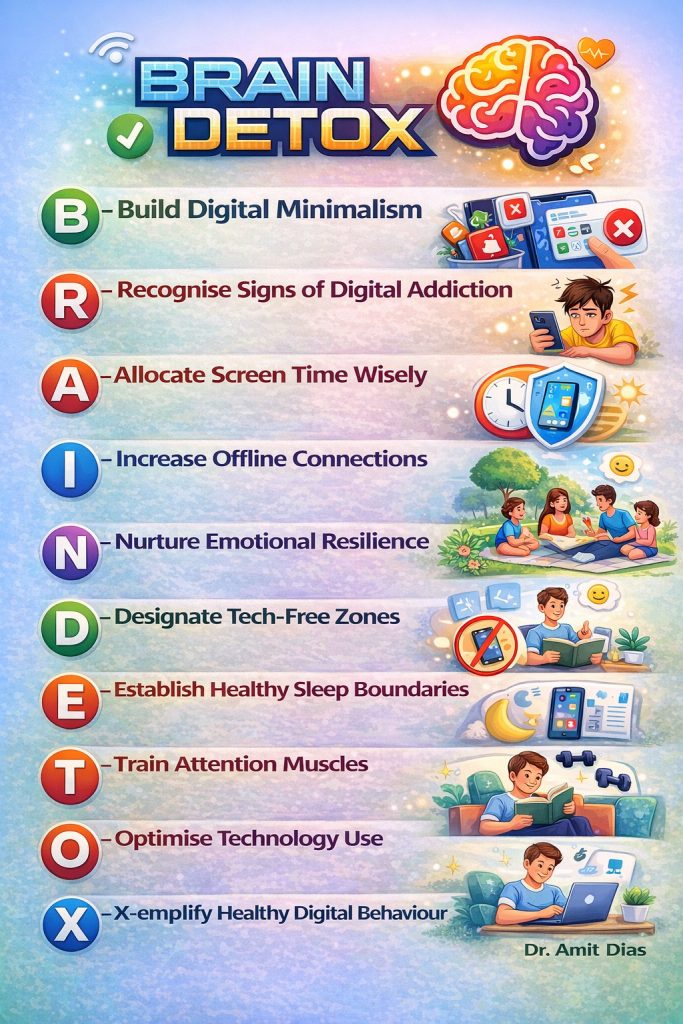
Practical Suggestions for BRAIN DETOX
So can we have the best of both worlds? The answer is YES !!—but only through intentional living. Digital wellbeing does not mean rejecting technology; it means reclaiming our control over it. We must shift from passive consumption to mindful usage.
BRAIN DETOX is about using technology intelligently—without sacrificing focus, sleep, relationships, or peace of mind. Simple tips can go a long way in keeping our wellbeing and mental health.
B – Build Digital Minimalism
Reduce digital clutter by disabling non-essential notifications and removing low-value apps.
R – Recognise Signs of Digital Addiction
Watch for compulsive checking, irritability when offline, poor sleep, and declining attention.
A – Allocate Screen Time Wisely
Use devices with purpose and intention rather than habit or impulse.
I – Increase Offline Connections
Prioritise face-to-face conversations, outdoor activities, and real-world relationships.
N – Nurture Emotional Resilience
Learn to tolerate silence, boredom, and reflection without reaching for a screen.
D – Designate Tech-Free Zones
Keep meals, bedrooms, and family time free from digital devices.
E – Establish Healthy Sleep Boundaries
Avoid screens at least one hour before bedtime to protect sleep quality.
T – Train Attention Muscles
Read physical books, practice mindfulness, and engage in activities requiring deep focus.
O – Optimise Technology Use
Make technology work for you, not against you—less scrolling, more meaning.
X – X-emplify Healthy Digital Behaviour
Children learn by observation; model balanced screen use in everyday life.
Conclusion: Too much of anything is bad
DIGITAL overload is not merely a technological issue; it is a human one. The real danger is not that machines will become like humans, but that humans will start functioning like machines—reactive, distracted, and emotionally exhausted.
Building emotional strength in a hyper connected world requires courage: the courage to pause, to disconnect, to be bored, and to be present. In doing so, we do not lose the digital world — we gain ourselves back.
 LETTERS TO THE EDITOR FOR ISSUE DATED APRIL 04, 2026
 REAL ESTATE BARONS OF GOA!
 THE SLOW VANISHING OF GOA’S GOLDEN BEACHES! By Raaisa Lemos Vaz
 WHO IS EXTRACTING GOA’S GROUND WATER? By Supriya Vohra
 PLANNING FOR RETIREMENT THE GOAN WAY! By Arvind Pinto
 WHEN `HOLY WEEK’ COMES LONG
 HPV Vaccine: PROTECTING INDIA’S DAUGHTERS FROM CERVICAL CANCER!By Dr Amit Dias, MD
 NO MORE PROTESTS AT AZAD MAIDAN?
 CURCHOREM SEX SCANDAL: Will the police really take action?By Olav Albuquerque
 WEEKEND UPDATESLETTER TO THE EDITOR FOR THE ISSUE DATED MARCH 28, 2026
 GOA’S GILDED HIGH RISE SLUMS!By Raaisa Lemos Vaz
 DIRTY TOWERS OF GOA!
 UNCLEAN WATER, CARRIER OF DISEASE! By Dr Amit Dias, MD
 LOOKING BACK AT GOA IN 60S! By Arvind Pinto
Goa is abuzz with excitement as vintage bike and car owners, users, collectors and fans are decking […]