Goa is abuzz with excitement as vintage bike and car owners, users, collectors and fans are decking […]
Old is Gold
October 4, 2016

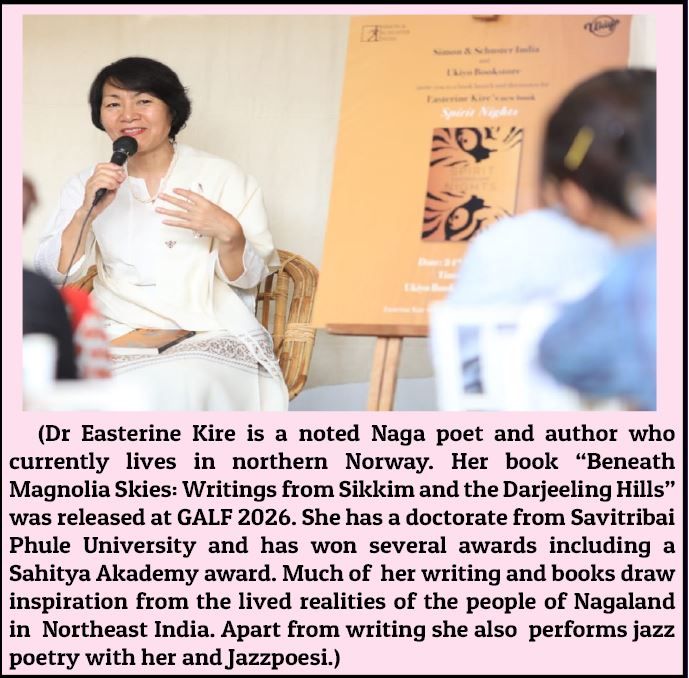
A thought-provoking keynote talk given by the writer at the recent 14th Goa Arts & Literature Festival which took place from February 12 to 14, 2026 at the International Centre Goa….
IN the Garden of Eden, God asked Adam,
“Who told you, you were naked?”
We too can pose a similar question, “Who told you, you were marginalised?”
This is a question relevant to the Northeast and to Goa and even Chennai. There might be more regions.
It is time to interrogate the term marginalisation once again. I want to question the motive behind such a definition. Marginalisation is a constructed identity that someone places on you and when you allow them to do that, you will end up seeing yourself as lesser. Be highly suspicious of any institution or region that calls itself the centre — that is how dictatorship begins.
Using the word marginalised suggests there is a centre, and it has margins, the Northeast and Goa being those margins.
It is fine to use the terms centre and margins for geopolitical purposes. But when it is applied to Literature and the Arts, it becomes a very dangerous idea. A dangerous ideology.
What I call dangerous is the division of literature into margins and centre, centre and peripheries. Because complexities arise that go beyond the geographical. Marginalisation messes with your head and you end up seeing yourself as forgotten, neglected, victimised, overlooked.
There is nothing positive about such a mind set. Why appropriate it? Why run after it when its survival depends on your inferiority complex? It is extremely unhealthy.
Because when we acknowledge the presence of a centre, we give authority to it. We give it the authority to define us and to make decisions over our writings. It then takes on the audacity to put expectations on our writing:
How we should write.
And what we should write.
This is so dangerous for our cultural survival and the threat of homogenisation becomes very real. If we choose to believe in the
existence of a literary centre, we will lose our quintessential selves. We will lose many of the elements that make us original and unique. An equal danger is the power we give it over our histories, including our political histories and the ways it happened.
The centre is a creation interested only in protecting itself. As you resist the majority narratives and build up narratives that are true for your situation, you will create something original and brilliant that others will flock to and not just that, you will create something completely relevant, because it is organic and therefore, authentic.
There will always be inequality and injustice in the acknowledgement of a literary centre and its margins. The insidiousness of the culture of a centre could end in de-legitimisation of our stories, even threatening our existence as ethnic entities.
What is the alternative?
Re-center the centre.
You take charge.
Resist the definitions others give you.
You take the decision to see value in what you have. You define yourself.
Recall not just the positive things visitors say about us but what we know in ourselves about ourselves for that is where our centre should be.
That is actually where our centre is.
That is what we should take care of and take pride in. It is about not allowing others to dictate to us or make us feel we are missing out, or that we are far from the imagined centre. We have to stop using political yardsticks to measure ourselves. We can do that by relearning to believe in our own worth.
Let us take care of our centre. No one else can do it like we can. And where is your centre? It is in the spaces of the places we define as home. Hold on to it.
 LETTERS TO THE EDITOR FOR ISSUE DATED APRIL 04, 2026
 REAL ESTATE BARONS OF GOA!
 THE SLOW VANISHING OF GOA’S GOLDEN BEACHES! By Raaisa Lemos Vaz
 WHO IS EXTRACTING GOA’S GROUND WATER? By Supriya Vohra
 PLANNING FOR RETIREMENT THE GOAN WAY! By Arvind Pinto
 WHEN `HOLY WEEK’ COMES LONG
 HPV Vaccine: PROTECTING INDIA’S DAUGHTERS FROM CERVICAL CANCER!By Dr Amit Dias, MD
 NO MORE PROTESTS AT AZAD MAIDAN?
 CURCHOREM SEX SCANDAL: Will the police really take action?By Olav Albuquerque
 WEEKEND UPDATESLETTER TO THE EDITOR FOR THE ISSUE DATED MARCH 28, 2026
 GOA’S GILDED HIGH RISE SLUMS!By Raaisa Lemos Vaz
 DIRTY TOWERS OF GOA!
 UNCLEAN WATER, CARRIER OF DISEASE! By Dr Amit Dias, MD
 LOOKING BACK AT GOA IN 60S! By Arvind Pinto
Goa is abuzz with excitement as vintage bike and car owners, users, collectors and fans are decking […]