Goa is abuzz with excitement as vintage bike and car owners, users, collectors and fans are decking […]
Old is Gold
October 4, 2016
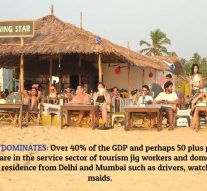
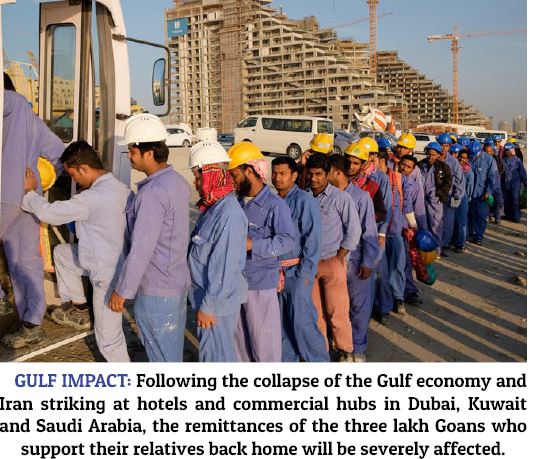
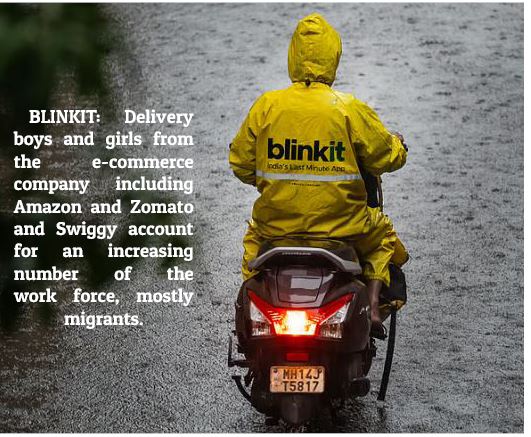
The Goan economy is totally dependent on the services sector comprising tourism, shops & establishment and digital delivery workers and in more recent years employees of casinos. Goa has also been dependent on remittances of the three lakh Goans settled in the Gulf and this will be affected by the ongoing Iran strikes on the Gulf countries.
GOA, long romanticized as India’s window to the world, today finds itself trapped in an economic twilight. The beaches may still glitter, the shacks stocks stay with less clients, but beneath this postcard veneer lies a stagnant economic malaise, whose engines of growth — tourism and mining — have stalled into inertia. The state once buoyed by foreign visitors, the dollars and pounds, and iron ore barges trundling down the Mandovi to deliver their load for export, is a thing of the past. Goa now drifts on borrowed time, unable to diversify, unable to deliver jobs, and unable to shake off the complacency of its own success story.
The result is a moribund economy: vibrant in image, hollow in substance. For years, Goa sold itself as the Indian paradise, golden sands, beaches filled with foreign tourists, cheap alcohol, and trendy music and casinos where people spent big bucks. But let’s pause to look at the reality
Goa is a small state, with a population of 1.6 million, with a population growth rate of 0.5% — lower than the national average of 0.9%. With around 76% of the population living in urban areas, there is high literacy and urban concentration, where people looking for work which is hard to find. For the small state with a high urban population, Goa is heavily reliant on the service sector. The hospitality, tourism and the support sector to tourism such as transport and allied services, are the mainstay of the economy.
Tourism was once the mainstay of the Goan economy with 8.4 million visitors. Talk to owners of hotels, or discuss with the taxi drivers, and you will hear about how business is declining. Today, it’s the domestic tourists, who give them business, the number of foreign tourists have declined with the stoppage of charter flights.
Let’s look at some of the Goan economic sectors that are slowing dying.
Agriculture
DRIVE across Goa, and you will notice that the once green rice and paddy fields are now patches of brown dust, waiting for real estate developers to buy the land. In the budget for 2025, the government of Goa launched an agricultural policy to prevent the conversion of rice, morad, kher and khazan fields (lands fed by irrigation). The policy promises to support the cultivation of new cash crops. The policy focuses on the creating of a robust supply chain infrastructure to reduce post harvest losses and ensure better market for farmers. Has this happened? Ask the locals and they will tell you a different story. Most of the parcels of land are economically unviable. The parcels of land are fragmented where mechanization is impossible. Goan farm labour is non- existent and outside labour is expensive. This has result in the abandoning of former agricultural practices. More important the system of khazan lands, these low lying areas along the rivers and estuaries, that were protected by bunds (dykes) and sluice gates (manos) over the decades have been abandoned after the Indian government took over the territory.
The khazan wetlands which once covered approximately 17,500 hectares across eight of Goa’s 11 talukas, represent a remarkable feat of traditional ecological engineering. These interconnected estuarine networks serve as vital agro-aquatic landscapes, featuring intricate systems of bunds (dykes), sluice gates called “manos,” water bodies known as “poiems,” and cultivable land. Originally maintained by the Comunidades, these traditional institutions maintained the delicate balance required for khazan sustainability. The management changed following the Goa Agricultural Tenancy Act of 1964, shifting responsibility to tenant associations supervised by government officials. Today, the communidades are dead, the community lands are government property with no effective management. Goan agriculture is in a state of decay and most of the food and even vegetables come from the neighbouring states.
Some experts feel that in certain areas, fishing is seen as the more lucrative option and that this shift toward commercial fishing over traditional agriculture, has undermined the integrated approach that made khazan agriculture sustainable. It has been also pointed out that this is not the case everywhere, as there are many villages where agriculture and pisciculture still work well together.
However, the damage to khazan fields due to damaged bundhs has been a big concern in many villages, like in Neura, Tiswadi, where there have been multiple inspections to assess the damage. This has resulted in the khazan lands in various states of decay. Traditional knowledge of maintaining these bunds and sluice gates has almost disappeared, leaving these wetlands subject to saline water or becoming parched. Of late the Goa government has invested around Rs48 crore in 2025, for repairing these bunds with an attempt to revive khazan agriculture especially around Panjim. But the expansion of urban limits, and the profits made from real estate coupled with the increased salinity of the water and the declining community participation has made these government schemes unattractive. The Goa that was once known as the land of the coconut trees, is no more. Production has fallen around 7.5% today, due to aging plantations, lack of coconut pickers and high fertilizer costs.
Mining
IF one lived in Panjim and walked along the Mandovi river front, inevitably one noticed the barges, filled with iron ore, trundling towards the ocean to empty their contents onto the ships out in the ocean. Today, the river Mandovi is chocked with casinos instead of the ore loaded barges. For in 2012, the Supreme Court suspended iron ore mining in Goa, due to illegalities in the leases issues and environmental violations. This ruling stopped mining and resulted in the loss of government revenue of nearly Rs2.5 crore each day. Besides thousands of mining workers, trucks and barge operators were out of jobs. Today, mining is being resumed with new auctioned leases, but mining is still to fully revive. Before the ban, most of our iron ore was being bought by China. Today however, China sources its ore from countries other than India. Goa has lost out a lucrative market.
Tourism
THE image of Goa in the minds of most Indians was of half-naked foreigners rambling on the sands of the beaches. It was this image that brought Indian tourists to Goa and trooping to Calangute, Baga and Anjuna in the ‘80s and 90’s to witness the hippie scene-scenary. Today the hippie happiness is history. Then it was the British charters, followed by Russian and Israel’s flights that brought plane load of tourists to fill the resorts that sprouted along the sandy shores.
Covid-19 killed the tourism industry with a drop of nearly 60% from the pre-Covid-19, arrivals of approximately 9.5 lakh foreign tourists. This decrease in the inflow of tourists, had an impact on the workforce at hotels, taxis, pilots (motor cycle taxis) and shacks. During this period the hardest hit was the informal sector. Many migrant workers left Goa for Karnataka, UP and Bihar. Today government is trying to resurrect this sector, but the flow of foreign tourists arrivals remains far below the pre-Covid-19 days. Today the government is moving to a policy of sustainable tourism to promote year round attractions to ensure that tourists are attracted to Goa on a year long basis rather than only for basking in the sun and for some fun!
The Goan economy is under serious stress, it needs looking into before it further deteriorates. In the first place, tourism contributes 30% to the Goan GDP. This overdependence on one sector which is vulnerable to seasonal shocks needs to be addressed. Our main cities are growing in population, but civic infrastructure and civic amenities are lacking, due to lack of funding and bureaucratic bungling. With poor waste management, garbage collection is dismal. The ban on mining has left the exchequer with lack of resources as this has left many unemployed. The unemployment rate is 5-6% which is higher than the national rate of 3.2%. Further, the local Goan workforce resents the fact that outsider workers (derisively called “bilo munis”) are taking away their sources of livelihood.
Our yearly budgets and plan on paper look ambitious and futuristic, but on the ground execution is poor. While the government is looking at ways to restart growth, it requires to look at new avenues and opportunity. With an educated population, and high unemployment, the focus could be on the SME and the MSME sector. However, with a small market size, a population of only 1.6 million, the scale for these services are limited. Further this sector is tied mainly to the hospitality, food and retail sector. There is an urgent need for the revival of the Goan economy, that is if Goa wishes to remain as one of the more progressive states in the country!
(Arvind Pinto is Retired Chief Commissionor of Income Tax, Chairman of Citizens Bank Chambur)
 LETTERS TO THE EDITOR FOR THE ISSUE DATED MARCH 07, 2026
 AMKA NAKA ‘NEW’ GOA: Our heritage is under a hammer!By Raaisa Lemos Vaz
 39A DELHI BUILDER DRIVEN!
 NEW HPV VACCINE TARGETS YOUNG GIRLS!By Dr RG Wiseman Pinto
 GLOBAL WAR CLOSER TO GOA!By Olav Albuquerque
 IF IT’S GREEN MANGO SEASON…
 WITH THE AMI PANJEKAR PANEL!
 PRAMOD SAWANT SAYS BIG BOAT WON’T COME!
 SPLASH THE COLOURS! FILL UP YOUR PLATE! By Dr Amit Dias
 WEEKEND UPDATES
 LETTERS TO THE EDITOR FOR ISSUE DATED FEBRUARY 28, 2026
 BORKAR ENDS FAST, ST ANDRE CONVERSIONS SUSPENDED!
 GOA’S ECOLOGY DESTROYED BY 39A! By Dean D’Cruz
 A PARCHED PARADISE! By Raaisa Lemos Vaz
 KARAPUR LOCALS PROTEST RANE LAND DEAL!
Goa is abuzz with excitement as vintage bike and car owners, users, collectors and fans are decking […]