Goa is abuzz with excitement as vintage bike and car owners, users, collectors and fans are decking […]
Old is Gold
October 4, 2016
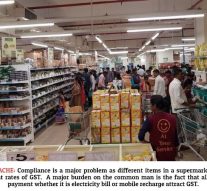
WITH Goods and Services Tax (GST) becoming an all-encompassing indirect tax, and its collection filling the government’s empty treasury, let us look at how does the common trader or service provider copes with this system . In February 2026, GST collections were Rs1.83 lakh crore gross, while the net GST after refunds was Rs1.61 lakh crore. However, many SMEs and MSMEs face a mounting challenge in being able to comply with the challenges that this tax has introduced.
In the first place there are multiple forms to be uploaded all online and the time lines are strict with interest and penalties for delay. Many small businesses are now forced to employ a consultant to do their filing since the knowledge and complexity of this tax is beyond the ken of the ordinary trader. Further errors in filing automatically trigger penalties, while blocking input tax credits (ITC), thereby depriving a small trader, the benefit of a set off of paid to the supplier of goods. While the government algorithm would like to match the input tax credits with the suppliers’ filings, at time the latter may not upload their returns thereby resulting in a denial of the ITC to the trader who enters the claim.
Key Changes in Budget 2026
BUDGET 2026, focussed on simplifying compliance reducing litigation and improving the refund efficiency of the system. Let us look at some of these changes that were brought about in the GST system.
ONE of the significant changes in GST in Budget 2026, was the removal of the intermediary service rule. Earlier intermediary services provided to foreign clients were treated as domestic supplies because the place of supply was considered to be the supplier’s location in India. This resulted in these services being taxed although they were rendered to overseas customers. The amendment now allows the service to follow the general place-of-supply rule where the location of the recipient determines the taxability. This change will ensure that such services will qualify as exports, making them zero-rated supplies, allowing them to claim input tax credit refunds.
Another area of dispute was the question of the treatment of post supply discounts. Businesses often provide trade incentives rebate and promotional discounts after the completion of a transaction. Disputes often arose whether such discounts could be deducted from the taxable income. This year’s budget allows the claim of such post-supply discounts subject to proper documentation and the reversal of input tax credits by recipients. This will now reduce disputes in industries such as FMCG and pharmaceuticals where post sale discounts are a normal trade practice.
A welcome feature of this budget was the removal of the minimum threshold of refund claims below Rs1,000. Earlier only refunds over Rs1,000 were processed resulting in government pocketing several crores of tax refunds from small tax payers. Now all refunds irrespective of the amounts will be processed, bringing the much-needed liquidity to small traders.
Burden on small traders & service providers
WHILE introducing GST as a system, government noticed that in a country, where informal trade and service providers flood the market, the system should ensure that this sector be accorded a special concession. Accordingly, government has a composition scheme where traders with a turnover of up to Rs 1.5 crore can opt for a composition scheme. These traders pay a fixed one percent of their turn over as GST, while restaurants owners pay 5% as GST instead of a detailed GST filing. It is estimated that 20% of the GST filings are under the composition scheme, mainly restaurants owners. Since GST is only application where the annual turnover is Rs40 lakh and 20 lakh in the case of services, this tax does not affect our small-time traders.
Evasion of GST
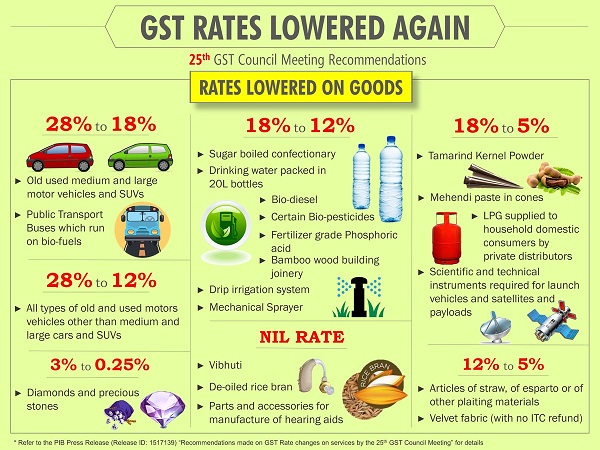
FOR small traders operating on small margins, the GST rates ranging from 5 to 28% make the temptation to evade this tax appealing. From September 2025, the GST rate for several categories of products have moved from 28% to 40%. These are tobacco, pan masala, aerated drinks, luxury vehicles, online gambling and gaming, and arms, aircrafts, and yachts. How does this enhanced GST impact Goa? While Goa has a large tourism and hospitality sector, where liquor and aerated drink consumption is high, GST inflows can be expected. However much of these products are sold by either small time traders or in the liquor in cash, there is neither proper invoicing leading to challenges in proper collection of GST. Go to buy liquor from any vendor in Goa, is there anyone giving you a receipt? All sales are cash and carry, the invoicing is done later with the help of a GST consultant. Like most taxes the collection of GST requires an audit trail, with invoices for every purchase or sale. In a country where even in the organized sector, where a certain portion of the transaction is carried in cash, this audit trail becomes difficult.
Operational Issues
MANY small-time users also face operational issues in GST. In order to ensure security of the portal, the protocol after one enters the user ID and password, is for a further authentication by way of an OTP sent to a registered mobile number. Many traders and service providers prefer to give their own mobile number. This often delays entry into the portal, since without an OTP verification, the consultant is unable to complete any upload.
Further, small traders or service providers have neither the time nor the expertise to manage their GST upload and are dependent on CA’s or consultants. Often this is an additional cost to their trade or service. Besides there is the issue or non-receipt of an OTP or network issues or the OTP being sent to an older number. Other technical disadvantages faced by GST payers is the frequent downtime during the peak filing dates, such as the 11th and 20th or the month, and the slow processing speeds when uploading invoices or reconciling returns . Often consultants advise their clients not to wait for the due date, but the nature of small traders or service providers in India, make it impossible to ensure early filing. For missing deadlines GST rules are equally stringent. sssssssssssssLate fees for filing is Rs 50 per day, fortunately capped at Rs 5,000. Interest on payment is 18% per annum. Mismatches of input tax credit or even late filing leads to the freezing of credits and repeated non-compliance with the GST rules can lead to suspension of GST registration. In a country, where GST is to be paid by SMEs and small traders and service providers, these are indeed harsh !
Many small traders and service providers have mixed perceptions about GST. While this all-India tax has replaced the multiple system earlier, where there was VAT, excise and service tax, GST has combined these into a single system of taxation. Further, the introduction of input credit, ensures that there is no cascading or double taxation. Registration under GST allows small traders to sell across states with certainty. However, the cost of compliance in the case of small traders is disproportionally high compared to their turnover for it is not only about the tax, but the time, money and resources spent on meeting technical requirements.
While governments can afford to spend enormous amounts of money on technical upgradation, our rural and semi-urban centres with a semi-literate population having to face the brunt of this tax to earn their daily bread. However, most traders and service providers in Goa or the rest of India, realise an important truth — that growth big time is impossible without a GST number!
 LETTERS TO THE EDITOR FOR ISSUE DATED MARCH 14, 2026
 TOWERING INFERNOS OF GOA COMING!By Raaisa Lemos Vaz
 MIRABAG GIFTED TO ADANI!
 DEPOSITS REFUND SCAM!WHO BENEFITS FROM THE RS 10.. By Misbah Quadri
 EATING FOR SUMMER TIME
 ACUTE SHORTAGE OF COMMERCIAL AND DOMESTIC LPG FORCES RESTAURANTS TO CLOSE
 NO KIDDING ABOUT YOUR KIDNEYS Healthy Kidneys, Healthy World! By Dr Amit Dias
 WEEKEND UPDATES
 LETTERS TO THE EDITOR FOR THE ISSUE DATED MARCH 07, 2026
 AMKA NAKA ‘NEW’ GOA: Our heritage is under a hammer!By Raaisa Lemos Vaz
 39A DELHI BUILDER DRIVEN!
 THE MORIBUND STATE OF THE GOAN ECONOMY! BY Arvind Pinto
 NEW HPV VACCINE TARGETS YOUNG GIRLS!By Dr RG Wiseman Pinto
 GLOBAL WAR CLOSER TO GOA!By Olav Albuquerque
 IF IT’S GREEN MANGO SEASON…
Goa is abuzz with excitement as vintage bike and car owners, users, collectors and fans are decking […]