Goa is abuzz with excitement as vintage bike and car owners, users, collectors and fans are decking […]
Old is Gold
October 4, 2016
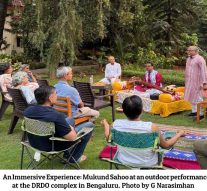
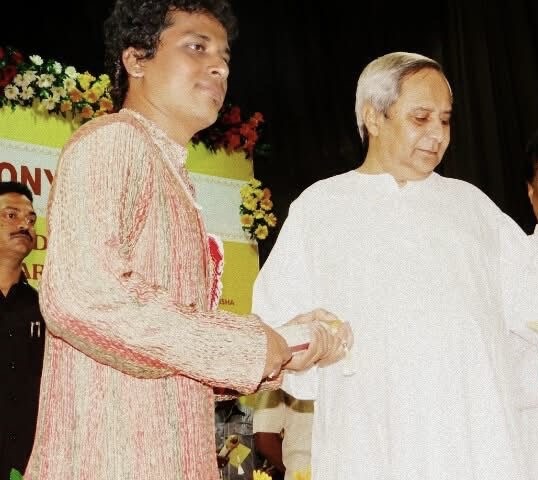
IN the quiet heart of Bhubaneshwar, Odisha, a musical transformation is unfolding — not through the frenetic energy of modern pop, but through the deep, resonant vibrations of India’s most ancient vocal tradition. Mukund Dev Sahoo, Chairman of the Dhrupad Music Foundation (DMF), stands at the helm of this movement.
For Sahoo, Dhrupad is far more than a genre; it is the janani — the sacred womb from which the melodic lifeblood of the Indian subcontinent has flowed for millennia.
Through his unique Deva Vani style, Sahoo seeks to bridge the chasm between the austere, often inaccessible technicalities of traditional Dhrupad and the emotional spiritualism craved by the modern soul.
After witnessing Sahoo’s soul-stirring performance at the Bangalore International Centre last month, and later interviewing him, I began to map the profound journey of an artist who believes that to sing Dhrupad is to “imbibe the wisdom that flows from silence.”
From Kirtan to the Himalayan Chilla
THE foundation of any great artist is often laid in the home. Sahoo’s journey began in a devout Vaishnava family, where the air was thick with the scent of incense and the sound of Prabhāta Kirtana. His father, the late Hem Chandra Sahoo, showed him the first gateway into the world of sound. “Each morning at 30 am, our home would awaken to my father’s voice,” Sahoo recalls. These early impressions planted the “seed of Dhrupad” long before he understood the complex grammar of a raga.
However, the path to mastery required a departure from the familiar. After several stints with music teachers in Odisha, Sahoo’s formal training began under the tutelage of Pandit Arun Kashalkar in Mumbai. “He introduced me to the Agra style of Dhrupad which had similarities with Khayal.”
But after listening to a concert by the Gundecha brothers, Sahoo found himself drawn to the Dagar style of Dhrupad. With the consent of Pandit Kashalkar, he headed to the Dhrupad Sansthan Gurukul run by the Gundecha brothers. It was here that he transitioned from a student of music to a practitioner of sadhana (spiritual discipline).
“When you sing Dhrupad with a tanpura, you are naked. You can’t hide. I realized then that Dhrupad is a mirror of your inner voice. If you learn this, you start seeing yourself. What you are exactly.”
Sahoo discovered in Dhrupad a very philosophical and spiritual experience.
He learnt that in Dhrupad the voice emanates from five centres of the body — the head, nose, throat, chest and navel.
Unlike Khayal, which celebrates the artist’s individual creativity and emotional range, Dhrupad focuses on the lower registers and the “purity” of the note, seeking the divine through discipline and the “stripping away” of the ego.
A pivotal moment in Sahoo’s musical evolution was the 40-day Chilla — a period of intense, solitary musical practice. He describes this experience as a “blessing” where “years of suppressed pain subsided.” But it was a subsequent journey into the Himalayas that defined his specific artistic identity. While in the high altitudes, away from the material world and the noise of technology, Sahoo practised in complete silence, speaking to no one. It was here, amidst the thin air and eternal stillness of the mountains, that he “chanced upon” the realization that Dhrupad must return to its Vedic roots. He felt that the “meaningless syllables” (Nom-Tom) had stripped the music of its original power. The Himalayas taught him that the breath must carry a Mantra to truly vibrate with the universe.
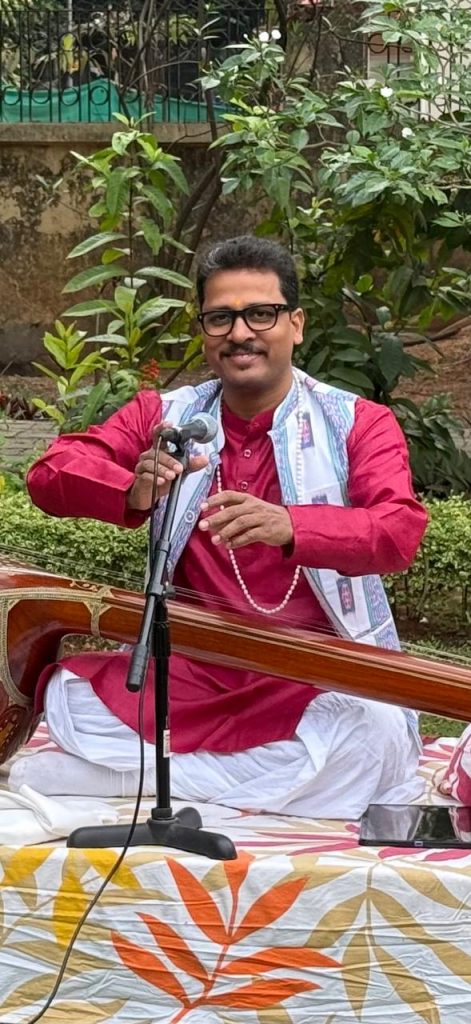
Deva Vani: Restoring Mantric Depth
ONE of the most significant contributions Sahoo is said to have made to the Dhrupad tradition is the introduction of the Deva Vani style. In contemporary Dhrupad circles, it has become common to use abstract syllables like Nom, Tom, Te, Re, Na. While these are phonetically effective, Sahoo felt they lacked the “bhakti essence” necessary to connect with a wider audience.
“Without meaningful words in the Alap, the emotional landscape becomes limited,” Sahoo notes. To address this, Deva Vani Dhrupad reintroduced a 16-syllable Vedic mantra into the very fabric of the music: “Om Hari Ananta Nārāyana Tarana Taarana Twam.”
This is the “engine” of the Deva Vani style. Each word carries a specific spiritual charge. Om is the primal vibration; Ananta is the infinite; Tarana/Taarana is the saviour who carries the seeker across the ocean of existence; and Twam is “You” — the recognition that the Divine alone exists, and the Absolute resides within each living being. By rendering this mantra with “grammatical precision,” Sahoo transforms the music from a technical exercise into an “immersive experience” where the audience is drawn into a state of stillness.
Sahoo claims that Nom-Tom syllables are “meaningless” and “strip the music of power.” One could argue, however, that these syllables are actually derived from the mantra “Ananta Hari Om” and that their abstraction is a deliberate artistic choice to prioritize pure sound over literary meaning.
By reintroducing a 16-syllable Vedic mantra, does the Deva Vani style not risk shifting Dhrupad from a universal exploration of nada (sound, as manifested in Dagar Vani) into a more narrow chant?
Sahoo believes the contrary. “From my understanding and sadhana, in our ancient tradition, sound (Nāda) and word (Shabda) are not separate. The scriptures speak of Shabda Brahma — that creation itself is manifested through sound, beginning with Omkara. Our ancestors have said, ‘Shabda Pratham Omkar,’ indicating that the experience of Nāda arises through Shabda.”
In that sense, the use of mantra in Deva Vani Dhrupad is not a limitation, but rather a return to its original source, Sahoo says. It is a way to experience Nāda more deeply within the body and consciousness. “I feel that this approach does not reduce the universality of Dhrupad; instead, it can make it more accessible and experiential for people, especially when these seed mantras are shared with sincerity.”
Sahoo claims that the Deva Vani is not a departure from the Dagar Vani. “Deva Vani Dhrupad is a part of the Dagar Vani Dhrupad lineage,” he says. “It (also) resonates deeply with the 16th century saint and Dhrupad guru Swami Haridas’s austere, contemplative style, grounded in nada (sacred sound) and bhakti (devotion).”
London: When Models Became “Devis”
PERHAPS the most striking demonstration of this style’s transformative power occurred during a fashion show in London featuring the traditional Sambhalpuri weaves of Odisha. Sahoo was invited to provide the recorded background score — an unusual setting for the austere tradition of Dhrupad.
Sahoo describes an ethereal shift in the hall’s atmosphere. As the ancient Vedic sounds permeated the modern runway, the audience was reportedly transported into meditative space, he says. “In fact, during a live presentation of the same show in Bhubaneswar, many people shared how they could clearly feel a transformation in the way the models were perceived against the backdrop of Deva Vani Dhrupad music which provided a divine ambience.” The models, dressed in the traditional Sambhalpuri garments, seemed to shed their worldly personas and assume a goddess-like stature, he says.
A purist might question whether the true purpose of Dhrupad — a music designed for deep, focused listening — is compromised when used as a “background score” for a runway. However, Sahoo’s intention was to elevate every activity – even a fashion show — to a meditative and spiritual plane.
The Sound That Leads to Silence
DEVA Vani Dhrupad is a conscious initiative to revive the true essence of the ancient musical tradition of Dhrupad, says Sahoo. “Music as devotion, not as entertainment. It’s a return to the spiritual and contemplative roots of the Dhrupad tradition, offering a path that moves away from performative virtuosity and toward inner experience.”
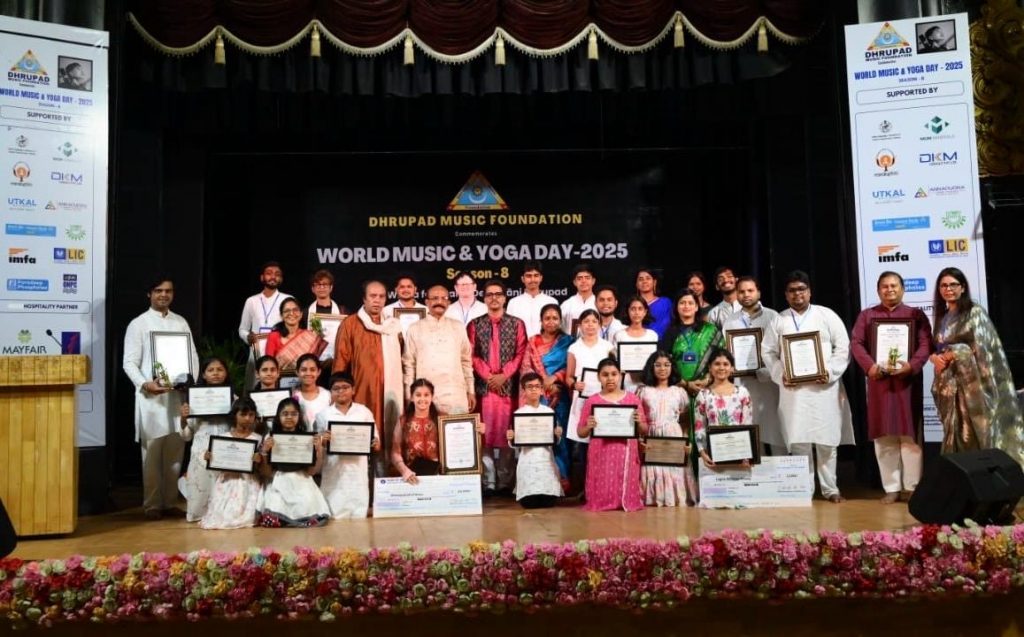
Sahoo describes his journey as one of “preservation and propagation,” specifically through the Deva Vani school of Dhrupad. By organizing major events like World Music and Yoga Day for the past nine years, he has successfully brought this fading tradition to a wider stage. In Odisha, his work is defined by the spirit of seva (service), he says. He provides free instruction to build awareness and foster a community of listeners where none previously existed.
Ultimately, the story of Mukund Dev Sahoo and Deva Vani Dhrupad is a story of reconciliation. It is the reconciliation of the ancient with the contemporary, the technical with the emotional, and sound with silence.
The Architecture of the “Om Twam” Alap
To understand the technical virtuosity of Sahoo’s method, one must look at the structural breakdown of the Alap. In the Deva Vani style, as Sahoo explains, this is divided into three distinct phases:
 LETTER TO THE EDITOR FOR ISSUE DATED APRIL 11, 2026
 DOUBLE ENGINE GOA GOVERNMENT DANCES TO ADANI TUNES!
 WHO IS FIXING THE SKY? The billionaires, the cops in SUVs, and the missing trees! By Raaisa Lemos Vaz
 UPHEAVAL OF THE SUSEGAAD!By Sumaiya Khan
 THE POWER AND THE POLITICS OF MINING IN GOA!By Arvind Pinto
 AT LEAST HOSPITALS CAN OFFER MILLET ROTI AND KICHADI!
 WHEN DO WE NEED PALLIATIVE CARE?
 GODI MEDIA TRUMPS TRUTH IN WAR & PEACE!
 World Health Day 2026: TOGETHER FOR HEALTH – STAND WITH SCIENCE! By Dr Amit Dias, MD
 FCRA AMENDMENT WILL ENABLE GOVT TO TAKE OVER PROPERTIES!By Olav Albuquerque
 WEEKEND UPDATESLETTERS TO THE EDITOR FOR ISSUE DATED APRIL 04, 2026
 REAL ESTATE BARONS OF GOA!
 THE SLOW VANISHING OF GOA’S GOLDEN BEACHES! By Raaisa Lemos Vaz
 WHO IS EXTRACTING GOA’S GROUND WATER? By Supriya Vohra
Goa is abuzz with excitement as vintage bike and car owners, users, collectors and fans are decking […]