Goa is abuzz with excitement as vintage bike and car owners, users, collectors and fans are decking […]
Old is Gold
October 4, 2016
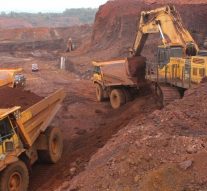
Former Goa Income-Tax Commissionor Arvind Pinto looks back at the Shah Commission Report which indicted the mining industry of Rs35,000 crore of illegal mining leading to the mining ban in 2007.
MINING in Goa, has a long and tumultuous history and it has determined the politics of this state. Even before the Portuguese set foot on the west coast, local small scale mineral extraction was carried on by local tribal groups such as the Dovolos at the foothills of the Western Ghats. On their arrival in the 16th century, the Portuguese, on extending their territory eastwards, learned about the existence of iron ore mining at the foothills of the Ghats, especially in the talukas such as Bicholim and Sattari. However, this was not publicised since the Portuguese were afraid that other foreign powers would also be interested in prospecting for minerals.
In the early 1906, the then colonial government formalized mineral exploitation with the promulgation of the Regulamento das Concessoes de Minas (Regulation of Mining Concessions). This law established the concessao system whereby individuals or corporates were granted perpetual, heritable and transferable rights over mineral tracts. These mine owners paid royalty, per tonne extracted, to the Portuguese, but there was little check on the amount of ore that was mined, and consequently little by way of state revenue. In the early part of the 20th century, mining by these concessaires was negligible, mainly manual, and locally used. With the rise of industrialization in Japan, Goan ore found an export market. The demand in the export market changed the manner in which ore was mined; manual extraction gave way to mechanisation. Soon several of the individual leases were consolidated into bigger concessionaries.
During the mid-20th century around 5 million tons were mined and mainly exported. While mining did contribute to the Portuguese coffers, with ineffective collection processes, it enriched the concessionaires making them the powerful power brokers in the future of the territory
POST-LIBERATION
HOWEVER, it was after Liberation that ore mining and its ancillary apparatus became an important sector of the Goan economy. The perpetual concessions granted under the Regulamento das Concessoes de Minas(1906) continued, until 1987, when these perpetual concessions were converted into 20-year leases to align the original Goan regulations with the Indian statue. With increasing mechanization many of the small concessionaires found themselves unviable players and were forced to sell out to the bigger players. This saw the rise of the dominant mining families where the Dempos, Salgaocars, Timblos and Chowgules bought out these smaller concessionaries. In 1954, an Italian entrepreneur arrived in Goa to establish Scambi Economici SA Goa — a company focussing on mining and export of ore. Over the decades it became a major exporter of Goan ore to Japan and later to South Korea and Europe. Gradually in the ‘90s Sesa Goa, entered into the manufacture of pig iron and metallurgical coke, attempting to add value to raw ore. Sesa Goa became one of the big players in mining during the late ‘90s. However in 1996, Sesa Goa was acquired by Mitsui and Co and subsequently was in 2007 acquired by the Vedanta Group. In 2009, Vedanta Group also acquired VS Dempo Co Pvt Limited to become one the biggest players in the Goa mining scene.
With the expansion of the bigger players and news about over-extraction and pollution concerns Goans began to become aware of the state of mining in the state. Public opinion grew regarding the irregularities in the sector, which prompted the government of India in November 2010 to set up a Commission of Inquiry , the Justice MB Shah Commission. This fact finding body exposed the massive scale of illegal mining that was happening in Goa. This excess extraction was unreported to the state leading to an evasion of royalty of over Rs35,000 crore over the decade from the year 2000 to 2011. This was a period when the Chinese demand for iron ore surged, and Goa began exporting ore fines, that were not being bought by other countries except China. The Shah report was so devastating that in October 2012, the Supreme Court suspended all iron ore extraction. Subsequently in 2018, the Supreme Court cancelled 88 renewed mining leases that were illegally extended by the Goa government, effectively stopping all mining activity in Goa.
But this stoppage by the Supreme Court, did not stop the money trail from moving into other areas of economic activity. While the Shah Commission quantified the amount of evasion, it did not undertake an audit trail of where the money went. It did document the fact that the unaccounted ore was sold abroad and that these funds were parked in off shore funds in Switzerland, Mauritius Singapore, Cayman Islands and British Virgin Islands. While the details to the investment in off shore companies or tax havens is not readily available, most of the mining magnates invested in local real estate, shipping, and hospitality units. Dempos set up Devashee Developers to build residential and commercial projects across Goa. It had plans of setting up a five-star hotel in Varca in Salsette. Then there were investments in their companies Goa Carbon, that make industrial chemicals and Hindustan Foods. The group is also the promoter of FC Goa, the football club. The Salgaocar family through its company VM Salgaocar and Bro operates the largest shipping fleet, that moves the ore down the Mandovi or Zuari rivers to the ore carriers that weigh anchor in the Arabian Sea. Further the Salgaocar family has invested in land and property development both in Panjim and in South Goa. The Group owns the Salgaocar Football Club and has invested in the Marriot Hotel in Panjim as also other leisure ventures. It also operates beneficiation plants for treatment or the ore as also have export facilities. The Salgaocar family was reported to be one of the major beneficiaries of the excess extraction and evasion of royalty The Timblos were another of the Goan family that held significant mining concessions post liberation. They also profited from the excess mining capacities. Much of this was diverted into their hospitality foray – Cidade de Goa. Finally the Chowgules was another of the dominant family holding substantial concessions. The Chowgules also ventures into automobile franchise and also real estate.
CLOSURE OF MINING
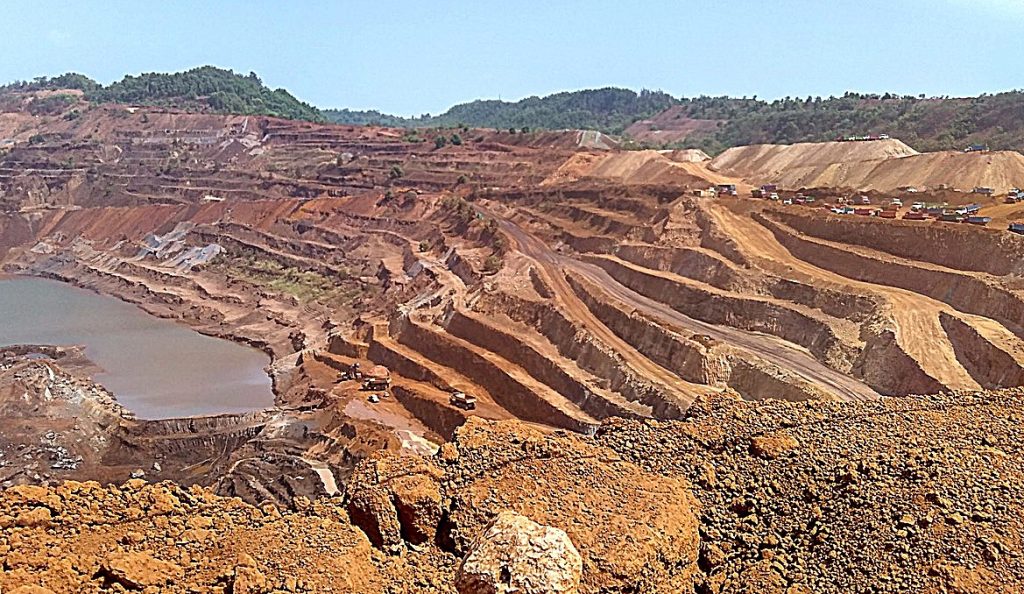
BUT the power of the mining lobby pushed political forces, after the closure of the mines in 2012, by the Supreme Court. In 2025, mining has resumed with regulated auctioned leases and stricter environmental safeguards. Current regulations require mine owners to adopt sustainable practices for environment regeneration of the disused mines. The Supreme Court continues to oversee the project to ensure that the lessees comply with both environmental and mining laws. Today’s production value at 773 crore (Jan 2026) is far below the hey days when there was unchecked extraction.
Mining in Goa is however a political game. With the saffron party at the helm of the state, the government is pushing hastening the increase of auctions and mining leases. The political payoffs are in terms of donations and payments through the now defunct scheme of electoral bonds. For the years 2009-2013, the BJP received 21 crore as electoral bonds, the biggest contributors being the Salgaocar and Dempo groups.
MINING LOBBIES
OTHER parties such as the Congress and the local outfits such as the MGP and other national parties such as the CPI and the CPM also received smaller amounts. For the mining lobby realises that without political patronage, and support, this important part of the Goan economy would not be able to survive.
Mining in Goa continues to play an important part for the various stakeholders, the Goan mining families, the politicians and the mine workers, and the various ancillary industries that are dependent on the extraction of ore. Today, however, with environmental concerns, Goa is slowly realising the ecological nightmares that this paradise faces!
 LETTER TO THE EDITOR FOR ISSUE DATED APRIL 11, 2026
 DOUBLE ENGINE GOA GOVERNMENT DANCES TO ADANI TUNES!
 WHO IS FIXING THE SKY? The billionaires, the cops in SUVs, and the missing trees! By Raaisa Lemos Vaz
 UPHEAVAL OF THE SUSEGAAD!By Sumaiya Khan
 DEVA VANI DHRUPAD: Alchemy of Sound, Silence and Sanctity!By Prema Viswanathan
 AT LEAST HOSPITALS CAN OFFER MILLET ROTI AND KICHADI!
 WHEN DO WE NEED PALLIATIVE CARE?
 GODI MEDIA TRUMPS TRUTH IN WAR & PEACE!
 World Health Day 2026: TOGETHER FOR HEALTH – STAND WITH SCIENCE! By Dr Amit Dias, MD
 FCRA AMENDMENT WILL ENABLE GOVT TO TAKE OVER PROPERTIES!By Olav Albuquerque
 WEEKEND UPDATESLETTERS TO THE EDITOR FOR ISSUE DATED APRIL 04, 2026
 REAL ESTATE BARONS OF GOA!
 THE SLOW VANISHING OF GOA’S GOLDEN BEACHES! By Raaisa Lemos Vaz
 WHO IS EXTRACTING GOA’S GROUND WATER? By Supriya Vohra
Goa is abuzz with excitement as vintage bike and car owners, users, collectors and fans are decking […]