Goa is abuzz with excitement as vintage bike and car owners, users, collectors and fans are decking […]
Old is Gold
October 4, 2016
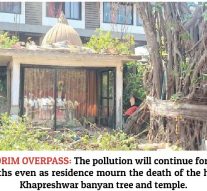
IF you’re ever unfortunate enough to board the bus from Mapusa to Panjim, you will hear through a haze of dust, the conductor blowing his whistle and shouting: “Wada-Kade.”
Physics teaches us that sound cannot travel through a vacuum. Yet the conductor’s shout somehow travels through one. Because today, there is no wad there.
In the place of the 200-year-old Khapreshwar banyan tree, there stands a 4-storey showroom. Yet you will never hear the conductor say, “Showroomakade.”
Renowned poet Manhoar Rai Sardessai called Goans “world-wanderers.” For a state with a large diaspora, this connection between people and land is unusually strong. It persists only because our eco-spiritual culture is deeply rooted in the landscape.
In Ponda taluka, there exists a deity called “Amarekar” who is supposed to reside in a sacred mangrove forest and preserves the khazan lands of Madkai. Other Raakhondaars exist at every village boundary. People across religions respect them and their sacred groves.
Goans proudly proclaim their village of origin; we are Cuncolkars, Panjekars, Nuvemkars, Moidekars, Valpoikars, Canaconkars. It is the land itself that gives us the right to claim these titles. It is the land that makes our identity tangible.
When this land is converted at an unthinkable pace, a dissonance begins to ripple through our generational heritage.
Showrooms replace the groves of raakhondars, malls replace wetlands, mega-housing projects replace paddy fields, villas replace hill slopes and Casinos occupy irrigation command areas.
The fact of the matter is that we have already lost many ecological and cultural treasures. The question is, what is left to lose and why it is imperative that we act now.
WHAT REMAINS TO BE SAVED
BEFORE we discuss the destruction that several new laws have caused, it’s important to take stock of what remains. Goa is indebted to regional planning. In 1986, we became the first state of the nation to set aside large areas for no development. In 2009 the draft regional plan locked 82% of the 3,700 square kilometers of land under various eco-sensitive categories including: No development slopes, natural covers, paddy fields, cultivable lands, and orchards. Between draft to final, certain orchards changed into settlement land. However, Dr Solano da Silva’s research indicates that till 2019, around 78% of Goa remains protected.
It is imperative that these lands remain untouched and unbuilt for the future. Perhaps a few orchards could be opened up for a pressing need. But the kind of projects that have taken the shelter of Section 39A, and its predecessor, spot zoning policies, do not address any need. Most of them appear to be second homes, luxury villas, or tourism projects. Just take a look at the projects that have started advertising. Abhinandan Lodha’s One Goa project is trying to sell 100 square meter plots for one crore. DLF’s Bayview is selling 4-BHK Villas for 40 crore.
THE WATER IS RISING, DON’T BOTHER HOLDING YOUR BREATH
WHAT Happens when you build in eco-sensitive zones?
The closest example of this is the Wayanad tragedy in Kerala which occurred in similar conditions to those found in Goa. A major cause for the landslides was unchecked construction in high ranges in Wayanad and Idukki.
The Western Ghats Ecology Expert Panel, 2011 under Madhav Gadgil, had recommended that 75% of the Western Ghats should be declared an environmentally sensitive area. This recommendation was not implemented.
In Bicholim, villagers and their BJP MLAs are suddenly worried that the reopening of the Sesa-Vedanta mine will de-stabilize the ground below Mulgao and Shirgao villagers’ homes.
Mining increases the chance of landslides and is a major cause of pollution of surface and groundwater resources. This has spelt complete agricultural ruin for villages in the past.
While water scarcity has become a potent issue in Goa, it has been found that the Mopa Airport sits atop a plateau that contains more water in the ground than there is in the Anjunem Dam.
Construction in forested areas has disrupted wildlife corridors and animals like leopards are finding their way into human habitation.
The most important symbiotic ecosystem in Goa is the khazan lands. Mangroves around their periphery prevent flooding and hold the soil together. The khazans also house the sleek-backed otters, who are bio-indicators of the river ecosystems.
Despite this, the data for the presence of khazans is not recorded by any government body and blatant antagonism towards law takes place when these lands are declared fit for construction of mega-housing projects.
In many other ways like these ones, we are losing our privilege to say that Goa is a disaster-free state.
SAVING SUNAPARANT
YEARS ago, Manohar Rai Sardessai wrote the following lines:
“In this famed state of Sunaparant
Something has gone wrong,
For a handful of cash
We have sold our soulful song.”
Those words feel painfully relevant today. But the soulful song still rings out in Goans’ hearts.
It echoes every time someone files an RTI. It echoes when villagers question decisions in a Gram Sabha. It echoes in protests at Azad Maidan and in debates within the Assembly.
Goa is still a blessed land. Much of its ecological wealth remains intact. But protection will not happen automatically. It depends on citizens who understand what is at stake and are willing to defend it.
Awareness is the first step. Participation must follow. Because if Goa is to remain Bhangarache Goem (a golden land), its people must ensure that what remains is not quietly lost.
“Xet asa te Xet, Bhatt asa te Bhatt, Raan asa te Raan”
Jai Hind, Jai Goa
(With inputs by Tahir Noronha)
 LETTER TO THE EDITOR FOR ISSUE DATED APRIL 11, 2026
 DOUBLE ENGINE GOA GOVERNMENT DANCES TO ADANI TUNES!
 WHO IS FIXING THE SKY? The billionaires, the cops in SUVs, and the missing trees! By Raaisa Lemos Vaz
 THE POWER AND THE POLITICS OF MINING IN GOA!By Arvind Pinto
 DEVA VANI DHRUPAD: Alchemy of Sound, Silence and Sanctity!By Prema Viswanathan
 AT LEAST HOSPITALS CAN OFFER MILLET ROTI AND KICHADI!
 WHEN DO WE NEED PALLIATIVE CARE?
 GODI MEDIA TRUMPS TRUTH IN WAR & PEACE!
 World Health Day 2026: TOGETHER FOR HEALTH – STAND WITH SCIENCE! By Dr Amit Dias, MD
 FCRA AMENDMENT WILL ENABLE GOVT TO TAKE OVER PROPERTIES!By Olav Albuquerque
 WEEKEND UPDATESLETTERS TO THE EDITOR FOR ISSUE DATED APRIL 04, 2026
 REAL ESTATE BARONS OF GOA!
 THE SLOW VANISHING OF GOA’S GOLDEN BEACHES! By Raaisa Lemos Vaz
 WHO IS EXTRACTING GOA’S GROUND WATER? By Supriya Vohra
Goa is abuzz with excitement as vintage bike and car owners, users, collectors and fans are decking […]