Goa is abuzz with excitement as vintage bike and car owners, users, collectors and fans are decking […]
Old is Gold
October 4, 2016
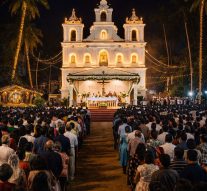
The shape of Christmas has changed in Goa. Even as it gets wrapped in a commercial layer, its underlying message of familial bonding and salvaging spirits seems intact…
By Praveena Sharma
CHRISTMAS is just a week away but where’s the Christmassy feel and energy? You can hardly feel them in your home or in the lane you live. They have moved to shopping malls, hotels, clubs and every place commercial.
Once upon a time in Goa, as soon as December would roll out, every home would be abuzz with frenetic excitement and filled with delicious aromas, as preparations for Christmas would kick off. Women spent hours in kitchen rustling up treats for the Christmas platter “kuswar” consisting of bebinca, bolinhas (coconut-semolina cookies), nevreos (fried pastries), baath (rice-coconut cake), dodol (coconut fudge), kulkul, mandares (rich chips) and other fritters.
Young Goans would band together for house-to-house Christmas carolling, singing songs on their guitars, violins, and drums, filling the air with festive cheer, and lifting everyone’s spirits. Houses and Christmas trees would be lit up with decorations, bright lights and stars dangled at the entrance of every home.
The wintry air would be crisp, and the beaches glistened with seashells – some powdered, some broken into small pieces and some intact. Christmas cribs or nativity scenes – depicting the birth of Jesus – would come up in one of the corners of the home or street. Children took the opportunity to display their artistry and crib-hopping was one of the many joys of the festival.
On Christmas day, the multi-course spread on table would be lavishly elaborate with sorpotel (stew or meat gravy), pork vindaloo, fluffy sannas (rice cakes), seafood and stuffed roasts. All of this to be washed down with homemade syrupy Port wine or simple grape wine, made from black grapes, sugar, spices and yeast.
All this would infuse Christmas magic into the air, which was then unpolluted. Every Goan old-timer misses that unadulterated Christmas – the time when Air Quality Index (AQI) hardly ever went up to over 50 or when one could breeze through the streets and never get caught in traffic jams or when one could hear church bells chiming across the paddy fields and houses.
Illustrator, former footballer, and adman Alexyz – mononym for Alex Raphael – feels the throbbing change in Goa every day, and the feeling gets accentuated during Christmas time.
“Times have changed now. Christmas is no more as much fun. It has become very commercial and a money-making racket. People take advantage of the festive season to make money. It used to be all about bonding with family,” he said.
As much as the change is stultifying, Alexyz feels relieved some of the little charms of old-time Christmas are still intact. For one, he said some families continue to come together for the Christmas feast.
The renowned artist from Siolim, who was bestowed with the Life-time Achievement Award for his contribution to journalism on the National Press Day (November 17) this year, said his daughter would be coming home from Mumbai for Christmas.
He fondly reminisced the Christmas cribs, mid-night masses and easy banter over hot coffee in the chilly December air. He felt grateful they had not yet disappeared.
Even as he spoke, a video of a crib on a footpath near St Joseph School in Aquem was going viral with accusations that it was blocking the way. Many saw it as a malicious attempt to incite religious conflict in the area for political gains in the Zilla Parishad election on December 20 in Goa.
Back in the day, religious harmony was the cornerstone of Christmas, or for that matter any festival, celebration.
Karen Dias, who works with a Singapore-based marine compliance firm from Goa, also feels bonding during Christmas has come down in a big way.
“My dad says there was a lot of visiting (to each other’s homes) back then. You would visit people and everybody would give you homemade sweets. He says, nowadays, that has reduced. So, if it was 90% before. Today, it is probably 20-30%. Most people buy sweets from the same few shops and so you’re eating the same thing at everybody’s house,” said Dias.
Amongst the things her father told her about Christmas in olden days, what got stuck in Dias’ head was the elaborateness of festivity and the preparation that went into it.
“They (women) would make all these special sweets and dishes. It was like an unspoken competition, where they wanted to be the best. This got stuck in my head,” she said.
As demand for readymade sweets surge, Dias says Bebinca made by Panjim’s Lucinda is most sought after. Some of the places people queue up to buy Christmas treats in Panjim are Tea Centre, Confeitaria 31 De Janeiro, Mr Baker and others.
For Dias, Christmas was also about post-midnight mass dance. Though, she’s not done that since Covid.
“Midnight mass starts around 12 and gets over on 1 or 1.30 am. After that, most Goans go for dance somewhere and dance in the night away. I haven’t been for this (dance) since Covid. Till then (Covid), it was very common. Even now, I am sure it must be. It’s just that I have stopped going,” she said.
Dias says “traditionally” one of favourite places for post-midnight-mass dance was Emerald Lawns in Parra. Revellers in Panjim would head to Gasper Dias while Gawin’s in Verna was popular in South Goa. Goans do not throng the beaches during Christmas.
It’s the tourists who crowd the beaches during Christmas. “No Catholic would like to go to the beaches. They would probably go either home or for a dance or both but less likely to go to the beach at night,” said Dias.
Going there would be just like any other day; “there’s nothing unique about going to the beach”.
Fr Mousinho de Ataide, priest, writer, and activist, who has translated liturgy written in Portuguese to Konkani, said Goan Christians now do not attend the mass passively but are more participative after translation of rites in Konkani.
He said the festival in Goa is no longer called Christmas; “we officially call it Krisht Jayanti because it is the birth anniversary of Jesus Christ.
“At the church, there is preparation of four weeks. It is spiritual preparedness – purification of mind and heart. Then, afterwards, on (December) 25th night, it (Christmas) is celebrated,” said the priest.
As Christmas fervour floats across the State, in one part of the Goa, Donald Fernandes, who runs Street Providence – destitute home for poor – gets busy preparing destitute ladies for a cultural event during Christmas every year.
“We are having a program for destitute ladies from our (shelter) home. It is only for ladies, not for men, because we can’t manage both at the same time,” said Fernandes.
At the event, organised on December 18 in Porvorim, women put up a play and their needlework was distributed to those who attended it. Fernandes has been doing this every year during Christmas festival to bring cheer to destitutes housed at his shelter home.
Like him, so many others in Goa get into the spirit of Christmas, no matter how hard things may be – All Because It’s Christmas Once Again.
 LETTER TO THE EDITOR FOR THE ISSUE DATED MARCH 21, 2026
 LOOK BACK IN ANGER, LOOK AHEAD WITH RESOLVE!By Gautam Patel
 OUR WOUNDED MANDOVI RIVER MAI! By Raaisa Lemos Vaz
 GARDEN SUBURB TO MONSTER TOWERS…Chembur then and now!
 PROTESTS PART OF GOAN DNA!
 `FISH CURRY AND RICE’ FOR GOANS
 OF IT IS GUDI PADWA…
 MIRABAG DAM WORK HALTED!
 THE WAR AGAINST TB Yes, we can end TB… By Dr Amit Dias
 70 ILLEGAL STRUCTURES USURP PRIME BEACH SPOTS FOR ILLICIT AIMS!By Dr Olav Albuquerque
 WEEKEND UPDATES
 LETTERS TO THE EDITOR FOR ISSUE DATED MARCH 14, 2026
 TOWERING INFERNOS OF GOA COMING!By Raaisa Lemos Vaz
 MIRABAG GIFTED TO ADANI!
 DEPOSITS REFUND SCAM!WHO BENEFITS FROM THE RS 10.. By Misbah Quadri
Goa is abuzz with excitement as vintage bike and car owners, users, collectors and fans are decking […]