Goa is abuzz with excitement as vintage bike and car owners, users, collectors and fans are decking […]
Old is Gold
October 4, 2016

These retreats that are run in the shadows and under the radar need to be regulated to bring about more transparency in their operations
Did you know intimacy can be a commercial commodity? If you go by ads on bookretreats.com, it could cost you over Rs5 lakh to experience intimacy at an 8-day retreat in South Goa.
The retreat website shows booking rates for intimacy and tantra – techniques and rituals for meditative and sexual practices – packages range from Rs20,000 to over Rs10 lakh for 3-day to 8-day programmes in Goa.
Far from Goa’s touristy buzz, a small and exclusive group of foreigners and Indians register themselves for a different kind experience, involving mindful touch, sensual massage, tantric practices, yoga, breathwork, guided meditation and relationship workshops.
These are intimacy and tantra retreats with different themes– reignite love and reconnect couples, spiritual tantra couples, private spiritual tantra couples, divorce recovery and breakup healing, celestial union couples and so many others.
Their organisers, often referred to as hosts, plan these events for small groups of high net worth individuals (HNIs) – between 10 and 20 people – in luxurious settings of resorts or private properties.
They prefer to mostly stay in the shadows, away from the crowds and the piercing gaze of outsiders, by creating temporary blackholes that suck them into it. Like the dark side of the moon, many of these retreats remain largely unseen and hidden.
Not many in Goa are aware of this bubble-like existence of theirs. Intriguingly, not even the police.
“I’m hearing for the first time about these kinds of retreats,” said a Goan cop, when queried on whether such gatherings, where people pay to attend, have come to the notice of the State police.
Speaking on condition of anonymity, the cop said such commercial events cannot escape the illegal and vigilance or social media monitoring centres of the police; “they (paid events like intimacy and tantra retreats) invariably get flashed to them (the respective police cells).”
Over the past decade, Goa has emerged as one of India’s most prominent hubs for intimacy, tantra, and relationship-healing retreats. Once associated mainly with backpacker spirituality and alternative lifestyles, these retreats are transforming into structured, high-value wellness offerings aimed at global and urban Indian clientele.
Bosco George, who retired as deputy inspector general (DIG) of police, said one of the reasons these retreats go under the radar is because very few people participant in it. The other reason was their compulsion to be discreet.

“It’s just like holding a conference in a hotel or a resort or a gathering on a private property. They don’t even use loudspeakers. Just some soft music is played. These could be the reasons which allow them to get away from the requirement of getting permission, approvals, or licenses,” he said.
Arunendra Pandey, founder of NGO Anyay Rahit Zindagi (ARZ) – meaning life without injustice, views some of goings-on at intimacy and tantra retreats as “commercial sexual activities” and “possible violations of central and local laws”.
“We feel all possible laws are violated – whether local or central. They are not just Indians but even foreign citizens (who register for retreats),” he said.
Pandey wondered how were incomes and transactions from such events being reported with domestic and overseas tax authorities.
“I don’t think any goods and services tax (GST) or tax deducted at source (TDS) is being paid on whatever income they (organisers) generate. If they are organising events and have foreigners coming for them, they need to inform authorities how they are taking money from foreigners. They are also advertising on social media and websites. Do they have bank accounts to receive money from clients, especially foreigners,” he elaborated.
A lot of these retreats were also conducted events on foreign shores like Thailand, Indonesia, Cambodia, and other such countries. According to Pandey, this may necessitate registering with foreign regulatory agencies to operate in those countries.
Preliminary information collected by Pandey’s ARZ on these operations reveal very few Goans were involved in intimacy and tantra retreats. They are mostly run by North Indians, especially operators from Haryana and Madhya Pradesh. He did not rule out the hands of foreign players in them.
An interesting finding that has come to fore is women are as much a part of intimacy and tantra retreats as men. Low entry barrier, lucrative returns, and growing demand have seen these retreats mushroom in Goa.
There is no officially published data on growth of intimacy or tantra retreats in Goa as they are not regulated and therefore not mandated to report to any regulatory authority. They broadly fall under the wellness and tourism umbrella. Therefore, their growth could be reflected in the growth trends of wellness and tourism figures.
As per International Market Analysis Research and Consulting (IMARC) Group, India’s wellness tourism market was valued at around $19.4 billion in 2024 and is projected to reach around $29.9 billion by 2031, growing at 6.4% compound annual growth rate (CAGR).
The same research agency claimed yoga and retreats alone made up 37% of the wellness tourism in 2024. Intimacy and tantra retreats seem to have piggybacked on demand growth for wellness tourism.
Their growth may also be mirrored in overall jump in tourist arrivals in Goa, which grew at 10.5% in the first half of the last calendar year compared to the same period in the previous year. The most suggestive data would be sudden jump in foreign tourist inflow into the State at 29% last year.

It could possibly be linked to intimacy and tantra retreats, which have high attendance by foreigners. Another telling data point is from Retreat.Guru, an aggregator of retreat programmes from organisers worldwide.
The retreat aggregator’s online director shows listing of around 105 tantra and couples retreats in Goa compared to smaller numbers of other tourist destinations like Himachal Pradesh (20) and Kerala (13).
“These retreats practically need no investment. Everything is arranged at local level. It is a well-oiled corruption machine. There is always a local person, who helps in this,” said Pandey.
He said they are unregulated and this makes it difficult for police or other regulatory bodies to initiate action against them; “keep in mind unless any violation is brought to the notice, there cannot be any legal action. They (retreats) could be hiring women to swim with guest in the swimming pool. This is what I have heard is one form of meditation or yoga asana. Then, nude hugging and female or male removing clothes and sleeping on another person. They say these are some kind of yoga asanas. But if there is exchange of money for it then it is a violation”.
Pandey said even if such activities are consensual but if it’s paid then people can be booked under law because it is perceived as commercial sexual activity, which is a crime; “they can do it without paying. If they are paying it becomes an offence. And, it is an offence not just for the two persons involved in it but also the owner of place where it is carried out. The place is taken as brothel and the person who organised it as pimp”.
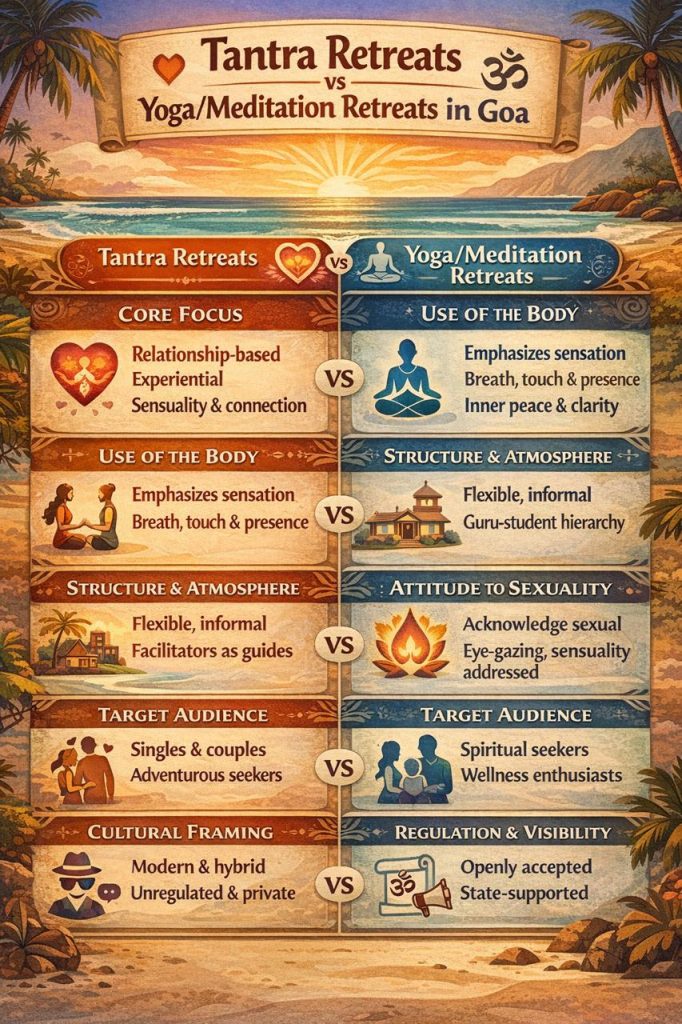
The NGO founder said if it is commercial activity, permissions or licenses need to be acquired, even if it is a retreat. If it is brought to the notice of police, they can act against them. However, it becomes very difficult distinguish between authentic yoga and meditation centres and those running a commercial sexual racket in the name of intimacy and tantra retreats.
Pandey said these retreats are patronised by businessmen and senior professionals. There are many cases of rich housewives also being part of them. Till now, his ARZ has not received any complaint against these retreats.
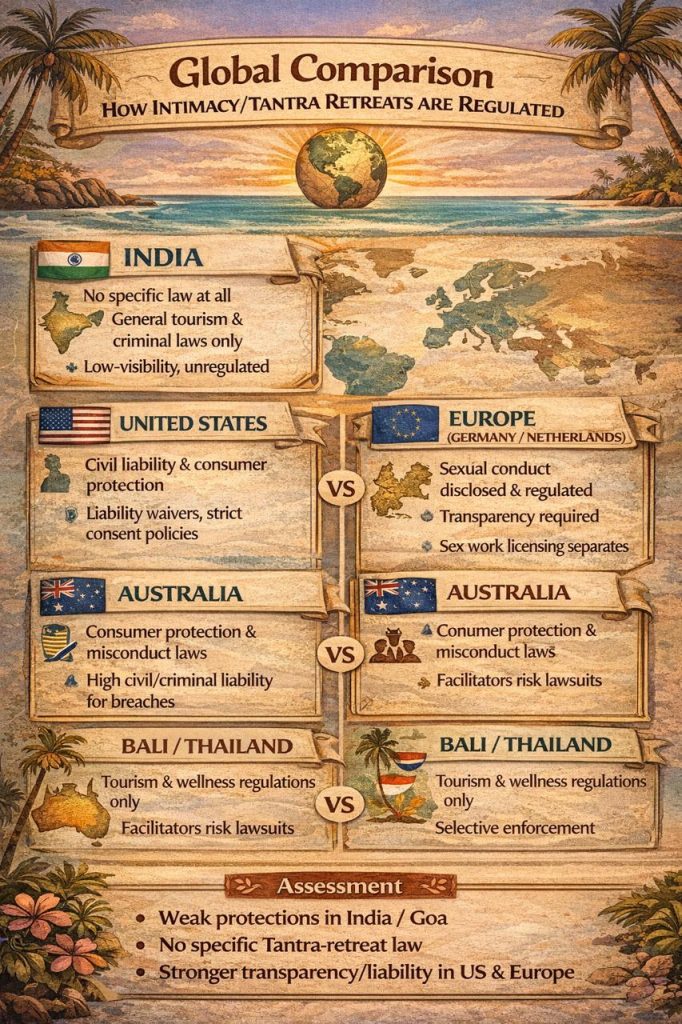
Currently, India has no specific law regulating intimacy and tantra retreats. There is no statute defining what these retreats can do or cannot do. There is also nothing on licensing and operational norms that they need to follow like other tourism operators.
However, they do come under general laws, which requires them to follow practices involving touch or interpersonal activities that demand mutual consent and respect for individual rights.
In some ways, they also come under tourism regulations, which would require them to comply with tourism licensing and local municipal rules, fire safety, accommodation licensing, and general consumer protection standards.
They can also come under the purview of criminal laws if their activities are construed as prostitution or sexual exploitation. In such cases, The Immoral Traffic (Prevention) Act (ITPA) that prohibits solicitation, pimping, or organised prostitution can be applied.
Also, acts that involve minors or coercion can be taken as illegal under Indian criminal law.
There are some industry self-regulations that exist in international tantra organisations, who have codes of conduct and ethical standards for teachers and facilitators that include respecting participant consent, adhering to local laws and maintaining professional boundaries.
These are voluntary and not legally enforceable by the government, but they create standards within the community.
Other general laws that could come into play include contract law (refunds, liability waivers), consumer protection (truthful advertising), information technology (IT) law (if retreats share intimate workshop imagery) and criminal code (offences related to sexual acts in public, obscenity, and trafficking).
David Gower, former English cricketer who founded the Ambrosia organic farm, said such retreats can help people, who feel lost, to find themselves.
“Intimacy has nothing to do with an individual. It is more to do with people around you. He said tantra retreats had the ring of Bhagwan Rajnish’s organisation, which was about getting intimate and tantric practices,” he said.
Whatever these retreats are all about, they need to be brought on the radar so that they can be regulated and made more transparent.
“Concerned authorities need to take notice of them and investigate what kind of activities are being carried at these retreats, who is funding them, do they have licenses and approvals to carry out their commercial activity, are they filing returns on their income. All these need to be done. We have a cell called special branch that collects underground information. They need to investigate it,” said the cop, who did not want to be named.
 LETTERS TO THE EDITOR FOR ISSUE DATED APRIL 04, 2026
 REAL ESTATE BARONS OF GOA!
 THE SLOW VANISHING OF GOA’S GOLDEN BEACHES! By Raaisa Lemos Vaz
 WHO IS EXTRACTING GOA’S GROUND WATER? By Supriya Vohra
 PLANNING FOR RETIREMENT THE GOAN WAY! By Arvind Pinto
 WHEN `HOLY WEEK’ COMES LONG
 HPV Vaccine: PROTECTING INDIA’S DAUGHTERS FROM CERVICAL CANCER!By Dr Amit Dias, MD
 NO MORE PROTESTS AT AZAD MAIDAN?
 CURCHOREM SEX SCANDAL: Will the police really take action?By Olav Albuquerque
 WEEKEND UPDATESLETTER TO THE EDITOR FOR THE ISSUE DATED MARCH 28, 2026
 GOA’S GILDED HIGH RISE SLUMS!By Raaisa Lemos Vaz
 DIRTY TOWERS OF GOA!
 UNCLEAN WATER, CARRIER OF DISEASE! By Dr Amit Dias, MD
 LOOKING BACK AT GOA IN 60S! By Arvind Pinto
Goa is abuzz with excitement as vintage bike and car owners, users, collectors and fans are decking […]