Goa is abuzz with excitement as vintage bike and car owners, users, collectors and fans are decking […]
Old is Gold
October 4, 2016
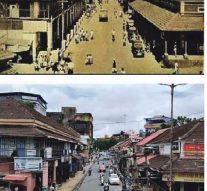
There was a time not very long ago when Goa was a peaceful paradise without tourist either foreign or domestic, and the capital city Panaji did not face any traffic jams or parking problems.
IT is now history. On December 1961, Goa was annexed by the Indian state in Operation Vijay. While most Indians celebrated this as Liberation, many of the older generation of Goans who lived during the colonial era, believed that they had seen better days. They still talk of the days when there were no “bailo munis” and where everyone knew each other, where you asked a person his or her name, and you knew from which village they came from. They reminisce of the days, when Goa had a green cover if one looks down from the sky, Where if a coconut fell it would hit a pig, since there were no many of these scavengers around the villages. People still talk about the climate that was cool evening in summer and the chill of the winters, when the morning mist covered the village, until the sun came over the horizon. Many of the older generation believe that Goa has indeed progressed from the secluded paradise that it once was to a change that is too fast and too sudden!
When the tiny colony of Goa came within the Indian state in 1961, after the initial euphoria of freedom, one of the political issues that the people faced was whether to remain independent or merge with either Maharashtra or Karnataka. For these two states enclose this tiny enclave from the northeast and south. Like vultures eyeing their prey, both these states were looking at annexing this little region and make it one of their districts. Karnataka lost on early since it did not have the political connections, although the then railway link when through Castle Rock in Karnataka. Maharashtra on the other hand had a better stake since the Maharashtra Gomantak Party headed by Dayanand Bandodkar had close connections with the Maharashtrian political class. Later it was learned that Bandodkar had promised the Maharashtrian politicians that it was only a matter of time that Goa would be the southern district of Maharashtra.
INDIA’S ONLY REFERENDUM
IN the only referendum held in the country, in Goa in 1967 the people of Goa voted to remain independent. This was due in a large measure to the United Goan Party – now defunct, and to the active involvement of several academic and literary personalities who believed that Goa had its unique identity that would die with any merger with Maharashtra.
During this agitation, one of the important aspects of discussion was the unique identity of Konkani as the language of Goa. Language was indeed one of the unifying factors in Goa. Unfortunately, over time, Konkani has been marginalized and more or less neglected. Associated with the language was the “tiatr” or prolific Konkani theatre scene. These theatre groups would tour villages and come sun-down these groups would entertain villages, with their plays. Like Konkani, tiatr is also on the decline. Many of the younger generation sadly do not appreciate the subtle local native humor of tiatr. Further more the classical artists who played these roles do not have many of the younger players who have taken to this profession.
WHEN GOA WAS SUSSEGAD
BACK is the’60s and 70’s life in Goa was sussegad – where both shops and business offices observed cooler hours of operation; they worked during the morning half of the day, and most of the shop establishments closed for lunch and siesta at 1 or 2 pm, then opened around 4pm till late evening. The main urban centers were Mapusa in the north, Panjim the capital, Ponda in the east and Vasco, the port city, and Margao in Salette. Life was easy going with “camiaos” – the Goan term for the old buses that transported both passengers and goods and sometimes livestock from villages to urbanized towns, hardly cities as we know them now. The camiaos were the most popular mode of transport in Goa, since cars were few and far between. This transport service stopped by evening, since most of the village roads were mud roads and most people came back to their houses by sunset.
From the Terekhol in the north that forms the boundary between Goa and Maharashtra, to the Galgibag in the south, 11 rivers flow from the Western Ghats to the Arabian sea. The most prominent are the Mandovi in the north and Zuari in the south. Crossing these rivers required boats or rafts by villagers and traders. In the late 19th century, the then Portuguese authorities instituted the “camiao de passage” or ferry services. The ferry services across the rivers were indeed an interesting experience. The huge barges, carried not only people but also cars, buses, cycles, while merchants carried their wares to sell in the neighboring towns. The ferries were regular with one ferry leaving and the other arriving. At the ferry station there would be a local camiao which carried passengers to their destination in the interiors of the village homes.
Ferry crossing was one of the unique experiences in Goa. I still remember the days, when I would cycle to ferry station at Siolim to catch the ferry to Pernem. Sadly, many of these rivers are now traversed by bridges, and the days when ferries served as a means of crossing are now few. There is still a ferry between Panjim and Betim, Ribandar and Chorao, Keri and Tiracol. Ferry crossing is one of the unique experiences of Goa of old!
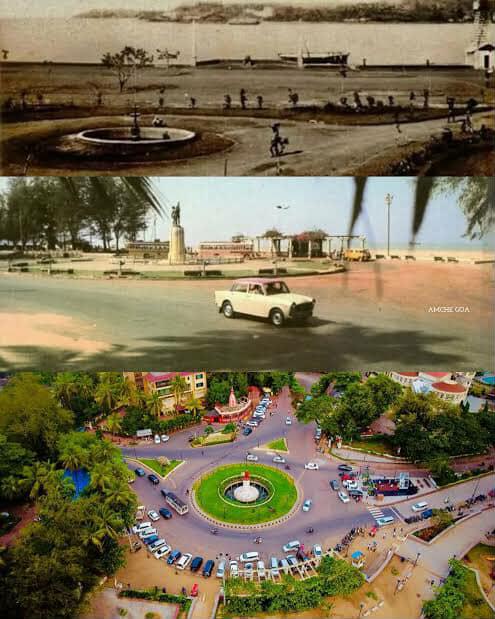
LIFE IN VILLAGES
WHILE most governmental activity was in the towns, Goa lived still does in its villages. Since transport was restricted to the camiaos, the village was the center of activity. Most of the bigger villages were divided into “vaddos” – like a ward. The vaddo is a cluster of houses where the families share a common ancestry, occupation or religious affiliation. Take my village, Siolim in Bardez, there were several vaddos, such as Baman vaddo – families of Brahmins, Porto Vaddo, Gaunsovaddo, Marna vaddo. The central space of the vaddo is the “madd” was where most of the villagers would congregate. The madd would be designated by the vaddo cross, a copel (chapel) or a temple, according to the religious affiliation of the vaddo. I remember as a child, during summer, the families of the vaddo would gather around the cross, candles lit and would recite the rosary or recite the ladainha – the litany for us children was the fun aspect of this for after the prayers there would be boiled chana diced with coconut chips, patoleo (rice cakes) and doce (coconut jaggery sweets). We would watch the men as they sat in a semi-circle, while a cop (cup) of feni would be passed around. Life in the Vaddo centered around the village, since communication was the newspaper that came a day late, and the radio in the house of the “badkar” (the landlord). In most villages, the badkar had the biggest house, since most of the lands around the village belonged to this family. Around the village were scattered houses of the “mundkar” or the tenants, whose houses were smaller than the badkar or batkar from whom they leased land for cultivation for the batkar. Often mundkar built their houses on land leased from the landlords. Over a period of time the Protection of Eviction Act 1975, gave mundkars’ right to remain in their dwelling and restricted the rights of the landlords to evict them.
Life in the villages were centered around either the temple or the church. In most villages, where the majority were Catholic, you would find families in their Sunday best walk to Church, while in a village where most of the villagers were Hindu, on certain festivals, the families would flock to the lit up temples. One of the interesting aspects of village life were the many religious fairs; for Catholics it would be the church or copel feast, while in villages surrounding the temples there would be the annual zatra, the traditional fair, in honor of the presiding deity, when the idol would be carried through the village in a “palkhi.” The festivals and fairs of both Catholics and Hindu were fun times; since it was the time when people from the surrounding villages congregated at the temple or church. The biggest of the Catholic festival is the Feast of St. Francis Xavier, who is considered the patron of Goa. Among the major zatra celebrations is the one at Shree Mangeshi Temple in Ponda or the Shantadurga Temple at Kavlem. In an agrarian society that was Goa, life revolved around religious festivals for all communities.
EASE OF ACCESS
OVER the decades post-Liberation Goa has evolved rapidly. Towns have urbanized into cities and they’re growing phenomenally. With the coming of the railway services Goa became accessible to a large part of India. Many from states across the country have found Goa an ideal state to settle for various reasons. With large scale migration into the state, there is a growth of migrant people requiring housing and other social needs. Further, the development of tourism has lured more people into Goa. Indeed, Goa has changed for the better and for the worse. The key question is are the changes for the better and for the larger good of a small, ecologically fragile coastal state like Goa? With awareness of the degradation that is happening all around today, Goans are now asking themselves: Is this the kind of change that we want?
 LETTER TO THE EDITOR FOR THE ISSUE DATED MARCH 28, 2026
 GOA’S GILDED HIGH RISE SLUMS!By Raaisa Lemos Vaz
 DIRTY TOWERS OF GOA!
 UNCLEAN WATER, CARRIER OF DISEASE! By Dr Amit Dias, MD
 THE ROAD WE STILL WALK: CONFRONTING CASTE ON VAIKOM’S ANNIVERSARY! By Prema Viswanathan
 WILL THE NEW ADVOCATES PROTECTION BILL STOP ATTACKS ON LAWYERS?By Dr Olav Albuquerque
 ABHINANDAN LODHA CONQUERS BICHOLIM
 IT’S `NIMBU-SODA’ SEASON!
 `Our Rights: Essays on Law, Justice and the Constitution’ by Dr Justice F I Rebello WHAT ARE YOUR RIGHTS?Most of us don’t even know!
 WEEKEND UPDATES
 LETTER TO THE EDITOR FOR THE ISSUE DATED MARCH 21, 2026
 LOOK BACK IN ANGER, LOOK AHEAD WITH RESOLVE!By Gautam Patel
 OUR WOUNDED MANDOVI RIVER MAI! By Raaisa Lemos Vaz
 GARDEN SUBURB TO MONSTER TOWERS…Chembur then and now!
 PROTESTS PART OF GOAN DNA!
Goa is abuzz with excitement as vintage bike and car owners, users, collectors and fans are decking […]