Goa is abuzz with excitement as vintage bike and car owners, users, collectors and fans are decking […]
Old is Gold
October 4, 2016
Reviewed by Tara Narayan
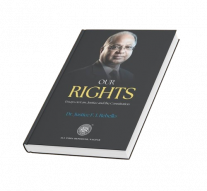
HOW many judges care enough to sum up how the justice system works in a democracy? Not many. Dr Justice FI Rebello (of the Enough is Enough movement fame in recent times) is a rare judge who thinks the people must be educated about their rights in their own interests, so that no government may take them for a ride of their lives – be it a democracy or a failing democracy. Hence, the need for his very enlightening book “Our Rights: Essays on Law, Justice and the Constitution” (an All India Reporter, Nagpur publication). The now retired Justice Rebello’s book is considered as a treasure house of case laws since 1911 and Chief Justice of India B R Gavai in his Forward to the book praises the book saying the author in his book affirms that “law is not merely a tool for governance but the moral architecture of a diverse nation.” The book is a significant and incisive analysis of India’s jurisprudence and observes Justice Gavai, “He has been candid in his criticism of my view on the creamy layer exclusion, and he is, of course, fully entitled to do so. Such reasoned disagreement lies at the very heart of our constitutional democracy.”
Even for a lay reader this is most un-didactic book and easily comprehensible, even exciting. Justice Prasanna B Varale in his Message well draws our attention to the fact that the “Indian Constitution is not merely a legal document – it is a living moral compass, a charter of transformation that aspires to shape the soul of the Republic. As we navigate the changing contours of governance, economy, and society in the 21st century, the relevance of constitutional principles and human rights become more urgent than ever…”
AMIDST the silence of the midnight hour of 14th August, 1947 and the birth of a new day, a day and time chosen to balance the wisdom of the old and scientific temperament of the new, an ancient land with a marked tendency for disintegration as evidenced by history once again found its soul and took its rightful and honoured place amongst the nations of the world, inspired and led by a naked Fakir, a lawyer by profession who fashioned a revolution unparalleled in the history of mankind. The escape of the Israelis from the Egyptian captivity aided by Divine Providence as revealed in the Old Testament or the birth of a new nation of Israel; the American war of independence or the ideological conviction that saw the October Revolution install a Government of Soviets and the formation of the Soviet Union, the long march which laid the basis for a Communist Regime in China pales into insignificance before the instrument of Satyagraha, which brought out the best in man: his moral courage, care for the common man, sharing his sorrows and love for fellow citizen. This was a legacy bequeathed by the Father of the Nation and which ought and should have been the foundation on which to rest and build the future of modern India.
Justice Rebello’s book is a collection of compelling articles under the interlinked heads of “The Golden Triangle of the Indian Constitution” and “Empowering the World through Human Rights Literacy.” Here is a learned judge and a human being who constantly appeals for “empathy in interpretation of law, inclusivity in implementation, and awareness as the bridge between right and remedy.”
Here is a judge who also perceives himself as an activist for the larger good of society and in his Prologue states that the articles in the book are courtesy his “experiences stemming from his involvement in various movements, which opened his eyes to the plight of the marginalized, the working class and the socially, and educationally backward class of citizens.”
If you’re looking for a very lucid education of the law as it works in a country like India, here is your book – it is invaluable reading for both students of law as well as the aam aadmi citizen, who is often at sea when it comes to matters of law and is easily intimidated by it. Understanding how the law will work for you in any situation is half the battle won or so to speak.
Altogether a fascinating guide to how the law works in India through the eyes of a most perceptive and humane judge, also a man of letters who is well read on subjects not necessarily to do with the law. Justice Rebello’s narrative is peppered with literary quotes as he has tempered justice with mercy in his career as a judge. Here’s a book by a judge replete with interesting and pertinent cases from which one may learn much both as just a reader taking an interest in the law, or as a student of law – undoubtedly, a whole lot of learned folk on the subject too will take pleasure in reading Dr Justice Rebello’s book. “Our Rights: Essays on Law, Justice and the Constitution” is an educative, entertaining and distinguished book to read, his canvas of cases and matters for discussion is vast and as a bonus it also captures the history of post-independence modern India.
About the Author
Justice Ferdino I Rebello is former Chief Justice of the High Court of Judicature at Allahabad, a position he held after a distinguished service as a Judge of the Bombay High court. Prior to his appointment as a Judge, Justice Rebello had a notable career that included serving as President of the Goa High Court Bar Association, an elected Member of the Goa Legislative Assembly, and a Lecturer at Salgaocar Law College, Goa. He was part of a Bombay High Court delegation studying U.S. Mediation Systems. Actively engaged in legal education, social movements, and sports, he has contributed extensively through articles, seminars, and legal forums.
Judicial Fault Line
AN independent, wise and learned Judiciary is the surest barometer of a vibrant democracy, which in turn means, a society in which the rule of law prevails. It is only in a democratic society, that courts can protect the citizens against arbitrary State action and their right to life and liberty. A society where fundamental rights constitutionally guaranteed, are protected by the Courts, is an assurance that all opinions can be articulated and voiced and a society where all sections including minority groups can express their opinion without fear of reprisals from majority or interest groups, would be a testimony to the judicial independence of our constitutional Courts, which since the birth of the Republic have been zealous guardians in protecting the right to life and liberty.
The proactive role of Judges in helping to promote poverty alleviations programmes, like the right to food, minimum wages for labourers, freeing bonded labourers, protecting the forest ecology and its communities, the coastal environment and ecology, the right of citizens to open places, the right of minority groups, women, children, linguistic or religious and the like has raised the people’s faith and expectations from the Judiciary. As the Courts perceive and see themselves as the guardians of citizens rights, they are increasingly questioning issues pertaining to social and economic matters and in the process an executive answerable to the court on all issues, sits over the decisions making process fearing the Court’s anger and resulting actions affecting their service careers. Result has been on several issues, much delay in Government decision making process. Let the courts decide, is what is heard in the corridor of government decision making process. On emotive issues, Courts have become the last chance chamber to douse the fires. The citizens therefore increasingly turn to Courts to espouse public causes and Redressal of public grievances. This in turn finds echo in the docket explosion that Courts are facing. With inherent difficulties in their own functioning on account of various reasons including infrastructure, shortage of judges, and lengthy and repetitive judgments on issues which are no longer res Integra’ withobiter dicta’ sometimes contrary to settled law by co-ordinate Benches, resulting in the Court’s finding it difficult to reconcile which judgment to follow, thus compounding the problem.
Time has come for introspection on the fault lines, in order that they can be connected, so that the Judiciary in the words of some does not deviate from its constitutional function of judicial review. Those of us who were part of the system must begin, by asking questions, to remind ourselves, as Chief Justice Anand observed “Our function is divine, the problem begins when we start thinking that we have become divine.” It is time for Courts to help, aid and assist the other organs of our dynamic constitution to function, rather than taking over the direction of administration from the executive. Courts rather than believing that their ever-increasing intervention is necessitated by the abdications by the executive of their duties must consider the fault lines in our approach to judicial review to enable the executive to discharge their functions.
This is not to say that the Courts should not intervene in case of palpable wrong doings or in matters of misuse of public funds by those in power for enrichment of self, friends or relatives in the absence of other corrective mechanisms. To be fair to the judges, the judges are not using the court to threaten the other wings. Assumptions of power not delineated in the constitution some times, is to restore constitutional balance because the executive and the legislature have themselves been engaging in extra-constitutional activities. On the other hand, must we not ask ourselves the question, why orders re passed which are expansive and many a time incapable of being complied, when there is no statutory law to enforce the directions. The Contempt Jurisdiction is no mechanism to enforce unenforceable orders. How long in the guise of directions are courts going to act as the third chamber which they are not? How long do we perceive or believe that the Courts are the best mind readers of the people’s needs and not the legislators, who have been elected by the people, The observations by Mark Twain that “members of the congress as the only truly native class of American Criminal,” is no answer in a society which values democracy and the rule by the majority, which may have its defects, for Courts to expand their jurisdiction. Any expansion of the power of the Court must require powerful justification.
An expanded judicial Review would inevitably limit the power of the more democratically responsive branches of Government in favour of the judiciary. It is in this context that the question must be posed. Must not Courts be slow to intervene in cases where they have neither the technical competence or realize the financial implications or long term consequences? Krishna Iyer J is a recent article in the Hindu’ observes “When the implications are too great to grasp and the consequences may be beyond repairs, “hasten slowly” will be a good piece of advice. Never assume that the robed wisdom that is good for jurisprudence will not land us in dangerous waters.”
Furthering constitutional principles has to be read in the context of the social dynamics of our society. This because the constitution, the basic law isorganic.’ It grows and even mutates with time. Constitutions therefore cannot be barricaded by reasoning which walls them This does not mean that the judiciary should enlarge its jurisdiction into areas within the province of the Executive and legislators. The powers and duties of each organ flows from the constitution. Our constitutional philosophy of justice – social, economic and political – can be best achieved, if all wings work to tandem, each recognizing the role assigned to the other. Incidentally, the U S Supreme Court ever since the `NEW DEAL’ legislation has given congress latitude in economic regulations.
In today’s discussion, as part of understanding Judicial Fault Lines, we will consider
A. Is speedy justice a myth in our courts?
B. Is expanding the scope of PIL jurisdiction justified?
C. Do we re-visit the appointment and removal procedure of the judges of constitutional courts?
 LETTER TO THE EDITOR FOR THE ISSUE DATED MARCH 28, 2026
 GOA’S GILDED HIGH RISE SLUMS!By Raaisa Lemos Vaz
 DIRTY TOWERS OF GOA!
 UNCLEAN WATER, CARRIER OF DISEASE! By Dr Amit Dias, MD
 LOOKING BACK AT GOA IN 60S! By Arvind Pinto
 THE ROAD WE STILL WALK: CONFRONTING CASTE ON VAIKOM’S ANNIVERSARY! By Prema Viswanathan
 WILL THE NEW ADVOCATES PROTECTION BILL STOP ATTACKS ON LAWYERS?By Dr Olav Albuquerque
 ABHINANDAN LODHA CONQUERS BICHOLIM
 IT’S `NIMBU-SODA’ SEASON!
 WEEKEND UPDATES
 LETTER TO THE EDITOR FOR THE ISSUE DATED MARCH 21, 2026
 LOOK BACK IN ANGER, LOOK AHEAD WITH RESOLVE!By Gautam Patel
 OUR WOUNDED MANDOVI RIVER MAI! By Raaisa Lemos Vaz
 GARDEN SUBURB TO MONSTER TOWERS…Chembur then and now!
 PROTESTS PART OF GOAN DNA!
Goa is abuzz with excitement as vintage bike and car owners, users, collectors and fans are decking […]