Goa is abuzz with excitement as vintage bike and car owners, users, collectors and fans are decking […]
Old is Gold
October 4, 2016
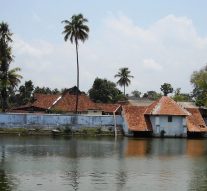
The afternoon sun in Vaikom has a way of making the white-washed outer walls of the Mahadeva temple glisten with a deceptive serenity. As I walked on the paved path surrounding Kerala’s famed temple complex, the air was quiet, broken only by the sonorous chime of bells and the soft rustle of leaves. Yet every step felt heavy with the knowledge that exactly 102 years ago, my presence here would have been a protected privilege, while another’s would have been deemed an act of “pollution.”
Entering the Vaikom Satyagraha Gandhi Memorial Museum nearby, the intimacy of the century-old struggle to end caste discrimination hit home. Looking at the archival photographs of the Satyagrahis—men and women who stood in waist-deep monsoon waters for months on end—history ceased to be a dry academic record. For a visitor from a Savarna background, these exhibits were a re-awakening. They forced a realization that the very ground I walked on was once a site of systemic cruelty, enforced by those who shared my lineage.
The Spark of Resistance
On March 30, 1924, this quiet stretch of road became the frontline of a moral revolution. While the Vaikom Satyagraha is often remembered as a struggle for temple entry, its primary objective was more fundamental: the right of every human being to walk on a public road.
While Gandhi provided the moral compass and strategic leadership for the movement, Vaikom was where his philosophy of non-violence met the raw grit of Kerala’s local reformers.
The movement was anchored by the vision of T.K. Madhavan, whose relentless advocacy of a casteless society and whose historic meeting with Gandhi brought the local struggle for dignity to the national stage. Alongside him stood K.P. Kesava Menon, the Kerala Provincial Congress Committee President, who led the first batch of volunteers to face arrest. Their 603-day siege against Theendal (pollution by approach) was a demand for the recognition of a shared humanity.
An Inclusive Fight for Justice
A unique chapter of this struggle was the Savarna Jatha (the march of the forward castes). Led by Mannathu Padmanabhan, hundreds of members of the dominant castes marched from Vaikom to Trivandrum to submit a petition signed by over 25,000 citizens. They marched to tell the Regent Maharani that they no longer wished to be the beneficiaries of a system that dehumanized a community. This was a rare historical moment where a group of people from the “oppressor” community publicly demanded the dismantling of their own privileges.
Women played a pivotal role in the fight against caste injustice. Nagamma and SR Kannamma, joined by many other nameless women, led efforts to break through police barricades on May 23, 1924, and enter the prohibited roads around the Mahadeva Temple.
It was a struggle that drew allegiance from different corners of the country. From the north came the Akalis from Punjab, setting up a community kitchen to feed the hungry. From the south came E.V. Ramaswami Naicker (Periyar), his voice thundering against the chains of tradition. Vaikom became the heart of India, proving that the struggle for justice is a burden that must be shared by all.
The Lunacy and the Light
In the late 19th century, Swami Vivekananda looked at the emerald landscape of Kerala and called it a “lunatic asylum.” It was a land where the geography of the road was mapped by the cruelty of the tape measure. To be a Nambuthiri was to own the air; to be a Pulaya was to be a ghost, required to vanish 64 feet into the foliage lest your shadow “pollute” a fellow human.
But even in the deepest night of the “lunatic asylum,” the light was spreading. It came first in the form of Arattupuzha Velayudha Panikkar, the Ezhava warrior who donned the robes of a Brahmin to learn the Vedas, proving that sacred knowledge had no DNA. It came through Ayya Vaikunda Swami, who told the oppressed to place a mirror in their shrines and worship their own image—to find the divine not behind a locked sanctum, but in the reflection of their own resilient faces.
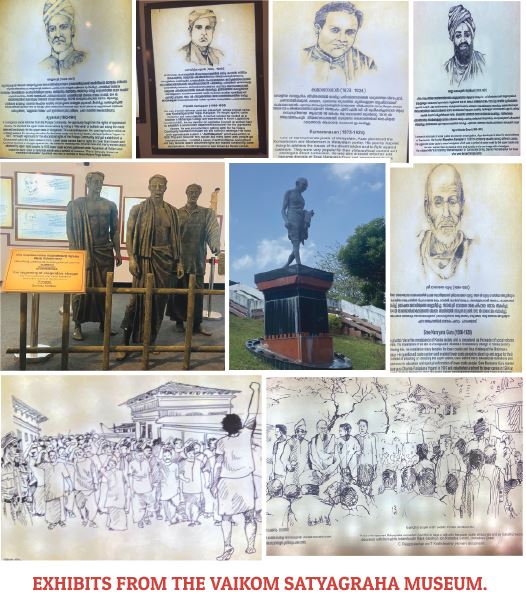
The Architect of One God
The museum honours the quiet, revolutionary gaze of Sree Narayana Guru. In 1888, at Aruvippuram, he didn’t pick up a sword; he picked up a stone from the riverbed and installed it as a Shiva idol. It was a silent earthquake. By creating temples for those denied entry into existing shrines, he challenged the very monopoly of the heavens. His motto—One Caste, One Religion, One God—did not just seek reform; it sought a total reimagining of what it meant to be a human being in the presence of the infinite.
Beside him in this tapestry of resistance stands Ayyankali. Imagine the audacity of this amazing fighter way back in 1893: a man from the Pulaya community riding a Villuvandi (bullock cart) through the streets of Venganoor, bells jingling, defying the law that reserved the road for the “upper” castes. Ayyankali understood that dignity is often a physical act—wearing headgear, covering one’s bosom, or refusing to work the fields until a school door was opened for a child of the soil.
A Laboratory of Truth
When the Satyagraha finally began on March 30, 1924, it was the first time the Indian National Congress, under the direct leadership of Gandhi, applied the tool of non-violence to the internal rot of the caste system. Vaikom became the testing laboratory for Satyagraha in India, a method the leader had successfully forged in South Africa.
The museum brings us face-to-face with the first volunteers: Kunjappi, Bahuleyan, and Govinda Panikker. There they stand, recreated in bronze, behind a wooden fence. They represented a trinity of castes—Pulaya, Ezhava, and Nair—standing together as a singular wall of tolerance. For over six hundred days, through the blistering sun and the monsoon floods, the protest endured.
The Heart-Touching Moments
The museum does not shy away from the pain. It records the Dalawakkulam incident, where young men who tried to enter the temple were suppressed with such brutality that their blood was said to have coloured the temple pond. It records the lackadaisical replies of a government that claimed it wasn’t aware that untouchability signs caused “agitation.”
Yet, alongside the pain, the museum also records the poetry. Kumaran Asan, the poet of the oppressed castes, turned his verses into weapons. He didn’t just write about flowers and lakes; he wrote about the “downtrodden” with a philosophical fire that inspired a generation to break their stone chains—the Kallumala—and demand their place in the sun.
A Continuing Journey
The resolution of November 1925, yellowed with age, marks the moment the roads to the Vaikom temple were finally opened. It was the preamble to the more comprehensive Temple Entry Proclamation of 1936. Vaikom proved that Gandhi’s vision of non-violence wasn’t a sign of weakness, but a “novel protest with incomparable tolerance.”
As you leave the museum, passing the statue of Gandhi looking out over the town, you realize that the Vaikom Satyagraha was more than a victory for the oppressed castes. It was a liberation of society as a whole. It taught us that as long as one person is denied the right to walk a public road, no one is truly free.
The museum is not just a collection of artifacts; it is a repository of courage. It reminds us that the road to equality is long, often blocked by the barricades of “orthodoxy” and “tradition,” but as the voices of Vaikom still whisper: the truth, when held with enough persistence, eventually opens every gate.
The Mirage of Equality
Today, as we mark the 102nd anniversary of that first step to usher in a casteless society, we are forced to confront a sobering reality. While the Constitution of India—specifically Article 17—outlawed untouchability decades ago, the spirit of exclusion remains stubbornly alive.
We see it in the overt atrocities that still require the protection of the SC/ST Act, and we see it in the “covert” discrimination that persists in our urban housing markets, corporate boardrooms, and social circles. The roads around the Vaikom Temple are physically open, but the metaphorical roads to true social and economic equity remain gated for many.
 LETTER TO THE EDITOR FOR THE ISSUE DATED MARCH 28, 2026
 GOA’S GILDED HIGH RISE SLUMS!By Raaisa Lemos Vaz
 DIRTY TOWERS OF GOA!
 UNCLEAN WATER, CARRIER OF DISEASE! By Dr Amit Dias, MD
 LOOKING BACK AT GOA IN 60S! By Arvind Pinto
 WILL THE NEW ADVOCATES PROTECTION BILL STOP ATTACKS ON LAWYERS?By Dr Olav Albuquerque
 ABHINANDAN LODHA CONQUERS BICHOLIM
 IT’S `NIMBU-SODA’ SEASON!
 `Our Rights: Essays on Law, Justice and the Constitution’ by Dr Justice F I Rebello WHAT ARE YOUR RIGHTS?Most of us don’t even know!
 WEEKEND UPDATES
 LETTER TO THE EDITOR FOR THE ISSUE DATED MARCH 21, 2026
 LOOK BACK IN ANGER, LOOK AHEAD WITH RESOLVE!By Gautam Patel
 OUR WOUNDED MANDOVI RIVER MAI! By Raaisa Lemos Vaz
 GARDEN SUBURB TO MONSTER TOWERS…Chembur then and now!
 PROTESTS PART OF GOAN DNA!
Goa is abuzz with excitement as vintage bike and car owners, users, collectors and fans are decking […]