Goa is abuzz with excitement as vintage bike and car owners, users, collectors and fans are decking […]
Old is Gold
October 4, 2016
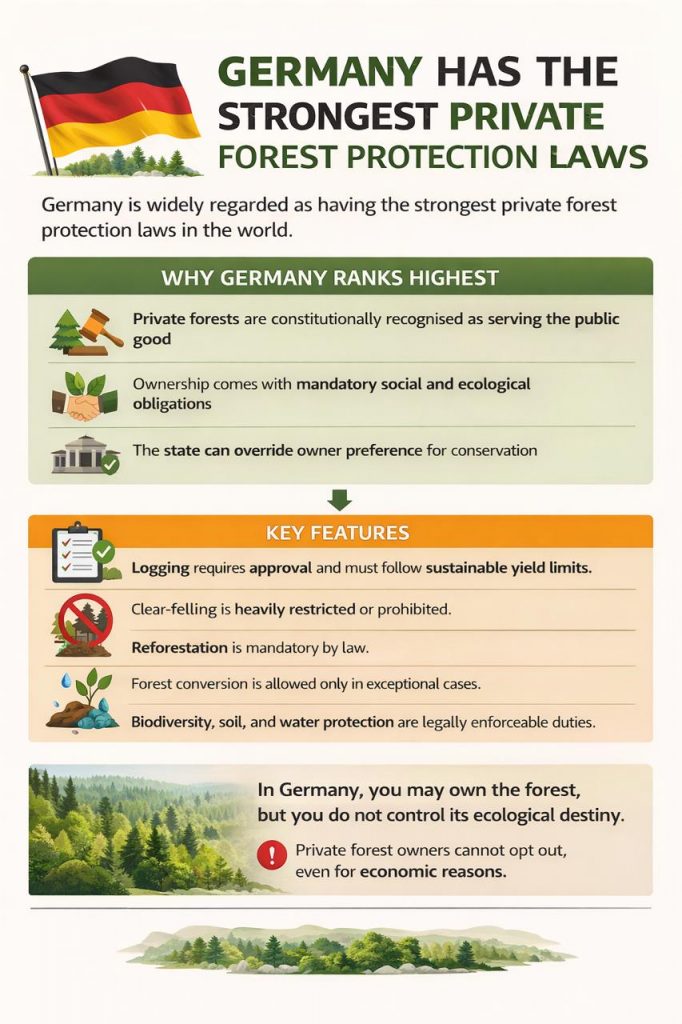
Almost 30 years since the process of identification and demarcation of the State’s private forests began, less than 2% of Goa’s total area has been notified as private forest till now. If those in the know are to be believed, a powerful lobby of private forest owners is at work to scuttle the government exercise.
Circa 1986, an application for tree felling lands on the desk of a tree officer at the Goa forest department. It sought permission to clear 77 trees for cultivating a rubber plantation on around one hectare (ha) land surveyed as bharad (barren land), which had been classified as forest under the Trees Act, 1984.
After carefully perusing it, the officer decides to reject the application citing application of Forest (Conservation) Act (FCA), 1980, on the land. The matter lands in the Bombay High Court at Goa. On November 27, 1990, the high court (HC) delivers a judgement in the writ petition—Shivanand V Salgaocar vs Tree officer, Dy Conservator of Forests and the State of Goa — reaffirming the tree officer’s decision of applying the FCA to the land.
The HC observed an area of one hectare with 77 trees constitutes a forest and therefore the FCA was applicable to it. It was from this time onwards that the questions of what defined a private forest area and what criteria should be used to identify one have dogged everyone concerned with the issue.
Then, came the landmark Supreme Court (SC) ruling on December 12, 1996, in the T N Godavarman Thirumulpad vs Union of India case that broadly defined forest – state-owned and privately owned – and observed the FCA applies to all areas with trees or vegetation. It directed governments to ban non-forest activities and tree felling on these lands and create a centrally empowered committee (CEC) to ensure compliance to the forest law.
Norma Alvares, lawyer, social worker and environment activist, says the SC ordered halting of all non-forestry activities in forest areas “that were taking place under Section 2 of the FCA”.
Section 2 of the FCA mandates State governments or authorities to obtain approval from the Central government for using forest land for non-forest purposes, de-reservation, or transferring it to private entities and restricts activities like agriculture, mining, or commercial construction, aiming to prevent deforestation.
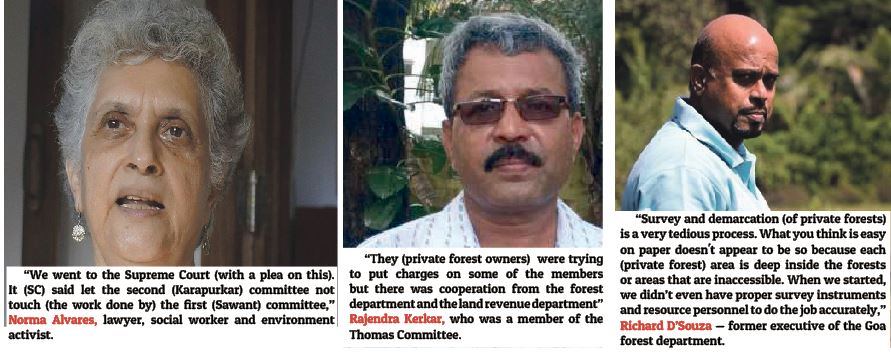
Further, the SC mandated the States to evolve criteria as per their local situation as forest is a concurrent subject and applicability of FCA is determined at the State level; “In the context of Goa, reserve or government-owned forests were already identified but privately owned forests farmers, orchard owners, individual, corporates and others had to identified,” quips Alvares.
Over a month after SC order, the Goa government constituted the S M Sawant Committee on January 24, 1997. Since then to many private forest committees and review panels to now, a lot of water has flown under the bridge, but Goa has yet to complete the exercise of surveying and demarcating private forest areas.
Richard D’Souza — former executive of the Goa forest department who was involved in the process of survey and demarcation of private forests from the start — says the task is not as easy as it may appear on paper.
“Survey and demarcation (of private forests) is a very tedious process. What you think is easy on paper doesn’t appear to be so because each (private forest) area is deep inside the forests or areas that are inaccessible. When we started, we didn’t even have proper survey instruments and resource personnel to do the job accurately,” he informed the Goan Observer.
It was D’Souza, who placed the first order for survey instrument Total Station; “Then (around 1997), I had bought one (Total Station). They (forest department) would have purchased more later”.
According to him, what was done by the Sawant Committee, and then the Karapurkar Committee (set up in 2000) was largely ocular survey. D’souza said proper demarcation of private forests began only after a petition was filed by the NGO Goa Foundation – with which Alvares is associated – in the Supreme Court.
The Sawant Committee, which began work in 1997, adopted three criteria to identify private forest areas – first, 75% of the trees on these lands should be of forestry spices, second, the area should be contiguous to the government forest lands and if non-contiguous then the minimum area should be 5 hectare (ha) and third, the canopy density should not be less than 0.4.
Two years later — on December 10, 1999 — the committee submitted its final report, identifying 46.60 sq km as private forests. The government, on examining the committee report, found it was not complete and therefore decided to constitute another committee.
And so, another panel was formed under the chairmanship of Hemant Karapurkar. Its final report submitted on December 16, 2002, states its terms of reference as; “to demarcate and to delimit and or otherwise suggest measures by a proper land survey all those private properties having natural forests standing thereon and to mutate all such identified areas in land records to show the classification as forest”.
Goa Forward lawyer Alvares said they suspected the Karapurlar Committee wanted to “remove survey numbers” from Sawant Committee’s final report.
“We went to the Supreme Court (with a plea on this). It (SC) said let the second (Karapurkar) committee not touch (the work done by) the first (Sawant) committee,” the environmentalist activist told Goan Observer.
Karapurkar Committee identified another 20.52 sq km of private forest area in Goa. Thus, the total area of private forest identified by both committees was 67.12 sq km in 2002. However, the Karapurkar Committee had stated in its report that the process of identifying of private forest was still incomplete. This necessitated setting up another committee to give full effect to the 1996 order of the SC.
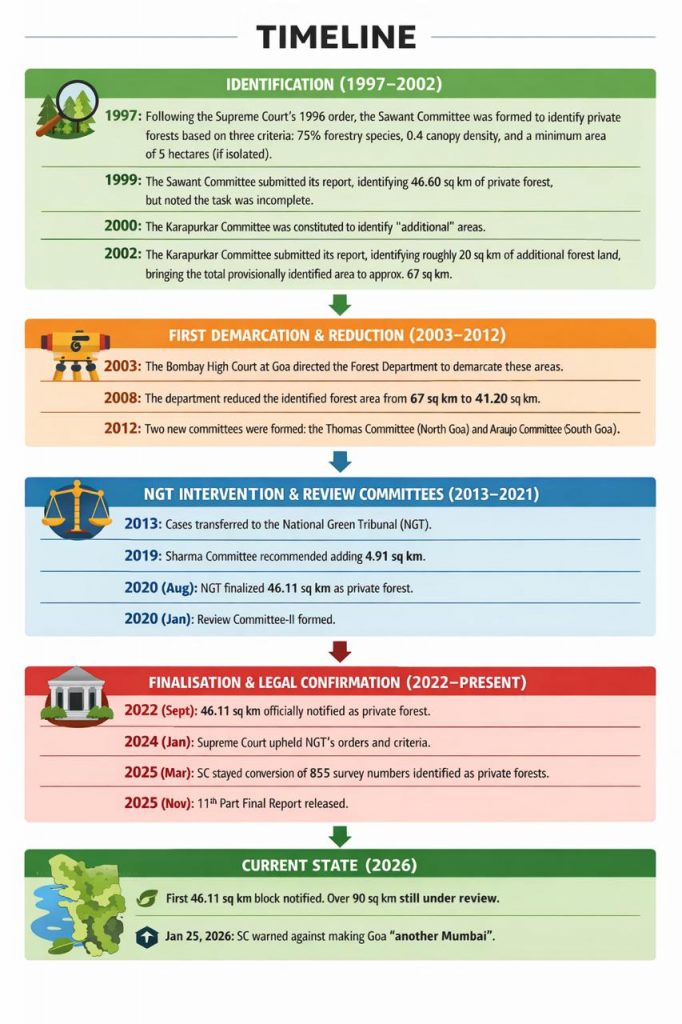
In the meantime, in 2003, the high court ordered the State government to demarcate the non-forest areas from the forest areas based on reports of the two committees. The Goa forest department completed the exercise in five years. Its report showed private forest area over 41.20 sq km, down from 67.12 sq km area identified by the Sawant and Karapurkar Committees. This was challenged in the court by Goa Foundation.
In July 2006, GF approached the court with a plea for another committee to be set up to complete the identification and demarcation of private forest in time-bound manner. In 2009, the court ordered the State government to constitute two committees for the two districts of Goa to identify balance privates forest areas.
Following the court order, the government appointed two committees for North Goa and South Goa headed by K G Sharma and P V Sawant respectively, which failed to come out with a report within the stipulated two years. The led to creation of two new committees—North Goa Division Committee under V T Thomas and South Goa Division Committee under F X Araujo in 2012.
The two committees submitted their reports in late 2018, after being disbanded on April 23, 2018. The North Goa Division Thomas Committee, in its report, published in October 2018, states; “the actual survey and demarcation by wooden pegs were taken up in the provisionally identified areas by a team of surveyors from the Directorate of Settlement and Land Records since 2015”.
The Thomas Committees surveyed and demarcated 326.51 ha of the 1661.72 ha provisionally identified forests. It suggested that “the exercise should be continued and should be completed at the earliest”.
In its recommendation, the committee advocated protection of the demarcated private forest area; “because of the unique ecological, bio-diverse endowments, endemism and aesthetic values, protection of these identified and demarcated private forest areas is of paramount importance,” states the Thomas Committee report.
Rajendra Kerkar, who was a member of the Thomas Committee, said they faced fierce opposition from some of the owners of the private forests, who were keen on carrying out non-forest activities on their land.
One of the most problematic areas was Porvorim, where there were protests held against the survey and demarcation exercise of the committee. Kerkar said many owners wanted to build cottages on their private forest land.
“If your land is classified as private forest area, you cannot build new cottages on it. You can only repair the old cottage in a way that it does not disturb the ecology of the area, and the tree cover is maintained,” he said.
Kerkar said the committee had to deal with threats and dissatisfactions from some owners of private forest owners; “they were trying to put charges on some of the members but there was cooperation from the forest department and the land revenue department”.
Another source told Goan Observer on condition of anonymity that there were some powerful and influential people, who wanted their land removed from the final survey and demarcation report.
“There was tremendous pressure on the committee by these powerful private forest owners to remove survey numbers of their land in the final report,” he said.
This issue was highlighted as ‘limitation’ by the Karapurkar Committee in its report; “It was also anticipated that some of them (owners of properties) due to fear/apprehension of their areas being identified as forest by the committee might try to put hindrance in the field visit, thereby stalling the committee task”.
On November 27, 2012, the Araujo Committee, which had conducted survey and demarcation in South Goa, released its report, identifying nine patches of private forests totalling up to an area of 538.65 ha after visiting 96 villages in six talukas.
“Still, there are many survey numbers of these three villages (Cortalim, Sancoale and Dabolim) and another five villages from Mormugao Taluka, where prospective forests have been located and are to be demarcated and surveyed,” the report said.
The same day — April 23, 2018 — as the Thomas and Araujo Committees were disbanded, the government created a review committee head by Conservator of Forests (Working Plan) Deepshika Sharma. It identified and demarcated another 4.91 sq m in addition to the 41.20 sq m of the Goa forest department’s estimate, putting the total area at 46.11 sq m. This was filed before the National Green Tribunal (NGT) on December 6, 2019, and accepted by it on August 18, 2020.
Thereafter — in January 2020 — another review committee, headed by Anthony D-Souza, was formed after the transfer of Sharma to review the private forest provisionally identified by Thomas and Araujo Committee. Alvares of Goa Foundation says it has now been six years since the second review committee was appointed and “they are (still) chasing 91 sq km (to be reviewed) all over (the State)”.
A forest official, who did not want to be named, was more upfront; “You know, review committees have ulterior motives to take out private forest area of those fellows who have the wherewithal and power to get their forests deleted from the survey. And so, every time a new committee is formed, they are trying to carry out the whole exercise already done by earlier committees and erase some forests”.
Meanwhile, the government has notified 455.10 ha land as “part (private) forest area in 60 qualifying survey numbers”.
“And, whereas, in pursuance of the said direction of hon’ble National Green Tribunal (NGT), the review committee has so fare reviewed 1,678 survey numbers out of 3,349 survey numbers, which were identified by the said committee,” says the notification issued in official gazette brought out in August 2023.
In 2025, the SC, in an interim order, stayed conversion of 855 survey numbers identified and demarcated as final forests by the Thomas and Araujo Committees. In a recent hearing, the apex court made a strong observation on Goa’s rich environmental legacy and criticised its steady march towards becoming another Mumbai.
It’s been a long journey since the process of definition, identification, survey and demarcation of private forests began in the 1990s. Their value and environmental benefits were recognised early by people working on it. This was expressed in the Karapurkar Committee report published in 2002.
“The State (Goa), in this sense, is highly privileged to have such a large percentage cover of greenery (58.2%), which help in providing luxuriant evergreen coverage which adds to the beauty of the landscape, and are good source of water flow through its river, clean and pollution free environment for ecological and well being of the people concerned (both government as well as people) to help maintain this green cover for property and welfare of the people of the State and their future generation,” it stated.
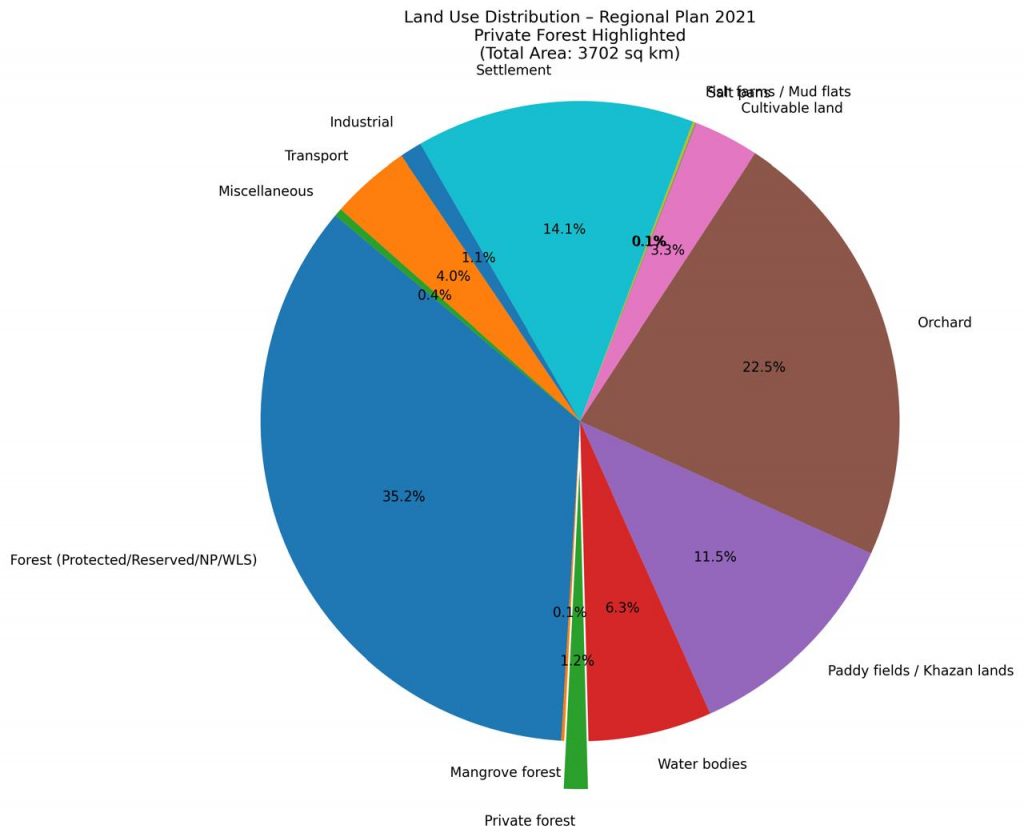
Today, notified area of private forests in Goa stands at less than 2% of the State’s total area as a handful of influential groups, with commercial interests, allegedly try everything in their power to stall the process and ensure their forest land areas are not surveyed and classified as private forest in government records.
It was also anticipated that some of them (owners of properties) due to fear/apprehension of their areas being identified as forest by the committee might try to put hindrance in the field visit, thereby stalling the committee task
The Karapurkar Committee stated in its report released in 2002
It was also anticipated that some of them (owners of properties) due to fear/apprehension of their areas being identified as forest by the committee might try to put hindrance in the field visit, thereby stalling the committee task
The Karapurkar Committee stated in its report released in 2002
Another source told Goan Observer on condition of anonymity that there were some powerful and influential people, who wanted their land removed from the final survey and demarcation report.
“There was tremendous pressure on the committee by these powerful private forest owners to remove survey numbers of their land in the final report,” he said.
This issue was highlighted as ‘limitation’ by the Karapurkar Committee in its report; “It was also anticipated that some of them (owners of properties) due to fear/apprehension of their areas being identified as forest by the committee might try to put hindrance in the field visit, thereby stalling the committee task”.
On November 27, 2012, the Araujo Committee, which had conducted survey and demarcation in South Goa, released its report, identifying nine patches of private forests totalling up to an area of 538.65 ha after visiting 96 villages in six talukas.
“Still, there are many survey numbers of these three villages (Cortalim, Sancoale and Dabolim) and another five villages from Mormugao Taluka, where prospective forests have been located and are to be demarcated and surveyed,” the report said.
The same day — April 23, 2018 — as the Thomas and Araujo Committees were disbanded, the government created a review committee head by Conservator of Forests (Working Plan) Deepshika Sharma. It identified and demarcated another 4.91 sq m in addition to the 41.20 sq m of the Goa forest department’s estimate, putting the total area at 46.11 sq m. This was filed before the National Green Tribunal (NGT) on December 6, 2019, and accepted by it on August 18, 2020.
Thereafter — in January 2020 — another review committee, headed by Anthony D-Souza, was formed after the transfer of Sharma to review the private forest provisionally identified by Thomas and Araujo Committee. Alvares of Goa Foundation says it has now been six years since the second review committee was appointed and “they are (still) chasing 91 sq km (to be reviewed) all over (the State)”.
A forest official, who did not want to be named, was more upfront; “You know, review committees have ulterior motives to take out private forest area of those fellows who have the wherewithal and power to get their forests deleted from the survey. And so, every time a new committee is formed, they are trying to carry out the whole exercise already done by earlier committees and erase some forests”.
Meanwhile, the government has notified 455.10 ha land as “part (private) forest area in 60 qualifying survey numbers”.
“And, whereas, in pursuance of the said direction of hon’ble National Green Tribunal (NGT), the review committee has so fare reviewed 1,678 survey numbers out of 3,349 survey numbers, which were identified by the said committee,” says the notification issued in official gazette brought out in August 2023.
In 2025, the SC, in an interim order, stayed conversion of 855 survey numbers identified and demarcated as final forests by the Thomas and Araujo Committees. In a recent hearing, the apex court made a strong observation on Goa’s rich environmental legacy and criticised its steady march towards becoming another Mumbai.
It’s been a long journey since the process of definition, identification, survey and demarcation of private forests began in the 1990s. Their value and environmental benefits were recognised early by people working on it. This was expressed in the Karapurkar Committee report published in 2002.
“The State (Goa), in this sense, is highly privileged to have such a large percentage cover of greenery (58.2%), which help in providing luxuriant evergreen coverage which adds to the beauty of the landscape, and are good source of water flow through its river, clean and pollution free environment for ecological and well being of the people concerned (both government as well as people) to help maintain this green cover for property and welfare of the people of the State and their future generation,” it stated.
Today, notified area of private forests in Goa stands at less than 2% of the State’s total area as a handful of influential groups, with commercial interests, allegedly try everything in their power to stall the process and ensure their forest land areas are not surveyed and classified as private forest in government records.
 LETTER TO THE EDITOR FOR THE ISSUE DATED MARCH 28, 2026
 GOA’S GILDED HIGH RISE SLUMS!By Raaisa Lemos Vaz
 DIRTY TOWERS OF GOA!
 UNCLEAN WATER, CARRIER OF DISEASE! By Dr Amit Dias, MD
 LOOKING BACK AT GOA IN 60S! By Arvind Pinto
 THE ROAD WE STILL WALK: CONFRONTING CASTE ON VAIKOM’S ANNIVERSARY! By Prema Viswanathan
 WILL THE NEW ADVOCATES PROTECTION BILL STOP ATTACKS ON LAWYERS?By Dr Olav Albuquerque
 ABHINANDAN LODHA CONQUERS BICHOLIM
 IT’S `NIMBU-SODA’ SEASON!
 `Our Rights: Essays on Law, Justice and the Constitution’ by Dr Justice F I Rebello WHAT ARE YOUR RIGHTS?Most of us don’t even know!
 WEEKEND UPDATES
 LETTER TO THE EDITOR FOR THE ISSUE DATED MARCH 21, 2026
 LOOK BACK IN ANGER, LOOK AHEAD WITH RESOLVE!By Gautam Patel
 OUR WOUNDED MANDOVI RIVER MAI! By Raaisa Lemos Vaz
 GARDEN SUBURB TO MONSTER TOWERS…Chembur then and now!
Goa is abuzz with excitement as vintage bike and car owners, users, collectors and fans are decking […]