Goa is abuzz with excitement as vintage bike and car owners, users, collectors and fans are decking […]
Old is Gold
October 4, 2016

The golden beaches of Goa are now tarnished with the National Institute of Oceanography revealing that the prime Goan beaches are heavily polluted. There has been a steady erosion of the sands even of popular beaches at Miramar, Baga, Calangute and Morjim. The grains of pristine sand are slipping through the hands of Goa Tourism or so to speak….
GOA was once the gold standard of global tourism, a 100-mile stretch of sun-kissed sandy beaches where the Arabian sea whispered to a land defined by the spirit of susegad. But today, this “gold” of sand is literally slipping through the fingers of the people. In short, varnishing. From the high-octane shores of Calangute to the supposedly “pristine” retreats of Cavelossim, the ground beneath Goa’s beaches is retreating.
A series of devastating scientific assessments from the National Centre for Sustainable Coastal Management (NCSCM) and the National Institute of Oceanography (NIO) have confirmed what locals have long feared: Goa’s beaches are getting exhausted. Between the physical disappearance of the sand and a tourism model that has breached its “carrying capacity” — the state is facing a real existential crisis.
The numbers tabled recently in the State Assembly are nothing short of alarm bells ringing. Of Goa’s 193.9 km coastline, a staggering 27% is currently being lost to erosion. Perhaps more alarming is the death of the “stable coastline” which are stretches where the shoreline remains consistent. This stable zone has plummeted from 21% to just 14% in less than a decade. In north Goa the situation is dire. The stable coastline in the Bardez and Pernem taluka has withered from 30% to a mere 18%. In south Goa, the decline is even more prominent, dropping from 23% to 9%.
We are no longer talking about “seasonal shifts”, we are witnessing a permanent retreat of the land. According to the NCSCM, 90 beach stretches across the state, covering roughly 52 km, are showing “persisting erosion.” The report highlights that 88 of these 90 eroding beaches are hubs of tourism activity. The correlation is impossible to ignore: wherever the tourists go, the sand disappears.
WHILE rising sea levels due to climate change play a role, the CSIR-National Institute of Oceanography (NIO) has been vocal about the “unscientific human intervention” accelerating this decay. For over 6,000 years, Goa’s sand dunes acted as natural shock absorbers, protecting the hinterland from saline ingress and storms. In just five decades, we have decimated them.
The NIO’s “Study of Goa and its Environment from Space” reveals that the construction of beach resorts, coastal roads, and the proliferation of shacks have led to the “desecration and consequent elimination” of these sand dunes. When a shack is built atop a dune, or a road is cut through it — as seen in the illegal stretches of Candolim and Ashvem — the dune’s ability to anchor sand is lost. The result? Mobile sand that blows away or is washed into the sea, never to return.
Furthermore, the NIO has raised red flags regarding the “shallowing of rivers” due to sand mining in the Chapora and Tiracol rivers. By stripping the riverbeds of sediment, we have cut off the natural supply of sand that replenishes our beaches and we are effectively starving our coastline.
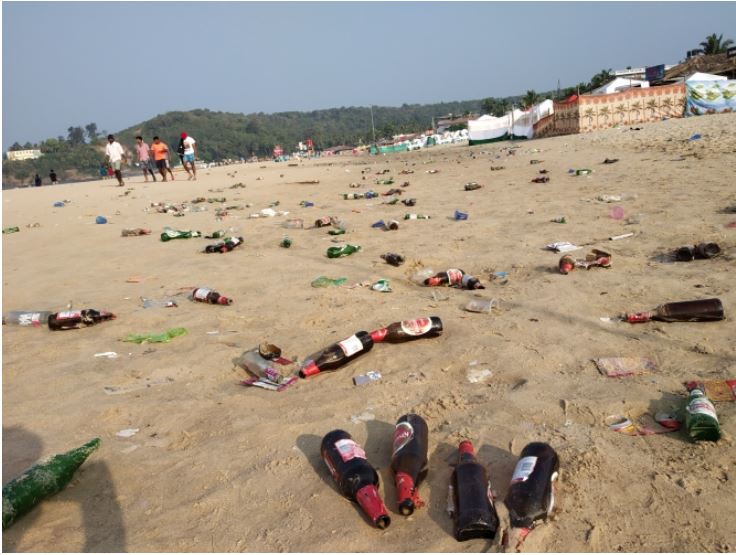
GOA AT CRISIS CROSSROADS
A MORE “discreet” crisis is unfolding beneath the waves. Off-shore coral patches and rocky reefs have historically served as Goa’s primary line of defense, natural “breakwaters” that gently dissipate the energy of the Arabian sea before it reaches the shore. However, these underwater guardians are currently facing an unfavorable environment. The influx of unprocessed sewage and the chemical footprint of millions of swimmers — specifically oxybenzone from sunscreens — have led to a localized decline in reef health.
When these reefs “cease to function,” the ocean’s energy is no longer filtered. Larger, more aggressive waves are granted “unrestricted access” to the coastline, since reefs act as natural breakwaters, their death allows these larger, more aggressive waves to hit the shore and strip away the sand with surgical precision.
The physical erosion of the sand is matched by the “exhaustion” of our infrastructure. In 2025, Goa recorded a record-breaking 1.08 crore (10.8 million) tourist arrivals. To put that into perspective, in 2021, that number was just 33 lakh. We have tripled our visitor load in four years without tripling our capacity or “carrying capacity”, to handle them.
Carrying capacity is defined as the maximum number of people that a tourist destination can accommodate at one time without causing negative impacts on the physical environment, infrastructure strain, local communities or the visitors’ experience.
The state of Goa has initiated a Tourism Carrying Capacity Study. This study is not just about space on the beach; it’s about the vitals which are:
Water Scarcity: Coastal belts now consume water at rates that leave local Goan villages with dry taps.
The Sewage Crisis: A recent NIO study on wastewater revealed a terrifying discrepancy. Goa generates approximately 176 million liters of sewage daily (MLD), but the state’s treatment capacity is only 66 MLD. This means over 60% of our sewage that is untreated and raw; often finds its way into our aquatic systems and, eventually, our beaches.
PLASTICS MENACE
The Microplastic Menace: The NIO has also detected high concentrations of microplastics in the waters around Panjim and the coastal belt, linked directly to laundry effluents and personal care products from the massive tourism load.
In a desperate bid to stop the sea, Goa has historically turned to “hard engineering”, consisting of seawalls and stone embankments. The NIO and the National Green Tribunal (NGT) have criticized these measures. A 2 km sea wall at Campal has effectively “replaced” the beach; where there was once sand, there is now only concrete.
The NGT has ordered the state to move toward “soft” options like beach nourishment, a technique used in the Netherlands where sand is pumped back onto the shore. The government has partnered with the Dutch institute – Deltares– to pilot these solutions, but experts warn that nourishment is a band-aid if the root causes, most eminent of which are over-development and dune destruction, are not addressed.
For too long, we have viewed the beach as an infinite resource. A cash cow that would never run dry. But the “exhaustion” of Goa is now visible to anyone who cares to look. It is in the murky waters of the Sal river, the disappearing shore at Anjuna, and the mountains of trash- over 766 tons daily — that our state struggles to process.
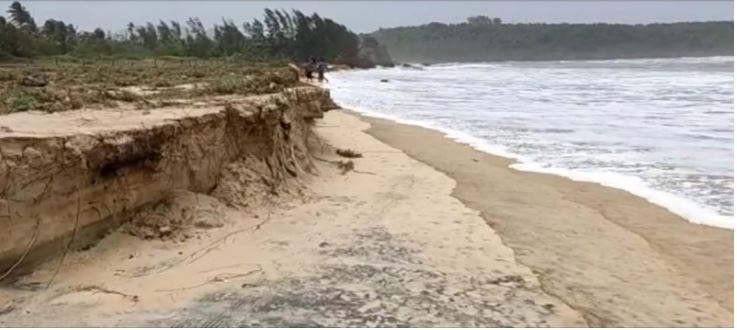
REGENERATIVE TOURISM?
THE shift toward “Regenerative Tourism” is a noble goal on paper, but it requires a fundamental change in the Goan mindset. We must move away from the “mass tourism” model that prizes headcounts over heritage.
A “stable coastline” is not just a scientific matrix. It is the difference between a thriving Goa and a drowning one. If we continue to allow the so called “dressing” up of sand dunes for temporary shacks and the discharge of untreated sewage into our seas — we are not just losing our tourism industry. We are losing our home state of Goa. The sands of time are not just running out but they are being pushed out in ever fast forward mode. The question is when are our powers-that-be going to act for the larger good of conserving the beaches of Goa? How long are we going to be the generation watching our sandy beachside paradise varnishing?
 LETTERS TO THE EDITOR FOR ISSUE DATED APRIL 04, 2026
 REAL ESTATE BARONS OF GOA!
 WHO IS EXTRACTING GOA’S GROUND WATER? By Supriya Vohra
 PLANNING FOR RETIREMENT THE GOAN WAY! By Arvind Pinto
 WHEN `HOLY WEEK’ COMES LONG
 HPV Vaccine: PROTECTING INDIA’S DAUGHTERS FROM CERVICAL CANCER!By Dr Amit Dias, MD
 NO MORE PROTESTS AT AZAD MAIDAN?
 CURCHOREM SEX SCANDAL: Will the police really take action?By Olav Albuquerque
 WEEKEND UPDATESLETTER TO THE EDITOR FOR THE ISSUE DATED MARCH 28, 2026
 GOA’S GILDED HIGH RISE SLUMS!By Raaisa Lemos Vaz
 DIRTY TOWERS OF GOA!
 UNCLEAN WATER, CARRIER OF DISEASE! By Dr Amit Dias, MD
 LOOKING BACK AT GOA IN 60S! By Arvind Pinto
 THE ROAD WE STILL WALK: CONFRONTING CASTE ON VAIKOM’S ANNIVERSARY! By Prema Viswanathan
Goa is abuzz with excitement as vintage bike and car owners, users, collectors and fans are decking […]