Goa is abuzz with excitement as vintage bike and car owners, users, collectors and fans are decking […]
Old is Gold
October 4, 2016
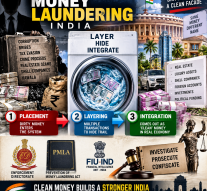
INDIA with a population of 1.4 billion is said to be the world’s largest democratic country, with elections held at the centre, state as also the local levels. These elections manifest the will of the people as to who would govern and the party or parties that would determine the policies of the country, the state or the local entity. The question that is often asked is how free and fair are our elections? Is it really the will of the electorate or is this will manipulated or “won” by unscrupulous means. The Association for Democratic Reforms (ADR) is a non-partisan, non- governmental organization founded in 1999, by three professors from the Indian Institute of Management Ahmedabad. It was established after the professors filed a public interest litigation at the Delhi High Court seeking disclosure of the criminal, financial and educational background of candidates standing for elections. This PIL resulted in the Supreme Court making it mandatory for candidates to disclose their criminal, financial and educational details in an affidavit to the Election Commission. The reports of the ADR, have resulted in both candidates as also their political affiliations sharing information and enabling voters to make more informed choices. The ADR has repeatedly exposed how money — often unaccounted, opaque, and suspected to be black — has become the lifeblood of politics. Their reports reveal a disturbing pattern: parties that barely contest elections or secure votes declare astronomical incomes, while mainstream parties thrive on anonymous donations and weak disclosure norms. This article examines ADR’s findings, situates them in the Goan context, and explores the implications for India’s democracy.
Registered Unrecognised Political Parties(RUPPs) – the Mules
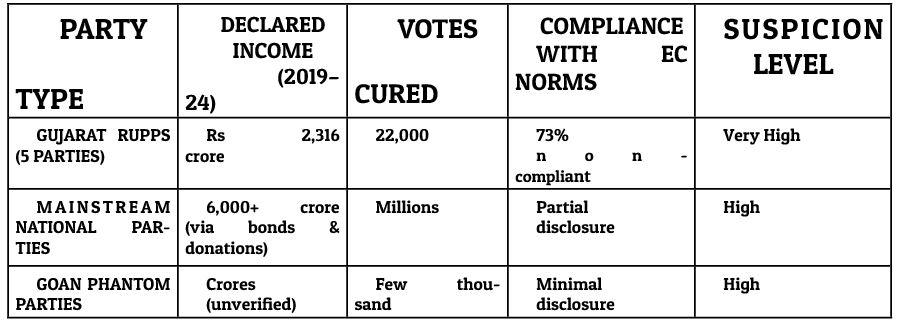
IN banking parlance, mules refers or better money mules refer to individuals or organizations that use their bank account to move, disguise or launder or white wash funds. This is exactly what RUPPs do. They provide a crucial link for laundering funds into the system in the guise of being political parties, but in reality, they are only money laundering machines. The ADR’s analysis of RUPPs is perhaps interesting. Between 2019–2024, five Gujarat-based RUPPs declared Rs2,316 crore in income, yet collectively secured only 22,000 votes. In FY 2022–23 alone, RUPPs reported a 223% rise in declared income, despite negligible electoral activity. 73% of RUPPs failed to submit audited accounts to the Election Commission. This raises a chilling question: are these parties genuine political outfits, or mere conduits for laundering black money? ADR’s data suggests the latter. The mismatch between declared income and electoral performance points to a shadow economy thriving under the guise of democracy. Has the ECI taken note of this phenomenon? Or is the ECI busy with playing partial politics while tracking such trails would be too much of a task, for the overburdened body?
The Mainstream Parties: Opaque Funding Channels
ADRs has looked at the broader pattern of political financing, in its 2026 report Political Finance System Assessment (2026) highlighting the following systemic flaws. While the Electoral bonds were heralded as a means to remove the black money component in elections the system deepened opacity since no record of the identity of the donors was maintained. . Donors remain anonymous, and parties are not obliged to disclose sources. Several of these ‘donations’ were in cash, and of amounts below Rs 10,000 the IT limit for cash transactions. Cash contributions, though capped, remain untraceable in practice. Corporate donations often exceed limits, routed through subsidiaries or shell companies. The result is a political economy were money power trumps ideology. Wealthy candidates and parties dominate, while grassroots movements struggle to survive. In a situation where the winner takes all, the party in power was able to ensure that the most prominent politicians were in their bag.
Let’s talk Local ADR’s Findings on Goa
GOA, with its vibrant yet fragile democracy, offers telling examples. The ADR has found that several small parties mushroom during election season, only to vanish afterward. Their financial disclosures, if any, are minimal. It has been found that many of these parties are often “ghosts” for some of the main parties. In Goa where the real estate , mining and tourist lobbies decide most issues, allegations of cash-for-votes and corporate patronage in mining and tourism sectors persist. Over the years the Goan voter’s cynicism is evident, the common man believes that nothing much can change, since parties are funded by “black money bags” rather than transparent donations. Phantom parties in Goa mirror the RUPPs nationally, while mainstream players rely on opaque funding to sustain campaigns.
The Nexus of Money, Crime & Politics
THE ADR report warns of a persistent nexus between money and crime. Candidates with criminal records often outspend rivals, leveraging illicit funds. Black money fuels muscle power, influencing voter intimidation and booth management. Policy-making is often distorted, since donors expect returns in the form of contracts, licenses, or favourable legislation. This is evident in mining contracts and recently in infrastructure projects in Goa
Transparency Gaps and Regulatory Failure
Over the decades, the country has attempted to bring about a cleansing of the system. During the regime of T N Seshan, the system of Election and Expenditure Observers was instituted in 1990’s. I was fortunate to have been election observer at several elections. Despite existing laws — the Representation of People Act (1951), Income Tax Act (1961), and Companies Act (2013) — compliance remains weak. Thousands of parties avoid filing audited accounts. Penalties for non-compliance are rare, and deregistration is almost unheard of. The Election Commission lacks investigative authority, limiting its role to passive oversight. The ADR report argues that without independent oversight and strict sanctions, black money will remain entrenched.
Implications for Democracy
THE dominance of black money has three major consequences, despite the demonetization that happened in 2016, is phenomenal in India. This has serious implications for candidates aspiring to stand for elections. Unaccounted money creates an unequal playing field. Smaller parties and candidates without access to illicit funds are marginalized. Then there is an erosion of trust among the electorate. Voters perceive politics as captured by wealth, not service. Post elections the influencers claim their pound of flesh. This is seen in policy distortion. Corporate and opaque donors influence legislation, undermining accountability. In Goa, this translates into skewed priorities— real estate , tourism and mining interests often outweigh environmental or social concerns.
ADR’s Recommendations
ADR in its report also proposes the way forward. It calls for mandatory audited accounts for all parties. The report seeks a Ban on anonymous donations, ensuring traceability. It seeks for an empowered Election Commission with investigative authority. Finally, it seeks strict sanctions, including deregistration of defaulting parties. These measures, if implemented, could restore transparency and level the electoral field.
Unsustainable Narratives
THE ADR’s findings help dismantle common myths The common narrative is that more money means more votes. In reality phantom parties prove otherwise; money circulates without electoral impact. Secondly it was presumed that electoral bonds increased transparency. In reality these electoral bonds only “anonymized” donors, deepening opacity. Finally, it is presumed that regulation is sufficient. The reality is that weak enforcement renders laws toothless, since law becomes meaningful only when it is enforced.
IN CONCLUSION, let me take a metaphor of the sea that skirts the western coastline of Goa. Imagine India’s political landscape as a vast ocean. Genuine parties are ships with sails of ideology, navigating toward the horizon of public service. But ADR’s reports reveal another fleet — ghost ships sailing on rivers of cash. These phantom vessels, the RUPPs, glide silently, their decks piled high with treasure chests of unexplained wealth. They do not carry passengers (voters), nor do they chart real journeys (policies). Instead, they drift aimlessly, serving as floating warehouses for black money.
Meanwhile, the mainstream galleons —majestic but opaque — sail under banners of electoral bonds and corporate patronage. Their hulls are reinforced not by transparency, but by secrecy. The ocean itself is polluted: currents of illicit funds swirl beneath, distorting the tides of democracy. For Goa, the metaphor is even sharper. Our coastal democracy, with its fishing boats and ferries, knows the danger of ghost ships. They loom large, casting shadows over smaller vessels, threatening to capsize genuine movements.
Unless the waters are cleared, the ocean of Indian democracy risks becoming a graveyard of ideals, haunted by ships of black money.
(Arvind Pinto is the chairperson of Citizencredit Cooperative Bank Ltd, he also practises at National Company Law Tribunal and is retired chief commissioner.)
 ELEVATED HIGHWAY TO HELL!
 MEDICAL DEVICES LOOT!By GS Mudur
 HOSTILE ACT BY PAKISTAN: `PNS HUNAIN’ TRIED TO DISRUPT OUR NAVAL SURVEILLANCE! By Dr Olav Albuquerque & Deborah Albuquerque
 `KHANDVI MILLE-FEUILLE’ AT BRICS ALL VEG BUFFET!
 SATYA NIKETAN TRAGEDY: HOW GLOBAL STUDENT HOUSING MODELS COULD HELP INDIA FIX A BROKEN SYSTEM!By Sneha Swaminathan
 GANESH PANDALS HIJACKED BY ADANI, AMBANI
 WHY DOES A DEMENTIA DIAGNOSIS MATTER? By Dr Amit Dias
 WEEKEND UPDATES
 LETTERS TO THE EDITOR FOR ISSUE DATED SEPTEMBER 12, 2026
 GOAN TEACHERS ARE CONTRACT LABOR!
 THE COLOUR IS PRESTIGIOUS! THE PROCESS MUST BE EQUALLY SO!
 DOGS ATTACK GOANS, OWNERS GET ACQUITTED!By Dr Olav Albuquerque & Deborah Cordeiro
 CYBER FRAUD: A THREAT TO FINANCIAL SECURITY & MENTAL WELL-BEING! By Adv Vinayak (Mama) D Porob
 RUPEE IN FREE FALL: WHY THE SLIDE MATTERS MORE THAN THE NUMBER! By Arvind Pinto
 SHRAVAN BYE-BYE, CHOVOTH WELCOME!
Goa is abuzz with excitement as vintage bike and car owners, users, collectors and fans are decking […]