Goa is abuzz with excitement as vintage bike and car owners, users, collectors and fans are decking […]
Old is Gold
October 4, 2016
It was a year when the fight to preserve everything Goan got fiercer. The Rakhandars of Goa were relentless in their battle to take back what belonged to them
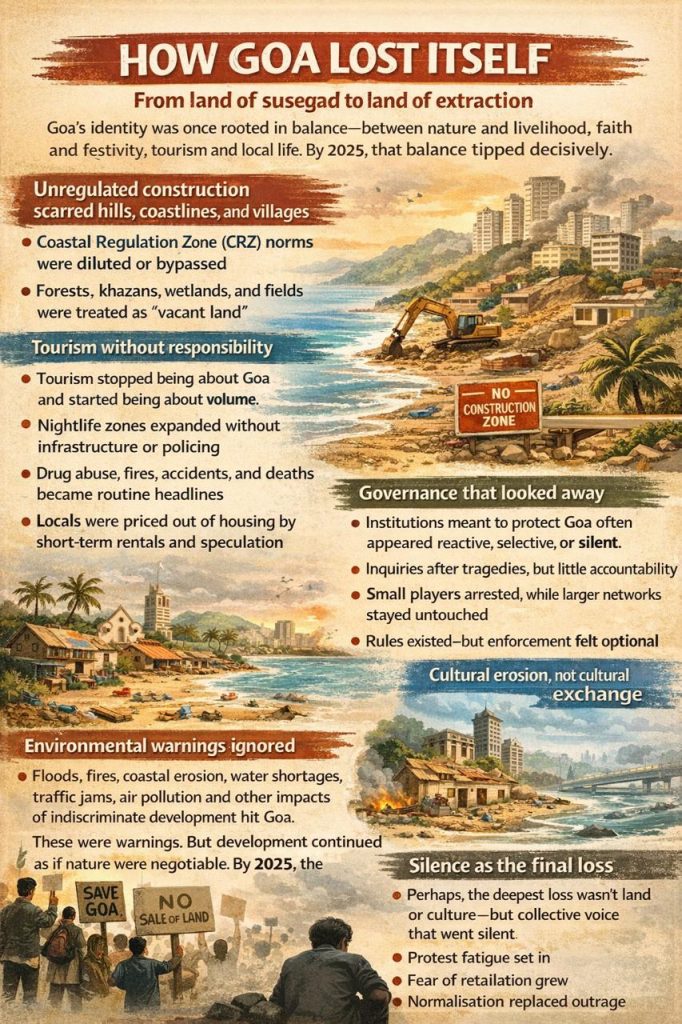
The year 2025 is ending. For many, in Goa, it was a year when many harsh realities dawned on them. One of them was that they were fast losing the Goa – their forests, hills, coastlines, wetlands, mangroves, culture, heritage, and way of life.
The very soul of the coastal State was being attacked from those supposed to be its guardian and enforcers of regulations and laws legislated to protect people, land, and livelihood. They had turned into invincible plunderers, trampling over anything and everything that came in their way.
Goans rose in anger and outrage, only to be violently flung aside by the muscle power of the State, which was endlessly concocting magic portions by legislating laws, rules, and policies to give more power to themselves.
But every time the people were pushed to the corner of desperation, they pushed back hard. The tussle between oppressed and oppressor continued through the whole year. Their Uzo or fire refused to die down.
Govind Shirodkar, president of Gakuved Federation and chairman of Biodiversity Management Committee (BMC), was unrelenting in his opposition to the 12,000-sqm Unity Mall and the 17-storey Prashasan Stumbh (administrative building) approved by the State government on the eco-sensitive wetland in his village Chimbel.
The authorities – from the ministry level to the village level – colluded to push the project through, even if it meant bending a few rules and laws. Shirodkar says authorities bypassed regulations to issue construction licenses, environmental clearances, and approvals, compelling him to approach the court or mobilise people to go on a protest.
And, he is not easily giving up his fight to reclaim the Goa he treasures.
“We wouldn’t stop here. It is do or die for us. Currently, we are struggling to save our lake (Toyyar), our land (wetland) and our natural resources. Everything in our village is under attack,” he said when asked whether he was waging an impossible war against destruction of Goa.
Former bureaucrat and Congress worker Elvis Gomes echoes a similar sentiment when he resolves to fight till his “last breath” to reclaim the Goa that is getting lost every day due to indiscriminate development in the State.
“If I you ask me as an individual, I will say I will keep fighting till my last breath. Everybody keeps saying Goa is being lost and it must be reclaimed. But it cannot be done sitting in the house and putting comments here and there. People worry that somebody will target them. That kind of fear has crept in their minds,” he said.
Gomes said an atmosphere of fear has swept across Goa; “people need to overcome that fear. Unless they do that there is no point in saying we are ready to do something to reclaim Goa. These people must come forward. When a collective force comes together the destructive forces can be pinned down”.
The Congress leader said the fear was largely unfounded because most common men were on the right side of the law and so had nothing to fear.
“They (common men) are clean people who have no (illegal) baggage. They are coming forward and speaking against illegalities, which is their democratic right. If they can exercise that right, more people can come together and that will change the whole thing. It’s not about individuals but about a collective group coming together,” he said.
Gomes said his support base has grown in 2025 as people rallied against illegal projects and manipulation of laws to push illegal projects in the State to facilitate investments from outside, which did not benefit Goans.
Many land-use and planning laws under Town and Country Planning Act were amended to allow plot-by-plot zoning alterations in the Regional Plan—originally justified as fixing inadvertent errors or inconsistent or incoherent zoning.
This has helped conversion of green zones like orchards, natural cover, agricultural land, and no-development slopes to be reclassified as settlement zones where construction was permitted.
These provisions were enabled piecemeal, discretionary rezoning that bypassed holistic planning and environmental safeguards that increased the risk of environmentally harmful development.
The Bombay High Court at Goa intervened and struck down amended rules in the TCP Act saying they “virtually mutilate” the Regional Plan and lacked clear environmental or public interest boundaries.
Even after this, the mere existence of such provisions encouraged land-use shifts that local activists say undermine ecological zones.
Nilesh Borde, professor of management studies at Goa Business School, believes “Goans are giving into a lot of stuff tourists are asking for rather than giving them what we want”.
“For example, whether it’s cuisine or culture or quality of life, we are giving the tourist what the tourist are asking for and not what we want to give them,” he said.
He complained one can hardly hear Goan songs around Goa. It is always some Bollywood number or some song from other States.
He said the movement to reclaim Goa has been set into motion but it has to gain momentum. He witnessed a fatigue setting in and wanted even outsiders, now settled in Goa for the love of the State, to chip in for reclamation of lost Goa.
According to Borde, the pace of destruction of Goa was far outpacing the pace of reclamation.
“At one end, you are trying to protect you Goa but at the other end there is large scale destruction taking place. We are burning the candle from both sides, and the candle is being burnt at a faster pace from the side of the destruction,” he said.
He heaped the entire blame of Goa’s ruin on the “mindless governance and administration”.
“I don’t blame the businessmen for it (destruction of Goa). He is doing his business. As far as businessmen are concerned, they play a secondary part. The primary role is played by those responsible for governance,” said Borde.
 LETTER TO THE EDITOR FOR THE ISSUE DATED MARCH 28, 2026
 GOA’S GILDED HIGH RISE SLUMS!By Raaisa Lemos Vaz
 DIRTY TOWERS OF GOA!
 UNCLEAN WATER, CARRIER OF DISEASE! By Dr Amit Dias, MD
 LOOKING BACK AT GOA IN 60S! By Arvind Pinto
 THE ROAD WE STILL WALK: CONFRONTING CASTE ON VAIKOM’S ANNIVERSARY! By Prema Viswanathan
 WILL THE NEW ADVOCATES PROTECTION BILL STOP ATTACKS ON LAWYERS?By Dr Olav Albuquerque
 ABHINANDAN LODHA CONQUERS BICHOLIM
 IT’S `NIMBU-SODA’ SEASON!
 `Our Rights: Essays on Law, Justice and the Constitution’ by Dr Justice F I Rebello WHAT ARE YOUR RIGHTS?Most of us don’t even know!
 WEEKEND UPDATES
 LETTER TO THE EDITOR FOR THE ISSUE DATED MARCH 21, 2026
 LOOK BACK IN ANGER, LOOK AHEAD WITH RESOLVE!By Gautam Patel
 OUR WOUNDED MANDOVI RIVER MAI! By Raaisa Lemos Vaz
 GARDEN SUBURB TO MONSTER TOWERS…Chembur then and now!
Goa is abuzz with excitement as vintage bike and car owners, users, collectors and fans are decking […]