Goa is abuzz with excitement as vintage bike and car owners, users, collectors and fans are decking […]
Old is Gold
October 4, 2016
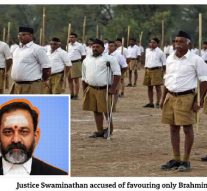
Advocates close to Justice GR Swaminathan denied allegations of caste, communal and political bias being leveled at the judge.
Last fortnight, 120 INDIA bloc MPs signed an impeachment motion against Justice GR Swaminathan. This is not the first time the Madras High Court judge has run into controversy: allegations of political favoritism as well as caste and communal bias have dogged his career.
The INDIA bloc in the motion on December 9 alleged that Justice GR Swaminathan’s conduct “raises serious questions regarding impartiality, transparency, and the secular functioning of the judiciary”.
The motion stated that Justice Swaminathan has shown “undue favouritism” toward advocates from a “particular community”, referring to allegations that he favoured lawyers from his own Brahmin caste.
It further alleged that he decides cases on the “basis of a particular political ideology”, alluding to his alleged leanings towards the Hindutva doctrine espoused by the ruling Bharatiya Janata Party and its parent organisation, the Rashtriya Swayamsevak Sangh.
The judge did so, the motion claimed, in a manner “contrary to the secular principles of the Indian Constitution”.
However, advocates close to Swaminathan denied all charges and argued that the judge’s Rashtriya Swayamsevak Sangh membership has had no bearing on his work on the bench.
The impeachment move followed Justice Swaminathan’s December 2 order permitting the lighting of a lamp on a stone pillar near a dargah on Madurai’s Thiruparankundram Hill, claiming it is the traditional spot where the lamp should be lit.The plea was filed by Vishwa Hindu Parishad and other Hindutva organisations, accusing the Dravida Munnetra Kazhagam government of stifling the rights of Hindus. The DMK, on the other hand, accuses the Vishva Hindu Parishad as well as Justice Swaminathan of inflaming communal tensions in the region. The flashpoint has been called the “Ayodhya of the South”.
For the Opposition, the order was one in a long series of claimed transgressions by Swaminathan. On August 11, the INDIA bloc released a letter signed by almost 50 MPs addressed to chief justice of India and the president alleging “proven misbehaviour and gross misconduct” by Justice Swaminathan. It urged that action be taken.
A member of the INDIA bloc told Scroll that since no action followed, MPs decided to move an impeachment motion given what they allege is the judge’s continued “communal bias”.
Becoming a judge
Justice Swaminathan’s journey begins far from the power corridors of the judiciary. Born in 1968 and raised in the small town of Thiruvarur in Tamil Nadu, he was a first-generation lawyer who entered the profession in 1991 after completing a law degree a year earlier.
Speaking to Scroll, former judge of the Madras High Court, Justice K Chandru, alleged that Swaminathan was an “active member of the right-wing student organisation Akhil Bharatiya Vidyarthi Parishad” in college and had started “mobilising students on the grounds that the law school syllabus was useless”.
For more than a decade, Swaminathan built a practice as a lawyer in Chennai before shifting to the newly established Madurai bench in 2004.
After moving his law practice to Madurai, “he broadened his network” and “became pally” with CP Radhakrishnan, now the vice president of India and someone who has been associated with the RSS since his youth, Justice Chandru claimed.
He said that Justice Swaminathan had tried to secure the post of Additional Solicitor General of India but did not succeed. However, in 2014, he was appointed as the Assistant Solicitor General of India for the Madurai bench, a position the former judge described as a “stepping stone” to his appointment as an additional judge to the Madurai bench of the Madras High Court in 2017. In 2019, he was made a permanent judge.
‘Everyone knows his politics’
Advocates told Scroll that Justice Swaminathan’s “Hindutva ideology” and “RSS leanings” are not new to the legal fraternity working at the Madras High Court.
“Every public meeting he participates in, he talks about upholding right-wing ideology,” said a senior advocate practising in the Madras High Court.
Said a retired Madras High Court judge, Justice D Hariparathanman, ““He speaks freely, and everyone knows he is RSS-leaning. How can he openly favour a side?”
Hariparathanman compared Swaminathan to another Madras High Court judge, Victoria Gowri, who is also seen to lean towards the BJP and RSS. “She also supports the RSS, and her elevation was questioned, but after her appointment, she has never been in a storm,” he said.
Former Madras High Court judge Justice K Chandru Chandru told Scroll that Justice Swaminathan recently delivered lectures to lawyers of the RSS-affiliated Akhil Bharatiya Adhivakta Parishad on service law and family law.
“My question is whether it is appropriate for a judge to conduct classes for RSS lawyers and then advise them on the grounds they should cite in cases that he himself is hearing in court,” Chandru said.
He went on to allege: “He can give relief in matters that are not an issue; the issue is what he is doing. He has a completely RSS agenda, and he doesn’t have qualms at all.”
Associates of Swaminathan do not deny his membership of the RSS. “Facts are facts,” said Madras High Court senior advocate Srinivasa Ragavan, who is close to Justice Swaminathan. “He has been a member of RSS since 1984 is a fact. Justice Swaminathan’s association dates back to 1984 and that he did not join the RSS after 2014, when the BJP came to power at the Centre, but out of an ideological commitment.”
Raghavan said that rather than deny his association with the RSS, Swaminathan would “wear it as a badge of honour”.
However, this does not impact his rulings, an advocate who worked with Swaminathan during his time as a lawyer. “He believes in human rights, admires Arundhati Roy and is the only judge who has actively upheld the rights of transgender persons and Dalits in Madras,” he said. “He has multiple identities…”
Favouring Brahmin advocates?
The August 11 letter also makes allegations of caste bias. “During his tenure as a single-judge bench, Justice GR Swaminathan is widely perceived to have consistently prioritised the listing of cases and allocation of time slots for a particular set of advocates,” the letter stated. “Especially those from the Brahmin community and those associated with right-wing groups.”
It added that several members of the bar have observed this pattern, noting that it was “not an isolated or occasional” occurrence.
The letter said that senior advocate M Sricharan Rangarajan, who belongs to the Brahmin community, appeared frequently before Justice Swaminathan between April and July 2024.
“He was repeatedly granted favourable time slots, often ahead of other cases of equal or greater urgency,” the letter alleged.
A senior advocate from Madras said that the Madurai bar is divided along “communal lines” and “political lines”. He added that such even judges are riven by similar divisions.
Referring to Justice Swaminathan, the advocate said that he has decided roughly 75,000 main cases. He said that the High Court data of the judge’s orders should be examined to see whether Brahmin lawyers had disproportionately been grated relief .
Responding to allegations that senior advocate M Sricharan Rangarajan was being favoured, the senior advocate denied the claim and alleged that the Madurai bench had long been dominated by a clique of lawyers.
“With the entry of Rangarajan, they may have lost some of their work,” he said, adding that the allegations amounted to “nothing but motivated slander”.
Denying any caste bias, senior advocate Srinivasa Ragavan said that Justice Swaminathan is an RSS member and that, for him, a “Hindutva identity” is important. But he “does not favour any caste”.
‘Vedas will protect you’
The impeachment is also driven by allegations of communalism against Swaminathan.
“At a 2025 event, Justice Swaminathan stated that Sanatana Dharma could save Vedic Brahmins from a murder case,” the letter stated. “Implying that anyone practising the Vedas would be shielded from legal consequences, even if they had committed the offence”.
At that event, as per the letter, Justice Swaminathan spoke about an incident from his days as a practising lawyer when he helped obtain the acquittal of a friend who had been convicted in a road accident case resulting in a man’s death.
His friend, who had spent several years studying the Vedas, had admitted to negligent driving even though it was his sister who was actually driving the vehicle at the time of the accident. Noting that none of the witnesses in the case had identified his friend as the driver, the judge was able to secure his acquittal on appeal.
Senior advocate Srinivasa Ragavan, who practices in Madras, said Justice Swaminathan was invited to inaugurate a session at a pathashala, or traditional Hindu school, in Chennai, where Vedic students from across the country had gathered.
“It is a public statement, he didn’t say this in a judgment, said Ragavan, countering claims made in the letter. “It is just a motivating statement.”
Rolling over banana leaves
In 2024, a petitioner sought permission for annathanam, free meal distribution, and angapradakshinam, rolling over banana leaves after Brahmins have eaten off them, at a temple festival in Karur, Tamil Nadu. A division bench had earlier banned angapradakshinam at the temple, calling it “inhuman”.
“But Justice Swaminathan, sitting alone, allowed the uncivilised practice, declaring the earlier division bench ruling null and void, something a single-bench judge cannot do,” the letter claimed.
The division bench later overturned his order and called it “judicial indiscipline”.
The letter claimed such “ideological partisanship undermines public trust in judicial neutrality” and “challenges the expectation that courts remain independent of political or social affiliations”.
A senior advocate from Madras High Court close to Swaminathan said that the ritual had been followed for over a century. Someone filed a writ petition, and the division bench banned the ritual without hearing the temple, he added.
“Is it not the violation of the principle of natural justice?” the advocate asked.
The advocate further said that, in this case, a “false narrative was presented” suggesting that Brahmins ate while non-Brahmins rolled, which he said was “incorrect”.
He pointed out that the district administration itself stated in its affidavit that “there was no caste or communal element” involved in the ritual at all.
“If people believe that rolling over is beneficial as part of angapradakshinam, what is the problem?” the advocate said, adding that the issue has “nothing to do with ideology”.
‘Crypto-Christian’
According to the letter, in 2022, a Christian priest faced prosecution for a speech he made during a protest on July 18, 2021 COMMA during Tamil Nadu Assembly elections.
The priest was charged for allegedly making derogatory remarks about Prime Minister Narendra Modi and Home Minister Amit Shah, and for comments seen as insulting “Bharat Mata”.
The letter by MPs alleged that in his judgment, Justice Swaminathan made comments about Kanyakumari’s demographics and used the term “crypto-Christians”, referring to Hindus who convert to Christianity but legally retain their Hindu faith.
The letter further stated that these comments were “irrelevant, inflammatory, and disrespectful particularly in a judicial proceeding”.
The letter alleged that in 2022 case of a 17-year-old girl’s suicide, Justice Swaminathan highlighted allegations of religious conversion pressure by her Catholic school, criticised the Tamil Nadu police, and transferred the investigation to the Central Bureau of Investigation.
But later, the bureau found “no evidence of forced conversion”, which, the letter stated, “showed that his earlier conclusions were wrong and had created a communally charged narrative”.
According to the letter, he also suggested that the Constitution’s validity depends on India’s demographic balance staying the same, and espoused views that, the letter argued, promoted “a majoritarian, religion-based vision, contravening the Constitution’s secular foundation”.
However, advocates close to Swaminathan denied any communal bias.
“There was an allegation by the party that a religious conversion had taken place [in 2022],” said Advocate Abhinav Parthasarathy, who has worked with Justice Swaminathan before. “He acted on the allegation without going into the merits of the case.”
“He is the most popular judge in Madurai,” Parthasarathy said. “Lawyers and litigants, setting aside their religious and caste differences, want to appear before him.”
He added that “Muslims also prefer to present their cases” before Justice Swaminathan, as he is a “relief-oriented judge”.
Political bias
Apart from ideology, Swaminathan is also being criticised for political bias. The August 11 letter sent to the President by MPs seeking action against Justice Swaminathan stated that on April 2, 2024, Justice Swaminathan attended a book launch event alongside “right-wing” political activists as well as Tamil Nadu BJP leader H Raja.
MPs further stated in the letter that at the event, he mocked the “Dravidian model” of governance, mimicked former Chief Minister M Karunanidhi, and criticised a former state minister for not recognising a portrait of the Kanchi Shankaracharya, the head priest of the prominent Hindu monastery in Kanchipuram, Tamil Nadu.
Advocates close to Swaminathan, however, denied these allegations.
“Justice Swaminathan plays different roles on and off the bench,” said senior advocate Srinivasa Ragavan denying any political bias. “He never declines an invitation to any event, whether right-wing or left-wing groups organise it.”
Another advocate known to be close to Justice Swaminathan alleged that the DMK was targeting the judge because “he is a Brahmin” and “has passed highly uncomfortable orders against the State, which they are unable to accept”.
Ragavan said that Justice Swaminathan is an “RSS member but “follows Gandhian philosophies”.
“You will find him attending events that lean towards Gandhian principles,” he added, stating that while he may have “personal ideological preferences, he never allows them to influence his judicial decisions”.
Courtesy: The Scroll
Last fortnight, 120 INDIA bloc MPs signed an impeachment motion against Justice GR Swaminathan. This is not the first time the Madras High Court judge has run into controversy: allegations of political favoritism as well as caste and communal bias have dogged his career.
The INDIA bloc in the motion on December 9 alleged that Justice GR Swaminathan’s conduct “raises serious questions regarding impartiality, transparency, and the secular functioning of the judiciary”.
The motion stated that Justice Swaminathan has shown “undue favouritism” toward advocates from a “particular community”, referring to allegations that he favoured lawyers from his own Brahmin caste.
It further alleged that he decides cases on the “basis of a particular political ideology”, alluding to his alleged leanings towards the Hindutva doctrine espoused by the ruling Bharatiya Janata Party and its parent organisation, the Rashtriya Swayamsevak Sangh.
The judge did so, the motion claimed, in a manner “contrary to the secular principles of the Indian Constitution”.
However, advocates close to Swaminathan denied all charges and argued that the judge’s Rashtriya Swayamsevak Sangh membership has had no bearing on his work on the bench.
The impeachment move followed Justice Swaminathan’s December 2 order permitting the lighting of a lamp on a stone pillar near a dargah on Madurai’s Thiruparankundram Hill, claiming it is the traditional spot where the lamp should be lit.The plea was filed by Vishwa Hindu Parishad and other Hindutva organisations, accusing the Dravida Munnetra Kazhagam government of stifling the rights of Hindus. The DMK, on the other hand, accuses the Vishva Hindu Parishad as well as Justice Swaminathan of inflaming communal tensions in the region. The flashpoint has been called the “Ayodhya of the South”.
For the Opposition, the order was one in a long series of claimed transgressions by Swaminathan. On August 11, the INDIA bloc released a letter signed by almost 50 MPs addressed to chief justice of India and the president alleging “proven misbehaviour and gross misconduct” by Justice Swaminathan. It urged that action be taken.
A member of the INDIA bloc told Scroll that since no action followed, MPs decided to move an impeachment motion given what they allege is the judge’s continued “communal bias”.
Becoming a judge
Justice Swaminathan’s journey begins far from the power corridors of the judiciary. Born in 1968 and raised in the small town of Thiruvarur in Tamil Nadu, he was a first-generation lawyer who entered the profession in 1991 after completing a law degree a year earlier.
Speaking to Scroll, former judge of the Madras High Court, Justice K Chandru, alleged that Swaminathan was an “active member of the right-wing student organisation Akhil Bharatiya Vidyarthi Parishad” in college and had started “mobilising students on the grounds that the law school syllabus was useless”.
For more than a decade, Swaminathan built a practice as a lawyer in Chennai before shifting to the newly established Madurai bench in 2004.
After moving his law practice to Madurai, “he broadened his network” and “became pally” with CP Radhakrishnan, now the vice president of India and someone who has been associated with the RSS since his youth, Justice Chandru claimed.
He said that Justice Swaminathan had tried to secure the post of Additional Solicitor General of India but did not succeed. However, in 2014, he was appointed as the Assistant Solicitor General of India for the Madurai bench, a position the former judge described as a “stepping stone” to his appointment as an additional judge to the Madurai bench of the Madras High Court in 2017. In 2019, he was made a permanent judge.
‘Everyone knows his politics’
Advocates told Scroll that Justice Swaminathan’s “Hindutva ideology” and “RSS leanings” are not new to the legal fraternity working at the Madras High Court.
“Every public meeting he participates in, he talks about upholding right-wing ideology,” said a senior advocate practising in the Madras High Court.
Said a retired Madras High Court judge, Justice D Hariparathanman, ““He speaks freely, and everyone knows he is RSS-leaning. How can he openly favour a side?”
Hariparathanman compared Swaminathan to another Madras High Court judge, Victoria Gowri, who is also seen to lean towards the BJP and RSS. “She also supports the RSS, and her elevation was questioned, but after her appointment, she has never been in a storm,” he said.
Former Madras High Court judge Justice K Chandru Chandru told Scroll that Justice Swaminathan recently delivered lectures to lawyers of the RSS-affiliated Akhil Bharatiya Adhivakta Parishad on service law and family law.
“My question is whether it is appropriate for a judge to conduct classes for RSS lawyers and then advise them on the grounds they should cite in cases that he himself is hearing in court,” Chandru said.
He went on to allege: “He can give relief in matters that are not an issue; the issue is what he is doing. He has a completely RSS agenda, and he doesn’t have qualms at all.”
Associates of Swaminathan do not deny his membership of the RSS. “Facts are facts,” said Madras High Court senior advocate Srinivasa Ragavan, who is close to Justice Swaminathan. “He has been a member of RSS since 1984 is a fact. Justice Swaminathan’s association dates back to 1984 and that he did not join the RSS after 2014, when the BJP came to power at the Centre, but out of an ideological commitment.”
Raghavan said that rather than deny his association with the RSS, Swaminathan would “wear it as a badge of honour”.
However, this does not impact his rulings, an advocate who worked with Swaminathan during his time as a lawyer. “He believes in human rights, admires Arundhati Roy and is the only judge who has actively upheld the rights of transgender persons and Dalits in Madras,” he said. “He has multiple identities…”
Favouring Brahmin advocates?
The August 11 letter also makes allegations of caste bias. “During his tenure as a single-judge bench, Justice GR Swaminathan is widely perceived to have consistently prioritised the listing of cases and allocation of time slots for a particular set of advocates,” the letter stated. “Especially those from the Brahmin community and those associated with right-wing groups.”
It added that several members of the bar have observed this pattern, noting that it was “not an isolated or occasional” occurrence.
The letter said that senior advocate M Sricharan Rangarajan, who belongs to the Brahmin community, appeared frequently before Justice Swaminathan between April and July 2024.
“He was repeatedly granted favourable time slots, often ahead of other cases of equal or greater urgency,” the letter alleged.
A senior advocate from Madras said that the Madurai bar is divided along “communal lines” and “political lines”. He added that such even judges are riven by similar divisions.
Referring to Justice Swaminathan, the advocate said that he has decided roughly 75,000 main cases. He said that the High Court data of the judge’s orders should be examined to see whether Brahmin lawyers had disproportionately been grated relief .
Responding to allegations that senior advocate M Sricharan Rangarajan was being favoured, the senior advocate denied the claim and alleged that the Madurai bench had long been dominated by a clique of lawyers.
“With the entry of Rangarajan, they may have lost some of their work,” he said, adding that the allegations amounted to “nothing but motivated slander”.
Denying any caste bias, senior advocate Srinivasa Ragavan said that Justice Swaminathan is an RSS member and that, for him, a “Hindutva identity” is important. But he “does not favour any caste”.
‘Vedas will protect you’
The impeachment is also driven by allegations of communalism against Swaminathan.
“At a 2025 event, Justice Swaminathan stated that Sanatana Dharma could save Vedic Brahmins from a murder case,” the letter stated. “Implying that anyone practising the Vedas would be shielded from legal consequences, even if they had committed the offence”.
At that event, as per the letter, Justice Swaminathan spoke about an incident from his days as a practising lawyer when he helped obtain the acquittal of a friend who had been convicted in a road accident case resulting in a man’s death.
His friend, who had spent several years studying the Vedas, had admitted to negligent driving even though it was his sister who was actually driving the vehicle at the time of the accident. Noting that none of the witnesses in the case had identified his friend as the driver, the judge was able to secure his acquittal on appeal.
Senior advocate Srinivasa Ragavan, who practices in Madras, said Justice Swaminathan was invited to inaugurate a session at a pathashala, or traditional Hindu school, in Chennai, where Vedic students from across the country had gathered.
“It is a public statement, he didn’t say this in a judgment, said Ragavan, countering claims made in the letter. “It is just a motivating statement.”
Rolling over banana leaves
In 2024, a petitioner sought permission for annathanam, free meal distribution, and angapradakshinam, rolling over banana leaves after Brahmins have eaten off them, at a temple festival in Karur, Tamil Nadu. A division bench had earlier banned angapradakshinam at the temple, calling it “inhuman”.
“But Justice Swaminathan, sitting alone, allowed the uncivilised practice, declaring the earlier division bench ruling null and void, something a single-bench judge cannot do,” the letter claimed.
The division bench later overturned his order and called it “judicial indiscipline”.
The letter claimed such “ideological partisanship undermines public trust in judicial neutrality” and “challenges the expectation that courts remain independent of political or social affiliations”.
A senior advocate from Madras High Court close to Swaminathan said that the ritual had been followed for over a century. Someone filed a writ petition, and the division bench banned the ritual without hearing the temple, he added.
“Is it not the violation of the principle of natural justice?” the advocate asked.
The advocate further said that, in this case, a “false narrative was presented” suggesting that Brahmins ate while non-Brahmins rolled, which he said was “incorrect”.
He pointed out that the district administration itself stated in its affidavit that “there was no caste or communal element” involved in the ritual at all.
“If people believe that rolling over is beneficial as part of angapradakshinam, what is the problem?” the advocate said, adding that the issue has “nothing to do with ideology”.
‘Crypto-Christian’
According to the letter, in 2022, a Christian priest faced prosecution for a speech he made during a protest on July 18, 2021 COMMA during Tamil Nadu Assembly elections.
The priest was charged for allegedly making derogatory remarks about Prime Minister Narendra Modi and Home Minister Amit Shah, and for comments seen as insulting “Bharat Mata”.
The letter by MPs alleged that in his judgment, Justice Swaminathan made comments about Kanyakumari’s demographics and used the term “crypto-Christians”, referring to Hindus who convert to Christianity but legally retain their Hindu faith.
The letter further stated that these comments were “irrelevant, inflammatory, and disrespectful particularly in a judicial proceeding”.
The letter alleged that in 2022 case of a 17-year-old girl’s suicide, Justice Swaminathan highlighted allegations of religious conversion pressure by her Catholic school, criticised the Tamil Nadu police, and transferred the investigation to the Central Bureau of Investigation.
But later, the bureau found “no evidence of forced conversion”, which, the letter stated, “showed that his earlier conclusions were wrong and had created a communally charged narrative”.
According to the letter, he also suggested that the Constitution’s validity depends on India’s demographic balance staying the same, and espoused views that, the letter argued, promoted “a majoritarian, religion-based vision, contravening the Constitution’s secular foundation”.
However, advocates close to Swaminathan denied any communal bias.
“There was an allegation by the party that a religious conversion had taken place [in 2022],” said Advocate Abhinav Parthasarathy, who has worked with Justice Swaminathan before. “He acted on the allegation without going into the merits of the case.”
“He is the most popular judge in Madurai,” Parthasarathy said. “Lawyers and litigants, setting aside their religious and caste differences, want to appear before him.”
He added that “Muslims also prefer to present their cases” before Justice Swaminathan, as he is a “relief-oriented judge”.
Political bias
Apart from ideology, Swaminathan is also being criticised for political bias. The August 11 letter sent to the President by MPs seeking action against Justice Swaminathan stated that on April 2, 2024, Justice Swaminathan attended a book launch event alongside “right-wing” political activists as well as Tamil Nadu BJP leader H Raja.
MPs further stated in the letter that at the event, he mocked the “Dravidian model” of governance, mimicked former Chief Minister M Karunanidhi, and criticised a former state minister for not recognising a portrait of the Kanchi Shankaracharya, the head priest of the prominent Hindu monastery in Kanchipuram, Tamil Nadu.
Advocates close to Swaminathan, however, denied these allegations.
“Justice Swaminathan plays different roles on and off the bench,” said senior advocate Srinivasa Ragavan denying any political bias. “He never declines an invitation to any event, whether right-wing or left-wing groups organise it.”
Another advocate known to be close to Justice Swaminathan alleged that the DMK was targeting the judge because “he is a Brahmin” and “has passed highly uncomfortable orders against the State, which they are unable to accept”.
Ragavan said that Justice Swaminathan is an “RSS member but “follows Gandhian philosophies”.
“You will find him attending events that lean towards Gandhian principles,” he added, stating that while he may have “personal ideological preferences, he never allows them to influence his judicial decisions”.
Courtesy: The Scroll
 LETTER TO THE EDITOR FOR THE ISSUE DATED MARCH 28, 2026
 GOA’S GILDED HIGH RISE SLUMS!By Raaisa Lemos Vaz
 DIRTY TOWERS OF GOA!
 UNCLEAN WATER, CARRIER OF DISEASE! By Dr Amit Dias, MD
 LOOKING BACK AT GOA IN 60S! By Arvind Pinto
 THE ROAD WE STILL WALK: CONFRONTING CASTE ON VAIKOM’S ANNIVERSARY! By Prema Viswanathan
 WILL THE NEW ADVOCATES PROTECTION BILL STOP ATTACKS ON LAWYERS?By Dr Olav Albuquerque
 ABHINANDAN LODHA CONQUERS BICHOLIM
 IT’S `NIMBU-SODA’ SEASON!
 `Our Rights: Essays on Law, Justice and the Constitution’ by Dr Justice F I Rebello WHAT ARE YOUR RIGHTS?Most of us don’t even know!
 WEEKEND UPDATES
 LETTER TO THE EDITOR FOR THE ISSUE DATED MARCH 21, 2026
 LOOK BACK IN ANGER, LOOK AHEAD WITH RESOLVE!By Gautam Patel
 OUR WOUNDED MANDOVI RIVER MAI! By Raaisa Lemos Vaz
 GARDEN SUBURB TO MONSTER TOWERS…Chembur then and now!
Goa is abuzz with excitement as vintage bike and car owners, users, collectors and fans are decking […]