Goa is abuzz with excitement as vintage bike and car owners, users, collectors and fans are decking […]
Old is Gold
October 4, 2016

THE Reserve Bank of India (RBI) is often seen as a distant institution in Mumbai, where the Governor and his advisors sit to shape the monetary policy for the nation. Yet its decisions ripple into every Goan household, every cooperative bank, to the common folk, who have little idea about finance or fiscal affairs and every remittance sent from the Gulf. For the RBI, India central banker, is the bank that controls the money supply in the country and its actions determined the financial stability of the country and its people.
Therefore, the control of inflationary trends, the determination of prime lending rates that determines the rate at which your bank lends to you, and foreign exchange management are not abstract levers — they determine the price of fish at Mapusa market, the viability of gold loans in village credit societies, and the competitiveness of Goa’s tourism industry.
Let’s look at the role of the RBI’s relevance in controlling inflation, guiding prime lending rates, and managing foreign exchange, with a sharp focus on Goa’s unique economic ecosystem. Let’s look at how the RBI’s diktat affects life in Goa.
Part I: Inflation Control – keeping costs of essential items stable
RBI’s Inflation Targeting
• Since 2016, RBI has formally adopted an inflation-targeting framework, aiming to keep CPI inflation at 4% ± 2%.
• The Reserve Bank uses monetary tools that include repo rate adjustments, cash reserve ratio (CRR), and open market operations.
Goa’s Inflation Sensitivities
• Tourism in Goa is a keep factor: Inflation raises hotel tariffs, restaurant bills, and transport fares — directly affecting Goa’s attractiveness as a destination. Over the years, the number of foreign tourists has dropped, fortunately domestic tourists continue to fill our hotels and restaurant tables.
• Household Budgets: Goan families dependent on Gulf remittances see their purchasing power eroded when inflation spikes. The same amount that Goans working on ships or in the Gulf send to their parents, has to be stretched to cover the rising monthly bills
• Fuel Imports: Goa’s reliance on imported fuel makes it vulnerable to global price shocks, which RBI can only partially cushion through monetary tightening.
Case Study: Fuel Price Inflation (2022–2024) When global crude prices surged, Goa’s taxi unions demanded fare hikes. RBI’s rate hikes curbed demand nationally, but for Goa, the effect was mixed — tourists paid more, while households faced higher cooking gas bills. Suddenly the price of bangda or eswon is not the same as it was a month ago.
Part II: Prime Lending Rate – Credit and Banking
• RBI’s repo rate signals guide banks in setting their Prime Lending Rate (PLR).
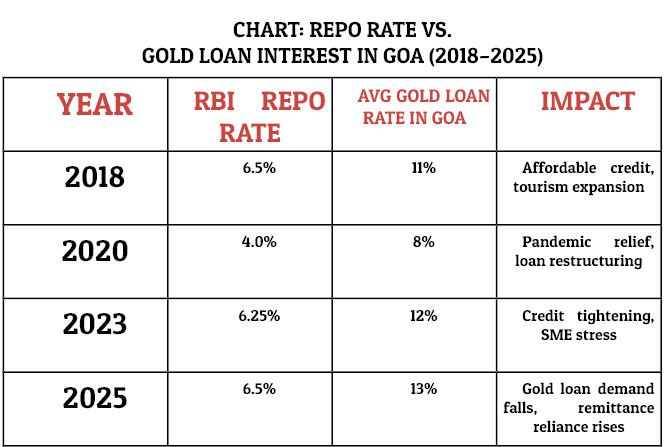
• Cooperative banks and credit societies that abound in rural Goa, dominating Goa’s rural credit landscape, align their loan pricing with these signals. When fisherfolk, approach their bank for a loan to repair their boat, the EMIs become higher than what was offered last year.
Goa’s Credit Realities
• Gold Loans: Popular in Goa, especially among households with Gulf connections. Gold loans are popular at the birth of an infant or during the wedding season. Rates have increased, to align with the increasing RBI rates.
• SMEs in Tourism: Guesthouses, shacks, and restaurants rely on affordable credit. Higher PLR squeezes margins.
• Cooperative Banks: Institutions like Goa Urban or Maupsa Urban Cooperative Bank must balance RBI’s directives with local lending needs.
Goa’s Global Linkages
• RBI intervenes in forex markets to stabilize the rupee, primarily against the US dollar.
• Legal authority comes from the RBI Act (1934) and FEMA (1999).
Goa’s Dependence
• Remittances from the Gulf: A weaker rupee boosts inflows, but volatility creates uncertainty for households.
• Tourism Competitiveness: A weaker rupee makes Goa cheaper for foreign tourists, but raises import costs (fuel, liquor, luxury goods).
• Exports (Cashew, Seafood): Exporters benefit from rupee depreciation, but RBI ensures volatility doesn’t destabilize trade.
Case Study: Rupee Depreciation (2025) When the rupee fell to Rs84 against the dollar, Goan households saw remittance values rise. Yet taxi fares and imported liquor prices spiked, showing the double-edged nature of forex shifts.
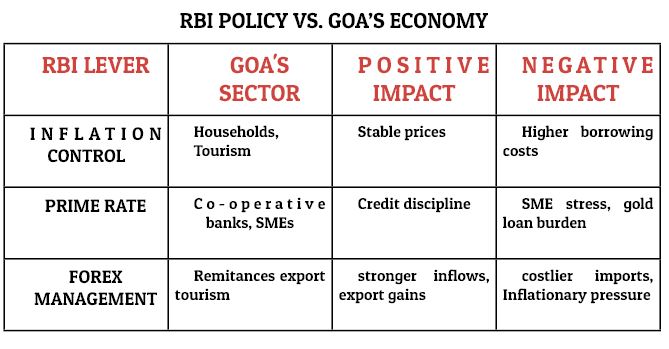
Goa’s Economic Triad – Inflation, Credit, and Currency
• Inflation: Determines household budgets and tourism costs.
• Prime Rate: Shapes credit availability for cooperative banks and SMEs.
• Forex: Governs remittance value and tourism competitiveness.
Together, these three levers form a triad of economic stability for Goa.
Risks and Challenges
RBI as Goa’s Silent Partner
Yes to the ordinary Goan, the Reserve Bank may not be a common place name as their local financial institution. However the Reserve Bank of India is more than a national regulator — it is Goa’s silent partner in economic stability. Its inflation control keeps fish prices and household budgets manageable. Its prime rate signals shape the viability of cooperative banks and gold loans. Its foreign exchange management safeguards remittance flows and tourism competitiveness.
For Goa, RBI is not a distant institution in Mumbai — it is the invisible hand balancing the state’s remittance-driven economy, tourism sector, and financial ecosystem.
 LETTER TO THE EDITOR FOR THE ISSUE DATED OCTOBER 24, 2026
 THERANOS MULTI-BILLION US PATHOLOGY COMPANY EXPOSED!
 INDIA’S PATHOLOGY LABORATORY SCANDAL! By Our Special Correspondent
 MUKESH, ADANI CONTROL MODI?By Our Special Correspondent
 “FRANCE KE SCHOOL THIK KARO”By Paris Correspondent
 INTEGRITY MUST BE CONDiTION FOR POWER!By Ranadhir Mukhopadhyay
 A PARADIGM SHIFT: POWER MOVES FROM POLITICS TO TECHNOLOGY AND TACTICS! By Arvind Pinto
 HI MUMBAI, MERI JAAN BUT…
 VILLAINOUS MUSK, ALTMAN, ZUCKERBERG, HOLMES!
 OPTOGENETICS AND THE RAY OF HOPE: LIGHT MEETS THE BRAIN! By Dr Amit Dias
 WEEKEND UPDATES
 LETTER TO THE EDITOR FOR THE ISSUE DATED OCTOBER 17, 2026
 AZAD MAIDAN NO LONGER FREE!
 AZAD MAIDAN CRACKDOWN! Goa’s crackdown on protesters raises grave questions about democracy! By Our Special Correspondent
 INDIAN WOMEN ARE ON THE STREETS AGAIN. EVERYTHING HAS CHANGED BUT NOTHING HAS CHANGED!By Shilpa Phadke
Goa is abuzz with excitement as vintage bike and car owners, users, collectors and fans are decking […]