Goa is abuzz with excitement as vintage bike and car owners, users, collectors and fans are decking […]
Old is Gold
October 4, 2016
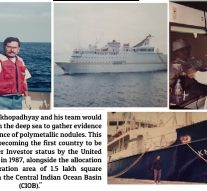
Goan Observer profiles marine researcher and author Ranadhir Mukhopadhyay, who came of age in an era defined by scientific temper and an unwavering zeal to build a knowledge-based nation
When Ranadhir Mukhopadhyay—a marine geologist who also wears the hats of an author, oceanographer, scientist, educator and policy advisor—first arrived in idyllic Goa in 1982 to join deep-sea research and exploration at the Council of Scientific and Industrial Research–National Institute of Oceanography (CSIR-NIO), it did not suit his temperament. Life on Goa’s streets would come to a halt by five in the evening, with silence descending over everything.
Having just completed an intensive 11-month study of the mangroves of the Sundarbans in the Bay of Bengal, young Mukhopadhyay took some time to adjust to the rhythm of life in Goa. But as he immersed himself in deep-sea exploration and the survey of polymetallic nodules in the Indian Ocean, his initial impression of Goa quickly faded.
There was unbridled excitement at CSIR-NIO as scientists looked to expand exploration activities beyond the Exclusive Economic Zone (EEZ)—an area extending 200 nautical miles from the coast—and stake India’s claim for deep-sea mining and other marine activities under the United Nations Convention on the Law of the Sea (UNCLOS), the legal framework adopted in 1982 to define states’ rights, jurisdiction and responsibilities over ocean space, environmental protection and marine resources.
CSIR-NIO launched the country’s first deep-sea programme through the Polymetallic Nodule (PMN) project, funded by the central government. The initiative led to the recovery of the first polymetallic nodule samples from the Arabian Sea in 1982. The institute was brimming with scientific fervour. Mukhopadhyay, who was part of this mission, felt he wouldn’t want to be anywhere other than Goa.
“It (Goa’s CSIR-NIO) was where I could make my mark,” he injected as narrated his story to the Goan Observer.
Along with a team of 20–25 members, he would set sail aboard a Norwegian research vessel on a six-day voyage into the deep sea. The team would then spend about 45 days at sea conducting research and exploration before returning to shore. Thereafter, they would spend another 45 days at the NIO laboratory analysing their evidences and findings, only to head back into international waters for the next expedition.
In 1987, India became the first country to be accorded Pioneer Investor status by the International Seabed Authority (ISA) and was allocated an exploration area of 1.5 lakh square kilometres in the Central Indian Ocean Basin (CIOB) for polymetallic nodule exploration. This was followed by the signing of a 15-year contract with the ISA in 2002. After detailed exploration and assessment, however, India relinquished half of the allocated area, retaining 75,000 square kilometres for continued deep-sea exploration.
“All this was possible because NIO was able to provide evidence of polymetallic nodules on the seabed. We meticulously worked to meet every criterion laid down under UNCLOS. It was tough, but we did it. It took us 20 years—from 1982 to 2002,” he said jubilantly.
The groundwork carried out by Mukhopadhyay and his team also helped expand India’s rights to explore and exploit seabed resources over an Extended Continental Shelf (ECS) spanning roughly 12 lakh square kilometres.
He was also part of CSIR-NIO’s extensive research on the Indian Ocean’s mid-ocean ridges—the Carlsberg Ridge and the Central Indian Ridge—which led to the discovery of deep-sea hydrothermal vents and revealed how glacial cycles and falling sea levels boost underwater volcanic activity.
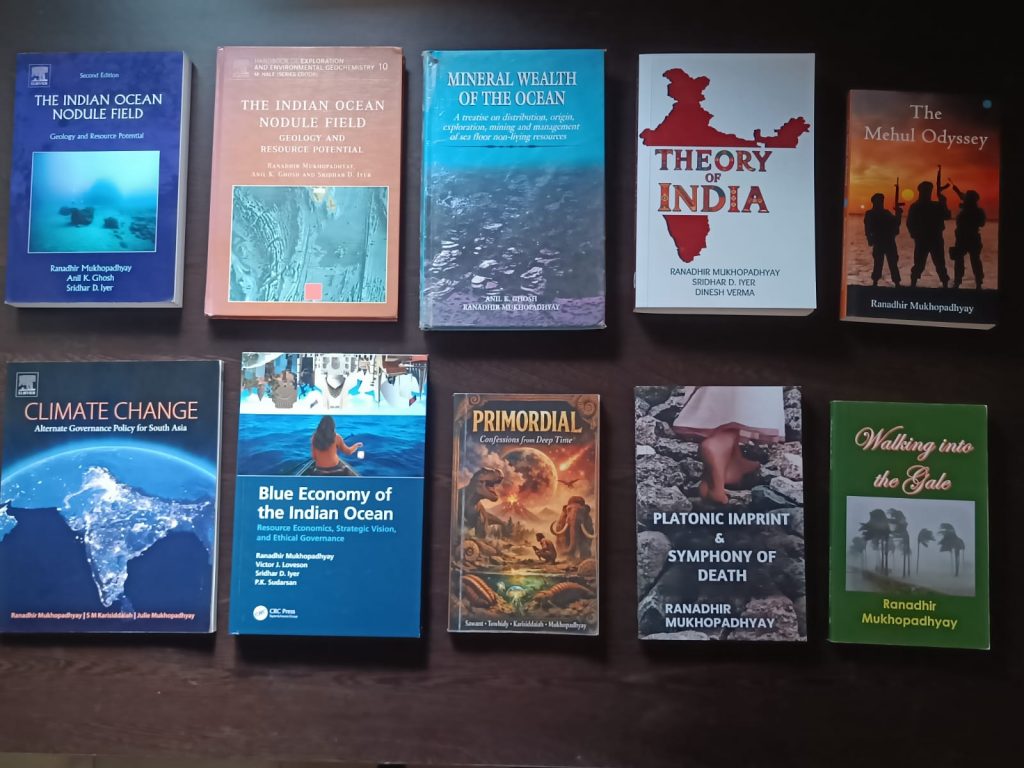
Having gained expertise in coastal geomorphology, deep-sea research and exploration, the blue economy, and climate governance during his tenure at CSIR-NIO, the avid marine geologist has authored ten books. The publication of these books stem from his staunch belief that knowledge does not serve its purpose until shared.
His next book, on the mangroves of the Sundarbans—a subject close to his heart—is expected to be published before the end of the year.
“I started working on it (mangroves of Sundarbans) in 1981 (after graduating from the University of Calcutta). There has been a gap of more than 35 years during which I didn’t actively work on it, but I kept track of the subject,” he said.
Decades of work in marine geology has made Mukhopadhyay acutely aware that geopolitics is integral to issues relating to the blue economy and climate governance. He firmly believes that any lasting solution to the governance of the Sundarbans can emerge only through collaborative efforts.
“Almost 60% of the Sundarbans lies in Bangladesh and 40% in India. If we believe the Sundarbans should be governed separately by each country, it will not work. There should be joint governance (of Sundarbans) by both countries,” he asserted.
In early 2000, when the island nation of Mauritius was looking for someone to set up its oceanography institute, it turned to Mukhopadhyay, who served as the director of the Mauritius Oceanography Institute (MOI) from February 2002 to February 2004.
“If any country should have a strong oceanography programme, it should be Mauritius. Yet, until the turn of this century, oceanography there remained underdeveloped. Today, it has grown not only in scientific depth but also in its breadth of activities,” he said.
Even after retiring from CSIR-NIO in 2018, Mukhopadhyay has refused to hang up his boots. He remains engaged in a wide range of pursuits, flitting from serving as the general secretary of the Ganga Zuari Academy—a platform promoting cultural harmony—to advancing his vision of spreading scientific knowledge for societal impact through the Tapovan–Centre for Contemporary Research (CCR).
He is now seeking to extend his work beyond India’s borders with the Global South Initiative, which aims to “advance the knowledge architecture of the Global South” and influence global policies relating to science, society, governance, culture, humanity and geopolitics.
He may have his finger in many pies, but he still finds time to organise a three-day workshop, ManavNama, to discuss the guiding principles of humanity and attempt to awaken the dormant sense of humanity within people.
And as he goes about all this, environmental activist and innovator Sonam Wangchuk’s hunger strike at Jantar Mantar in New Delhi has caught his attention, with its message resonating deeply with him. To express his solidarity with Wangchuk, Mukhopadhyay has also been on a liquid diet since July 2.
“We need people like Sonam Wangchuk, who are pure and have the spine,” said the scientist, who blends rationality and emotion in the right proportions.
‘ManavNama’ Conclave to Explore the Art of Being Human Beyond Leadership
Three-day Goa initiative will bring together thinkers, educators, professionals and seekers to reflect on the future of humanity
At a time when the world is witnessing extraordinary advances in artificial intelligence, technology and economic development while simultaneously facing rising conflict, loneliness, ecological crises and declining trust, a unique conclave in Goa seeks to ask a question that is both ancient and urgently contemporary: What does it truly mean to be human?
The Ganga Zuari Academy will organise “ManavNama – Beyond Leadership: A Three-Day Conclave to Rediscover the Art of Being Human” from 24 to 26 July 2026 at the Fern Residency Miramar at Caranzalem.
Unlike conventional leadership programmes that focus on management skills or professional success, ManavNama has been conceived as an immersive journey into self-awareness, ethical living and collective responsibility. Over three days, participants will engage in dialogue, reflection and collaborative learning through six thematic sessions covering Self, Mind, Relationships, Education, Wisdom and the Future of Being Human.
This is probably India’s first national conclave dedicated to rediscovering the art of being human. The conclave brings people from all social strata and age groups, who believe that sustainable progress requires not only economic and technological innovation but also moral imagination, compassion and wisdom.
Each session will combine expert perspectives with small-group deliberations, encouraging participants to question assumptions, exchange lived experiences and jointly explore pathways towards more humane societies. The organisers describe the programme as a “laboratory of ideas” where every participant becomes both a learner and a contributor.
Announcing the initiative, Dr Ranadhir Mukhopadhyay, Convenor of ManavNama, said: “Humanity has mastered the science of building faster machines, taller buildings and stronger economies. Yet we have paid far less attention to building character and better human beings. ManavNama is an invitation to pause, reflect and rediscover the values that make us truly human—awareness, compassion, integrity, imagination and responsibility. Before we transform society, we must first understand ourselves.”
The conclave will conclude with the ManavNama Declaration – A Call to Action. The programme is supported by the Government of Goa and the Maria Crescencia Menezes Memorial Education Trust. Registration for the conclave is now open.
Event Details
ManavNama – Beyond Leadership: A 3-Day Conclave to Rediscover the Art of Being Human (www.manavnama.gangazuari.org)
Dates: 24–26 July 2026; Venue: Fern Residency Miramar at Caranzalem
Call/ WhatsApp 9422438821 to register. Limited seats available.
 LETTER TO THE EDITOR FOR THE ISSUE DATED OCTOBER 10, 2026
 WHEN THE MACHINE OVERRIDES THE LAW!
 HAS GOA BECOME MORE PERMISSIVE? By Special Correspondent
 BILLIONAIRES MULTIPLYING AT THE COST OF THE MIDDLE CLASS!
 THE SHADOW OF VOTE THEFT: WHY CEC GYANESH KUMAR MUST RESIGN!By Dr Olav Albuquerque & Deborah Cordeiro
 ULTRA MODERN ‘MID-DAY’ OFFICE
 HI MUMBAI MERI JAAN BUT…
 TCS INVOLVED IN SIR MATCH FIXING!
 CEREBRAL PALSY: UNDERSTANDING ABILITY, ENABLING INCLUSION! By Dr Amit Dias
 WEEKED UPDATES
 LETTER TO THE EDITOR FOR ISSUE DATED OCTOBER 03, 2026
 GEN-Z BLOCKED FROM VOTING BY GYANESHWAR MODI!
 THE FORAL OF 1526 Five Hundred Years Later, What Does Goa’s Oldest Village Charter Really Mean?
 20 YEARS IN ‘HERALD’, 43 IN GOA!
 THE DEGRADATION OF JNU – MY ALMA MATER! By Arvind Pinto
Goa is abuzz with excitement as vintage bike and car owners, users, collectors and fans are decking […]