Goa is abuzz with excitement as vintage bike and car owners, users, collectors and fans are decking […]
Old is Gold
October 4, 2016

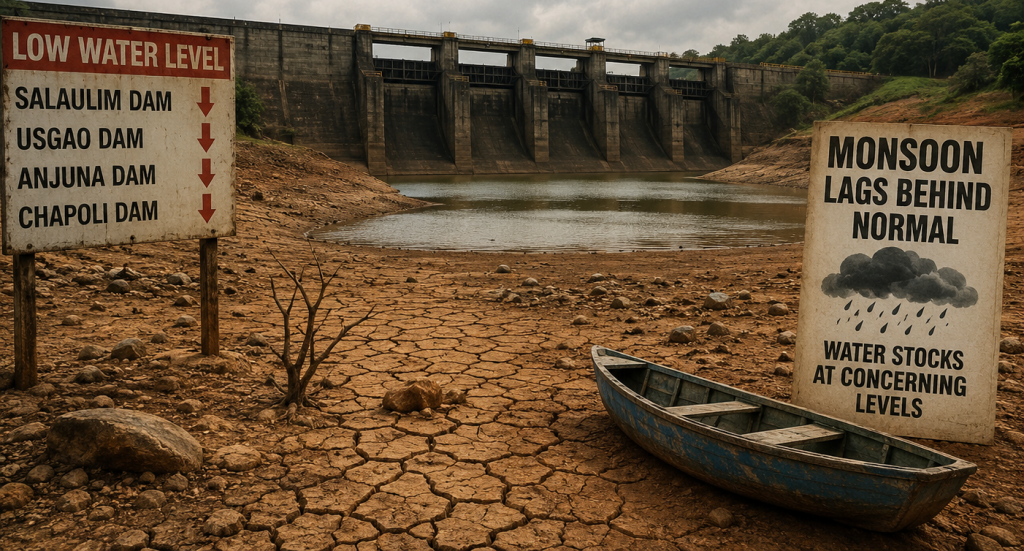
Though there have been reasonably heavy rains the dam reservoirs in Goa are still only half full. The rain in July has not made up for the deficit of rain in June. This will lead to water scarcity for the rest of the year and especially during peak tourism season which is from December onwards….
OUTSIDE the windows of any traditional Goan balcao, the weather presents a familiar, comforting illusion. Torrential July downpours pour off terracotta roof tiles, muddy waves lash the shores of Miramar and Calangute, and whatever coastal fields are around are brilliant shades of emerald. To the casual observer, Goa is drowning in water.
But 50 kms inland, deep within the densely forested valleys of the Western Ghats, a quieter and far more alarming reality is unfolding.
Goa’s massive reservoirs, the engineered lifelines that store the monsoon’s bounty to keep the state alive through eight months of dry weather, are enduring an unprecedented, sluggish recovery. The iconic Selaulim Dam in Sanguem, famous for its magnificent 44-meter “duckbill” spillway, missed its historic July 7 overflow deadline. For the first time in nearly a decade, the spillway stands bone-dry, a towering concrete monument to a changing climate.
If these grand reservoirs fail to hit peak capacity by October, Goa is hurtling toward a devastating socio-economic domino effect that will disrupt everything from village paddy fields to five-star coastal resorts by the spring of next year.
MONSOON CRISIS
TO understand why Goa’s dams are starving despite the current downpours, we have to look at the numbers from June. The crisis was born because the monsoon simply didn’t show up on time. Goa wrapped up the month of June with a staggering 34% shortage in total rainfall. Instead of the usual heavy rain expected for the month, the state received very little. It stands as one of the driest openings to a rainy season that Goa has seen in the last 14 years.
Worse still, the rain was highly unequal. North Goa took the hardest hit with a massive shortage, while South Goa fared slightly better. While a few isolated spots like Canacona saw heavy storms, cities like Panaji and industrial towns like Bicholim were left largely dry.
This lack of early rain meant that water levels inside the dams plummeted to dangerously low depths — before somewhat heavy rains finally arrived in July. Selaulim Dam dropped to just 27% full in mid-June, while the Anjunem Dam in Sattari was nearly empty at just 9.9%. When the heavy rainfall finally hit in July, billions of gallons of water were spent just trying to bring the dams back to a basic starting point, rather than building up toward an overflow.
How can it flood on the coast without filling up our main dams? It comes down to where the rain falls and how the ground behaves.
A dam does not fill up from the rain that falls on beaches or coastal towns. It relies entirely on the high, forested hills far inland where rivers are born. When May and June pass without a drop of rain, the soil in the forests turns into a giant, baked, dehydrated sponge.
When the first heavy storms finally hit in July, the parched forest floor drinks up the water to refill deep underground reservoirs and quench the roots of the trees. Until this massive underground “sponge” is completely soaked, very little water actually flows off the land into the rivers that feed our dams.
Furthermore, the style of our rainfall has completely changed. Instead of the steady, continuous, gentle drizzle that older generations of Goans remember, which allowed rivers to rise smoothly, modern weather brings sudden, violent cloudbursts, followed by long sunny spells. When a massive amount of water dumps over dry ground in just an hour or two, the water rushes off the surface too quickly. It causes local mudslides and flash floods instead of a steady, controlled rise of water inside the dams.
HOW WATER BEHAVES!
THE current crisis has exposed a massive difference in how water is behaving across Goa. The state’s five major and minor dams tell completely different stories:
WHAT HAPPENS IF DAMS DON’T FILL UP
IF the rainy season ends in October without these dams hitting 100% capacity, Goa will face a slow-burning crisis by next spring.
Selaulim Dam alone has the capacity to supply a staggering 380 million liters of water every single day to south Goa. If it sits low in October, water cuts will become mandatory by January. While big towns might suffer from lower water pressure for a few hours, villages at the very end of the pipeline will lose water entirely.
When public taps run dry, ordinary common people are left at the mercy of private water tankers. These commercial tankers buy water from private wells and sell it at exorbitant rates. Working-class families could find themselves paying between Rs1,000 to Rs1,500 per tanker multiple times a week — a crushing expense that many simply cannot afford.
For Goa’s farming communities, the consequences are immediate. The Selaulim canal system waters over 14,000 hectares of farmland. When drinking water runs low, the government is forced to shut off these agricultural canals early. Traditional Goan farmers who rely on this water for their winter crops like rice, local chillies, sweet potatoes, and onions will be forced to leave their fields empty, destroying their income and driving up vegetable prices in local markets.
As tap water vanishes, households will naturally turn to local open wells and bore wells. However, because the low dams will fail to refill the surrounding ground water, well levels would have dropped drastically. When fresh well water drops too low, it creates a vacuum that pulls salty water from the sea and tidal rivers straight into the ground. Once a village well turns salty, it is permanently ruined for both drinking and farming.
The current state of Goa’s dams proves that the old ways of managing our water no longer work. Despite living in a tropical paradise that receives massive amounts of rain every year, relying entirely on a few giant concrete dams leaves everyone vulnerable to just a single bad month of dry weather. As July progresses, the rains will likely continue to fall, and the dams will slowly climb. The famous duckbill of Selaulim may well overflow before the season ends. While the dam missed its traditional July 7 deadline to fill up completely and overflow from its famous duckbill spillway due to a dry, weak monsoon in June, the situation is turning around quickly. The dam is currently at a 42.5% storage capacity and the intense, heavy downpours hitting the state right now are rapidly saturating the forest ground and filling up the reservoir. WRD officials and water engineers expect that if the current heavy rains hold their momentum, the water levels will rise steadily, and Selaulim dam is on track to reach full capacity and spill over by August.
BUT this year’s frighteningly slow start must serve as an explicit warning. The monsoon is no longer a guarantee. It is time for Goa to stop looking at the dark skies for salvation, and start looking at how it manages the water right beneath its feet, and at the same time set the need to understand climate change at a deeper level and take action in motion to ensure a better future.
 LETTER TO THE EDITOR FOR ISSUE DATED OCTOBER 03, 2026
 GEN-Z BLOCKED FROM VOTING BY GYANESHWAR MODI!
 THE FORAL OF 1526 Five Hundred Years Later, What Does Goa’s Oldest Village Charter Really Mean?
 20 YEARS IN ‘HERALD’, 43 IN GOA!
 THE DEGRADATION OF JNU – MY ALMA MATER! By Arvind Pinto
 THE WOMEN WHO LOOK BACK! By Prema Viswanathan
 GOA IS CELEBRITY STATE!
 HI MUMBAI MERI JAAN BUT…
 WEEKEND UPDATES
 LETTER TO THE EDITOR FOR ISSUE DATED SEPTEMBER 26, 2026
 DIVIDED EVEN IN DEATH!By Rajan Narayan
 IF YOU CLAIM THE CREDIT, TAKE THE RESPONSIBILITY!By Joquim Goes
 8 EMAILS IN 7 DAYS, BUT VALID GOA VOTERS STILL LEFT OUT: EC’S FLAWED SYSTEM!By Ritika Chopra
 MAKE IN INDIA: UNITED PAYMENTS INTERFACE India’s digital local leap to global benchmark…By Arvind Pinto
 BRING BACK THE FLATBREADS OF INDIA!
Goa is abuzz with excitement as vintage bike and car owners, users, collectors and fans are decking […]