Goa is abuzz with excitement as vintage bike and car owners, users, collectors and fans are decking […]
Old is Gold
October 4, 2016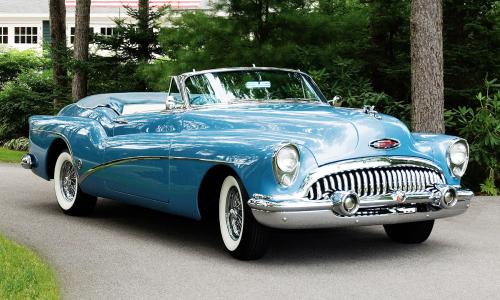
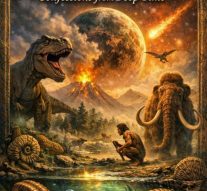
HUMAN experience is bound tightly to the ephemeral. We construct our civilizations, evaluate our economies, and map our global anxieties within frames of years, decades, or, at most, centuries. Yet the stage upon which this human drama unfolds operates on a scale so vast that it completely transcends our biological perception. This is the domain of the Reunion Hotspot — a 4.5-billion-year history written not in ink, but in the slow cooling of magma, the shifting of colossal tectonic plates, and the chemical signatures locked inside deep-sea sediments.
“What if the earth could speak?” In their groundbreaking book, Primordial: Confessions from Deep Time (published in March 2026), a multi-disciplinary team of Indian scientists — including renowned oceanographer Dr Ranadhir Mukhopadhyay, geologist Dr Poornima D Sawant, marine biologist Syntheia Towhidy, and pioneering earth scientist Dr S M Karisiddaiah — have come together to translate the earth’s biography through the voice of the Reunion hotspot by answering this question.
But this is not another textbook on ancient rocks. Viewed through the lens of today’s turbulent climate reality, “Primordial” serves as an urgent, poetic, and humbling mirror for 21st-century humanity. Including detailed images and graphs, this artful rendition of the voice of the Reunion hotspot is written in a poetic manner designed to touch the depths of your soul.
“Primordial: Confessions from Deep Time” is structured as a progressive journey from the earth’s chaotic, molten infancy to its present state of equilibrium. Quoting from the book the Reunion hotspot is “a storyteller of ancient fires that forged continents and sparked the dawn of life itself.” Rather than relying on dry academic jargon, the authors approach the planet as a dynamic, living system that continuously records its own history.
The book’s chapters are built around several foundational pillars of earth science, enriched by the authors’ real-world expeditions in the Indian Ocean:
• The Lithospheric Canvas: The authors unpack the mechanics of plate tectonics, showing how the Earth’s rigid outer shell is continuously recycled. They guide readers through the mid-ocean ridges– underwater mountain ranges where the Earth literally tears itself open to release mantle heat and create fresh crust.
• The Sedimentary Time Capsule: Through paleoceanography, the book explains how columns of deep-sea mud act as historical archives. By examining the micro-fossils of ancient plankton and calculating stable oxygen isotope ratios, scientists can reconstruct global sea levels, ocean currents, and atmospheric compositions dating back millions of years.
• Multiple generations: At its crux the book encapsulates the amount of life the earth has seen including the mass extinctions and the ever continuing evolution of different life forms. This mantle plume may wipe out generations but at the same time never stops giving birth to new ones — teaching us the philosophy of the continuation of life.
The Reunion Hotspot:
Unlike typical volcanism, which occurs at the boundaries where tectonic plates collide or separate, a hotspot is driven by a mantle plume — a localized, buoyant column of hyper-heated rock rising from the deep core-mantle boundary, thousands of kilometers beneath the earth’s surface. As a tectonic plate slowly drifts over this stationary thermal anomaly, the plume burns through the lithosphere like a cosmic blowtorch, leaving a chronological trail of volcanic activity etched into the earth’s crust.
The authors detail how the Réunion hotspot played a foundational role in fracturing continents and re-routing the course of evolutionary history, rising by consequence and not by chance.
The Deccan Traps:
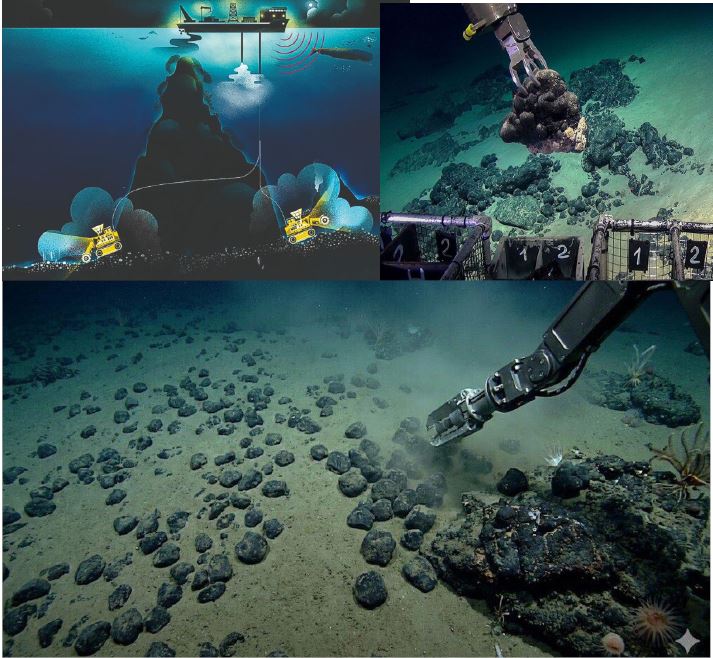
AROUND 66 million years ago, the northward-migrating Indian subcontinent drifted directly over the peak of the Réunion mantle plume. The resulting thermal pressure caused a massive rupturing of the continental crust, triggering one of the most violent volcanic episodes in earth’s history.
Over a brief geological window, millions of cubic kilometers of liquid basalt poured out across western and central India, creating the vast volcanic layers known today as the “Deccan Traps.” The book vividly describes how this event released staggering quantities of sulfur dioxide and carbon dioxide into the atmosphere, destabilizing global climates and acting as a primary driver — alongside the Chicxulub asteroid impact — of the mass extinction that wiped out the dinosaurs.
THE book also focuses in detail the hotspot’s geochemical architecture, chemistry and elemental characters, the formation of islands and continents, modern geopolitical ambitions regarding the deep ocean, and the important topic of civilisation which began with the unearthing of heat – fire — through which they dispel the myth of the earth being a cold static rock. This planetary metabolism operates under a strict law of conservation: heat must escape and crust must be recycled. The volcanic outpourings of hotspots like Reunion are the planet’s natural exhaust valves, regulating internal pressures accumulated over hundreds of millions of years. By observing the sheer scale of these thermal systems, the reader is forced to confront the absolute insignificance of human engineering when measured against the fundamental geodynamic forces that govern the globe.
The true brilliance of “Primordial: Confessions from Deep Time” lies in its final chapters, where the authors pivot from ancient geodynamics to the immediate reality of the 21st century. They construct a profound bridge between the slow, majestic rhythms of Deep Time and the hyper-accelerated chaos of modern industrial civilization by showcasing a fictional conversation between the hotspot and the sapiens (via Yuval Noah Harari’s Sapiens). The final chapters provide answers to riddles of the scientific mind inviting alleviation to curiosity and the conversations give us — sapiens of the 21st century — a copious amount of thinking to do about what we’re doing to our planet and how our planet will react to our actions once she’s had enough.
Evaluating the current state of our atmosphere and oceans, their tone shifts from scientific wonder to urgent warning. They note that during the creation of the Deccan Traps by the Reunion hotspot, massive amounts of greenhouse gases were injected into the biosphere, causing severe global warming and ocean acidification. However, even that cataclysmic volcanic event unfolded over hundreds of thousands, if not a million, years.
Today, human industrial civilization is burning fossil fuels and clear-cutting forests at a rate that injects carbon dioxide into the atmosphere roughly 10 to 100 times faster than the natural volcanic outpourings of the geological past. We have taken planetary shocks that the earth historically metered out over entire epochs and compressed them into a single human lifetime. This rapid change gives the biosphere no time to adapt, leading directly to the collapsing ecosystems, warming oceans, and accelerating mass extinctions we observe today.
Ultimately, “Primordial: Confessions from Deep Time” provides an antidote to the frantic modern world. It demonstrates that the climate crisis is not fundamentally about “saving the planet.” The earth has survived hotspots, massive asteroid impacts, and atmospheres thick with toxic gas, and it will continue to endure long after humanity is gone. Reunion tore apart Gondwana, ruptured the crust beneath India and spread the land with lava. Do humans think the earth won’t endure this? The true crisis is that we are rapidly dismantling the highly specific, incredibly fragile environmental parameters that allow human civilization to survive. By pulling our gaze away from the relentless, short-term anxieties of the 24 hours news cycle and anchoring it in the majestic, slow-churning narrative of plate tectonics and mantle plumes, the authors deliver a profound lesson in existential humility.
They remind us that human beings are not the masters of this planet, but are a living ongoing experiment and its newest, most volatile passengers — occupying a mere fraction of a second on the grand cosmic clock. They challenge us to shed our short-sighted perspectives, step away from our present-moment panic, and begin acting as responsible, long-term custodians of a planet that took 4.5 billion years to build the world we call home.
Reunion says, “I am not just a single event in isolation; I am avital note in Earth’s grand symphony—a voice that resonates throughout the planet. When I express myself, the atmosphere leans in to listen. The oceans respond, and life itself shifts, adapts, or struggles in response to my influence.” So ask yourself, why should you not?
 LETTER TO THE EDITOR FOR THE ISSUE DATED OCTOBER 10, 2026
 WHEN THE MACHINE OVERRIDES THE LAW!
 HAS GOA BECOME MORE PERMISSIVE? By Special Correspondent
 BILLIONAIRES MULTIPLYING AT THE COST OF THE MIDDLE CLASS!
 THE SHADOW OF VOTE THEFT: WHY CEC GYANESH KUMAR MUST RESIGN!By Dr Olav Albuquerque & Deborah Cordeiro
 ULTRA MODERN ‘MID-DAY’ OFFICE
 HI MUMBAI MERI JAAN BUT…
 TCS INVOLVED IN SIR MATCH FIXING!
 CEREBRAL PALSY: UNDERSTANDING ABILITY, ENABLING INCLUSION! By Dr Amit Dias
 WEEKED UPDATES
 LETTER TO THE EDITOR FOR ISSUE DATED OCTOBER 03, 2026
 GEN-Z BLOCKED FROM VOTING BY GYANESHWAR MODI!
 THE FORAL OF 1526 Five Hundred Years Later, What Does Goa’s Oldest Village Charter Really Mean?
 20 YEARS IN ‘HERALD’, 43 IN GOA!
 THE DEGRADATION OF JNU – MY ALMA MATER! By Arvind Pinto
Goa is abuzz with excitement as vintage bike and car owners, users, collectors and fans are decking […]