Goa is abuzz with excitement as vintage bike and car owners, users, collectors and fans are decking […]
Old is Gold
October 4, 2016
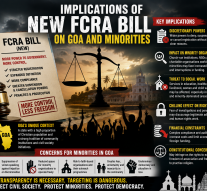
The Foreign Contribution (Regulation) Amendment Bill, 2026, establishes a stringent “Designated Authority” framework to manage and dispose of assets of organizations losing their FCRA licenses. While the government frames this as a transparency reform, minority groups and churches voice grave fears over potential executive overreach and asset takeovers. The impact of this legislative push is poised to hit Goa and its historical ecclesiastical infrastructure with unique structural and economic force.
The very fact that the Modi government wants to use this amendment to trace the roots of foreign inflows of funds, using the ploy that such huge amounts of funds have been used for anti-national policies, is a grave cause for concern. This is all the more so given that the murderer of Graham Staines will possibly be released by the Odisha government for setting on fire this missionary and his two infant sons. Nationalism is the last defence of the scoundrel, the thief and the religious fundamentalist.
The Anatomy of the 2026 Amendment
THE legislative push surrounding the Foreign Contribution (Regulation) Act (FCRA) marks a profound shift in how New Delhi monitors transnational philanthropy, religious remittances, and civil society operations. According to Ministry of Home Affairs data, thousands of organizations across India previously accounted for tens of thousands of crores in foreign inflows. The new statutory framework sets out clear parameters for what happens when an organization’s certificate expires, is surrendered, or faces cancellation.
At the heart of the legislation is the creation of a centralized designated authority. This body is empowered to provisionally or permanently vest, supervise, manage, and dispose of unutilized foreign contributions and any physical or institutional assets built using those funds. While the government insists that places of worship will retain their religious character under this authority, critics remain deeply skeptical about how these safeguards will apply in practice to expansive church compounds, educational blocks, and charitable infrastructure.
Apprehensions within Minority and Church Networks
RELIGIOUS bodies, including the Catholic Bishops’ Conference of India (CBCI), have voiced profound anxiety regarding the broad discretionary powers granted to state executives. Christian institutions across the country — ranging from rural dispensaries and elite urban colleges to historical dioceses — frequently depend on overseas humanitarian remittances.
Community leaders argue that introducing tighter compliance thresholds — such as compelling minimum spending metrics or restricting the transfer of funds — places an undue administrative burden on grassroots networks. For detailed background on how the core legislation operates, you can read the official overview on the Pib.gov.in Factsheet. Critics contend that rather than targeting financial corruption, the mechanisms risk choking the operational autonomy of minority-run institutions that have served marginalized populations for generations.
Structural Impact on Goa and its Diocesan Assets
IN Goa, where the Catholic Church manages an extensive network of centuries-old institutions, social welfare centers, and educational networks, the 2026 Bill introduces an unprecedented existential vulnerability. Goa’s distinct historical trajectory under Portuguese rule left the Church with substantial real estate holdings, old convents, and parish properties managed by the Archdiocese of Goa and Daman.
The creation of the centralized designated authority means that if an ancient educational trust, an orphanage, or a village medical dispensary faces an administrative license suspension or an un-renewed FCRA certificate, the physical real estate built or maintained via transnational historical funds can be provisionally frozen or vested with state administrators. Local legal watchdogs argue that the phrase “assets built using foreign funds” is dangerously ambiguous. In Goa, where local community contributions and foreign remittances have blended for decades to maintain vast heritage sites, this statutory ambiguity opens a wide backdoor for hostile bureaucratic interventions and land-grabbing attempts under a legal veneer.
Furthermore, Goa’s vibrant diaspora, spread across Europe, North America, and the Gulf, routinely sends charitable remittances back to their native parishes for village development, historical chapel restorations, and local medical relief. By complicating incoming remittances and enforcing micro-level minimum spending metrics, the Bill effectively chokes the localized financial pipeline that has sustained Goan social networks independently of state funding.
Legislative Intent Versus Civil Liberties
THE official rationale presented by the administration emphasizes national security, financial transparency, and the prevention of unauthorized proselytization or misuse of foreign donations. Proponents of the bill argue that stricter asset-vesting provisions plug critical regulatory loopholes, ensuring that funds from abroad fulfil stated developmental purposes without exerting un-vetted external influence on domestic social fabrics.
Conversely, opposition parliamentarians and civil liberties watchdogs view the timing and tenor of the legislation as an alarming parallel to other contentious identity-based legal overhauls. They point out that reducing maximum imprisonment terms for technical infractions from five years down to one year does little to mitigate the core fear: that the state is shifting its strategy from punitive penal action to total administrative expropriation of non-profit and faith-based assets.
Broader Implications and Parliamentary Debate
AS floor leaders spar in Parliament, the debate reflects a widening gulf between pluralist defence and majoritarian governance. In Goa, the political fallout could be severe. The state’s delicate socio-religious harmony relies heavily on mutual respect for institutional autonomy. Subverting this autonomy by enabling external state bureaucrats to sit on the boards of or supervise diocesan welfare assets introduces severe friction into the local governance fabric.
International scrutiny has also surfaced, with external observers noting the potential friction such sweeping regulatory powers could introduce into diplomatic and cultural exchanges. For Goa, a state that serves as a global cultural bridge and attracts international heritage travellers, the potential paralyzing of church-led social institutions under technical regulatory pretexts poses a grave threat to its global reputation and internal peace.
 LETTER TO THE EDITOR FOR ISSUE DATED SEPTEMBER 19, 2026
 ELEVATED HIGHWAY TO HELL!
 MEDICAL DEVICES LOOT!By GS Mudur
 HOSTILE ACT BY PAKISTAN: `PNS HUNAIN’ TRIED TO DISRUPT OUR NAVAL SURVEILLANCE! By Dr Olav Albuquerque & Deborah Albuquerque
 BLACK MONEY IN POLITIAL PARTIES: ADR’s Alarming Revelations By Arvind Pinto
 `KHANDVI MILLE-FEUILLE’ AT BRICS ALL VEG BUFFET!
 SATYA NIKETAN TRAGEDY: HOW GLOBAL STUDENT HOUSING MODELS COULD HELP INDIA FIX A BROKEN SYSTEM!By Sneha Swaminathan
 GANESH PANDALS HIJACKED BY ADANI, AMBANI
 WHY DOES A DEMENTIA DIAGNOSIS MATTER? By Dr Amit Dias
 WEEKEND UPDATES
 LETTERS TO THE EDITOR FOR ISSUE DATED SEPTEMBER 12, 2026
 GOAN TEACHERS ARE CONTRACT LABOR!
 THE COLOUR IS PRESTIGIOUS! THE PROCESS MUST BE EQUALLY SO!
 DOGS ATTACK GOANS, OWNERS GET ACQUITTED!By Dr Olav Albuquerque & Deborah Cordeiro
 CYBER FRAUD: A THREAT TO FINANCIAL SECURITY & MENTAL WELL-BEING! By Adv Vinayak (Mama) D Porob
Goa is abuzz with excitement as vintage bike and car owners, users, collectors and fans are decking […]