Goa is abuzz with excitement as vintage bike and car owners, users, collectors and fans are decking […]
Old is Gold
October 4, 2016
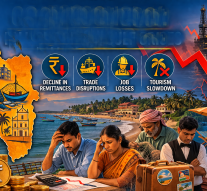
GOA, the tourist paradise of India, has been hard hit by the West Asian crisis. For while there is a temporary lull in the hostilities, the missiles and bombs have paused and talks have stalled, the damage in terms of monetary transactions and tourism has affected the state . While the US and Israel, seek to settle scores with Iran and Lebanon, the fallout for countries like India is enormous. For Goa, like Kerala, has a close connection with the Gulf, in terms of employment. Let us look at how does this war nobody wanted has affected the life of the common man in Goa.
For decades, the Gulf has been a dream for many Goans, given the fact that during the last decades of the last century, there were little opportunities in Goa. With oil, in the Gulf there were opportunities of jobs for Goans and many of the educated young men, worked their lives in these Emirates, sending dinars, dirhams and rials to their families in Goa. It is estimated that around 8 to 10% of Goans work in the Gulf, thanks to their education, their technical skills and earlier Portuguese colonial connection. These Goans continued to send money home to support their families. Let me give you one such example.
MRS DESOUZA lives as a widow in a village in Goa. Retired as a teacher from the local village school, she was happy when her son Romeo found a job in Saudi Arabia. Her trip to the local bank each month was important since Romeo would transfer a monthly remittance to his mother. She was indeed fortunate to have her son to send her money, and who would come home for Christmas with a little gold trinket for her. Now not only have the remittances stopped, but Romeo is on his way home, since the war has caused uncertainty in Saudi.
INCOMES IMPACTED
LIKE Romeo, there were several Goans employed in the UAE, Qatar, Bahrain, Saudi and Oman. Goans were employed in several sectors : hospitality, construction, and the service industry. Goans remitted around Rs1,200 to Rs1,500 crore annually, which was a crucial life line for their aged parents and families. It is expected that this will now dip by around 20% impacting family incomes and local consumption.
For the Goans who have been fortunate to retain their jobs in the Gulf, the regular remittance flows have also slowed, since many workers are unable to access banks or exchange houses easily. There are transaction delays of about two to three days for transfer of money due to restricted operation and strained correspondent banking. Besides the commission charges for transferring money has increased due to the current crises. In normal times, exchange houses in the Gulf would charge around 2 to 3 % for remittances. This has now increased to around 5% for transfers routed through secondary banking channels. Further the fluctuations in the rupee against the dirham, riyal and dinar, translates into extra margins raising the cost of remittances.
Interestingly enough, the hawala system of money transfer at this time has increased. With formal transfer costs increasing to 5%, several Goan workers rely on hawala transfer of money where the cost of commission is as low as 1 to 2% of the transaction.
Impact on Tourism
ONE of the mainstay of the Goan economy is tourism. The war in the Middle East has reduced foreign tourists from Europe and the Middle East, due to the increase in airfares, the destruction of the airports and the security concerns associated with the war. Russian and East European charters, once a big source of foreign tourists, have reduced both their flights as also the number of tourists. Reports from the Goa Tourism Department and the hospitality associations suggest a 15-20% drop in the inflow of foreign tourists as compared to the previous year.
This fall in the tourist arrivals has a ripple effect of the economy in diverse ways. Over the decades, Goa has built up a substantial infrastructure of hotels and resorts of different values. Currently, Goa has around 85,000 to 90,000 rooms available from high end resorts, guest houses, and homestays. The decline in foreign tourists will mean a lower occupancy rate as also a decrease in the income to these establishments. The decrease in the occupancy will directly affect employment of temporary staff, such as cleaning and housekeeping staff. Most of these are migrant gig workers, who would be hit by the layoff. Most of these unskilled workers earn around on an average around 300 per day, or 9000 per month, if they get daily work. These gig workers would be the first to be laid off in case of a drop in the income of the hospitality and tourism sector.
Further the hospitality sector, supports several ancillary industries. Around most of the coastal belt, there are several restaurants, eateries, shops, and other services for tourists. The fall in the number of tourists effectively translates into a fall in the revenue for these dealers.
With the decrease in tourism, many of the ancillary sectors would also see a down turn. This has affected many of the migrants from the neighbouring states who are now returning home. The return of the migrants to their homes, would also have an impact on the local services that most Goan households require.
LPG STATUS
WHILE in most other urban centres of the country, there is an acute shortage of LPG. Fortunately, in Goa there is no current shortage. The typical time to get a replacement cylinder is 25 days, as against the immediate delivery earlier. government is assuring Goans that there is a sufficient stock for 15 days supply in Goa. In order to ensure that domestic customers get their cylinders, commercial supply of LPG has been restricted. This restriction has affected the local “gaddos” which majorly use LPG cylinders to cook. Sadly, the shortage of LPG is felt in the villages of Goa, where distribution is poor. Many household have now to wait for a month before their can obtain a replacement of their cylinder.
While most of India, has been affected by the recent Gulf crises, the economy of Goa, being dependent upon tourism and is reliance on Gulf remittances, faces a double whammy. This has also affected the coffers of the government. How long will this crises last? While on the international scene, politicians play games, the lives of the common Goan continue to suffer in silence and hope of a better tomorrow!
 LETTER TO THE EDITOR FOR THE ISSUE DATED OCTOBER 10, 2026
 WHEN THE MACHINE OVERRIDES THE LAW!
 HAS GOA BECOME MORE PERMISSIVE? By Special Correspondent
 BILLIONAIRES MULTIPLYING AT THE COST OF THE MIDDLE CLASS!
 THE SHADOW OF VOTE THEFT: WHY CEC GYANESH KUMAR MUST RESIGN!By Dr Olav Albuquerque & Deborah Cordeiro
 ULTRA MODERN ‘MID-DAY’ OFFICE
 HI MUMBAI MERI JAAN BUT…
 TCS INVOLVED IN SIR MATCH FIXING!
 CEREBRAL PALSY: UNDERSTANDING ABILITY, ENABLING INCLUSION! By Dr Amit Dias
 WEEKED UPDATES
 LETTER TO THE EDITOR FOR ISSUE DATED OCTOBER 03, 2026
 GEN-Z BLOCKED FROM VOTING BY GYANESHWAR MODI!
 THE FORAL OF 1526 Five Hundred Years Later, What Does Goa’s Oldest Village Charter Really Mean?
 20 YEARS IN ‘HERALD’, 43 IN GOA!
 THE DEGRADATION OF JNU – MY ALMA MATER! By Arvind Pinto
Goa is abuzz with excitement as vintage bike and car owners, users, collectors and fans are decking […]