Goa is abuzz with excitement as vintage bike and car owners, users, collectors and fans are decking […]
Old is Gold
October 4, 2016

Three case studies covering the state of the water bodies, the opposition to infra projects in the Mollem wildlife sanctuary and the illegal buildings in a heritage zone dramatizes the failure of sustainable planning in Goa…
INDIA’S heritage management operates through a federal structure. The Archaeological Survey of India (ASI), established in 1861, oversees more than 3,600 centrally protected monuments under the Ancient Monuments and Archaeological Sites and Remains (AMSAR) Act. At the state level, approximately 5,000 additional monuments are protected under regional laws.
However, a 2023 NITI Aayog report estimates that India may have over 400,000 heritage structures, the majority of which remain unprotected. Alongside state and centrally protected sites, many “living monuments” are managed by religious trusts or private owners, further complicating governance.
Post-independence urbanisation often led to the neglect or demolition of historic fabric, especially in major cities. This triggered the rise of citizen-led conservation movements. The establishment of INTACH in 1984 marked a significant shift, promoting awareness and introducing concepts like heritage zones in urban planning.
Despite such efforts, conservation frameworks remain weakly integrated into statutory planning systems. The INTACH Charter (2004), which advocates embedding conservation within master plans, is still largely ignored.
The Goa Context
GOA offers a unique lens to examine these tensions. Geographically bounded by the Arabian Sea and the Western Ghats, it is endowed with rich biodiversity, river systems, and coastal ecosystems. Architecturally, it reflects a fusion of indigenous and European influences—Baroque churches, Manueline detailing, Indo-Portuguese houses, and temple complexes.
Unlike much of India, Goa’s villages function as “rururban” settlements, blending rural and urban characteristics. Its history spans prehistoric settlements, Kadamba rule, Deccan Sultanates, and over 450 years of Portuguese colonisation until liberation in 1961.
Today, Goa is India’s smallest state but one of its most visited, with tourism driving rapid transformation. This influx has placed immense pressure on its ecological and cultural systems.
Planning Frameworks and Gaps
THE Town & Country Planning (TCP) Department governs spatial development in Goa under the 1974 Act. Its mandate includes regional plans, zoning, conservation plans, and development control.
Parallel frameworks such as the Coastal Regulation Zone (CRZ) notification (1991) and the 73rd and 74th Constitutional Amendments emphasise environmental protection and participatory planning. In principle, these provide robust tools for sustainable development.
In practice, however, planning remains top-down, fragmented, and often susceptible to political and market pressures.
Citizen Initiatives and Mapping
Civil society has played a crucial role in Goa’s conservation discourse. The Goa Heritage Action Group (GHAG), established in 2000, has been instrumental in advocacy, research, and awareness.
A key contribution has been the mapping and listing of heritage in Panaji. Studies revealed that between 2005 and 2017, the city lost 124 heritage structures, even as over 900 survived—many through adaptive reuse despite lacking legal protection.
Mapping, as distinct from listing, proved transformative. It enabled citizens to visualise spatial realities and engage meaningfully in planning processes. However, despite such efforts, official recognition and enforcement remain weak.
Human presence on the Indian subcontinent dates back over 100,000 years, evidenced by sites such as the Bhimbetka rock shelters. Over centuries, waves of political and cultural change—from medieval kingdoms to colonial regimes—have shaped the subcontinent’s-built environment through cycles of demolition, reuse, adaptation, and synthesis. This layered evolution is especially visible in regions like Goa, where indigenous traditions intersect with Portuguese colonial legacies.
India today is both ecologically rich and culturally layered, with an immense repository of built and natural heritage. Yet, much of this heritage remains unprotected and increasingly vulnerable to contemporary development pressures.
Case Study 1: Regional Plan 2011
The Regional Plan (RP) 2011 became a watershed moment in Goa’s planning history. Notified in 2006 after delays, it proposed large-scale land-use changes that reclassified ecologically sensitive areas—forests, mangroves, khazans, and coastal zones—as settlement land.
This triggered widespread public outrage. Citizens, professionals, and activists mobilised through public meetings, visual campaigns, and technical education initiatives. The movement culminated in the scrapping of the plan in 2007.
Subsequent efforts toward RP 2021 introduced concepts like eco-sensitive zones and participatory planning. In villages like Parra, mapping exercises empowered residents to engage deeply with land-use decisions, identifying not just built heritage but ecological features such as water bodies, trees, and wildlife corridors.
Yet, despite this promising model, the participatory process failed to translate into a robust, notified plan. Incremental amendments and ad hoc decisions have since enabled unchecked development.
Development Pressures and Real Estate Dynamics
IN recent years, Goa has witnessed rapid transformation driven by tourism, second-home ownership, and speculative real estate. Traditional houses are increasingly demolished to make way for high-density developments.
The COVID-19 pandemic accelerated this trend, as Goa became a preferred destination for remote workers and affluent migrants. This has led to rising property values, gentrification of hinterland villages, and a growing disconnect between local communities and their environment.
A striking paradox is the proliferation of built-up space that remains vacant for much of the year, reflecting a model driven more by investment than habitation.
Case Study 2: Save Mollem Movement
In 2020, three major infrastructure projects—railway doubling, highway expansion, and a power transmission line—were proposed through the ecologically sensitive Mollem region, part of the Western Ghats biodiversity hotspot.
The “Save Mollem” movement emerged as a powerful citizen response. Notably, it integrated art, science, and activism, with over 250 artists contributing to a visual campaign that resonated widely.
The movement highlighted the ecological costs —deforestation, habitat fragmentation, and diversion of protected land — while reframing environmental activism through cultural expression.
Public mobilisation, combined with legal interventions, led to significant setbacks for the projects, demonstrating the potential of participatory resistance.
Case Study 3: Old Goa Bunglow Controversy
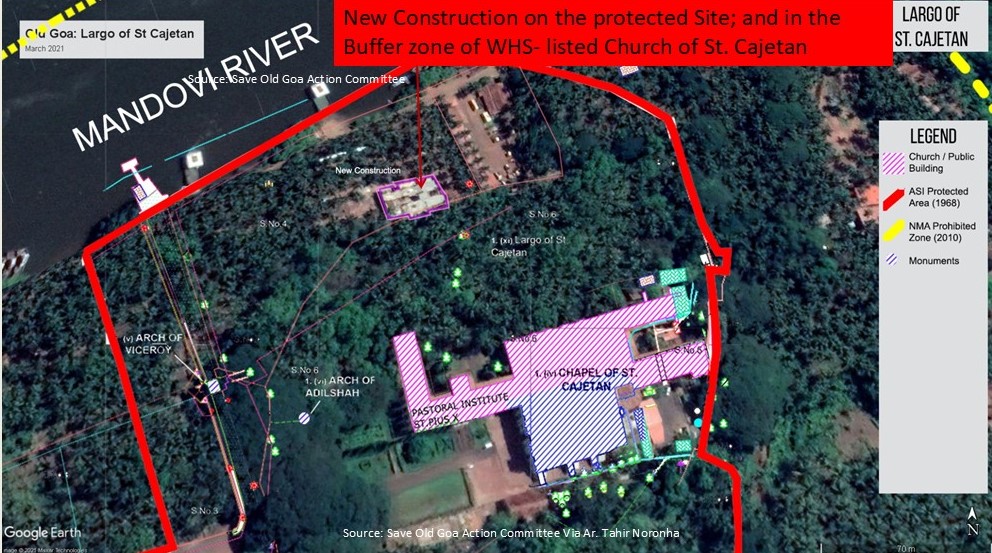
Another critical episode involved illegal construction within a protected area in Old Goa, part of the UNESCO-listed “Churches and Convents of Goa.”
Despite multiple regulatory frameworks —including ASI jurisdiction and buffer zone restrictions — permissions were granted under questionable circumstances. Investigations revealed systemic failures across agencies, including misuse of provisions meant for repairs.
Citizen groups mobilised through protests and legal action, resulting in cancellation of permissions. However, the case exposed deeper issues: lack of coordination, weak enforcement, and limited understanding of heritage regulations among stakeholders.
More critically, it underscored ecological risks, as the site lies in a flood-prone zone near the Mandovi River, highlighting the intersection of heritage and climate vulnerability.
Traditional Knowledge Systems: The Khazans
GOA’S traditional khazan system exemplifies sustainable land and water management. Developed over millennia, these reclaimed estuarine landscapes integrate agriculture, aquaculture, and flood control through an intricate network of bunds, canals, and sluice gates.
Khazans represent a sophisticated “design with nature” approach, rooted in community governance through the communidade system. Today, they are vital buffers against climate change, supporting food security, biodiversity, and water management.
Yet, they face increasing threats from land conversion, neglect, and speculative development.
Protection vs Development: A National Quandary
THE challenges observed in Goa reflect a broader national dilemma. Urban planning in India remains heavily influenced by colonial and modernist paradigms, often neglecting traditional knowledge systems and climate-responsive design.
The built environment contributes significantly to carbon emissions, yet traditional structures—often carbon-neutral and climate-adapted—are being rapidly replaced.
The lack of integration between conservation and planning, combined with weak enforcement and market-driven development, has resulted in widespread loss of heritage and ecological degradation.
Towards a Regenerative Future
Goa’s experience highlights the urgent need to rethink planning paradigms. The focus must shift from extractive growth to regenerative development — integrating ecological, cultural, and social dimensions.
Key priorities include:
• Comprehensive mapping of natural and cultural assets
• Climate vulnerability assessments as a basis for planning
• Participatory processes that empower local communities
• Protection and adaptive reuse of existing structures
• Integration of traditional knowledge systems into modern frameworks
• Transparency and access to information are essential to enable informed citizen participation.
Conclusion
GOA stands at a critical juncture. Its landscapes —natural and cultural — are under unprecedented pressure, yet its history offers valuable lessons in resilience, adaptation, and coexistence.
The path forward requires a fundamental shift in values—from viewing land as a commodity to recognising it as a shared resource. Planning must align with ecological limits, cultural continuity, and climate realities.
As articulated in contemporary conservation discourse, the goal is not merely preservation but the “creative rebirth” of systems that sustain life.
In an era defined by climate crisis, Goa’s future —and that of similar regions — depends on our ability to integrate knowledge, foster collective stewardship, and reimagine development as a process of regeneration rather than extraction.
The writer is a Conservation Architect, Director Archinova_Environs, Member: National Coordinator Risk Preparedness ICOMOS India, ICOMOS Climate Change Working Group, IIA, IID, and Council Member WICCI.)
 LETTER TO THE EDITOR FOR THE ISSUE DATED OCTOBER 10, 2026
 WHEN THE MACHINE OVERRIDES THE LAW!
 HAS GOA BECOME MORE PERMISSIVE? By Special Correspondent
 BILLIONAIRES MULTIPLYING AT THE COST OF THE MIDDLE CLASS!
 THE SHADOW OF VOTE THEFT: WHY CEC GYANESH KUMAR MUST RESIGN!By Dr Olav Albuquerque & Deborah Cordeiro
 ULTRA MODERN ‘MID-DAY’ OFFICE
 HI MUMBAI MERI JAAN BUT…
 TCS INVOLVED IN SIR MATCH FIXING!
 CEREBRAL PALSY: UNDERSTANDING ABILITY, ENABLING INCLUSION! By Dr Amit Dias
 WEEKED UPDATES
 LETTER TO THE EDITOR FOR ISSUE DATED OCTOBER 03, 2026
 GEN-Z BLOCKED FROM VOTING BY GYANESHWAR MODI!
 THE FORAL OF 1526 Five Hundred Years Later, What Does Goa’s Oldest Village Charter Really Mean?
 20 YEARS IN ‘HERALD’, 43 IN GOA!
 THE DEGRADATION OF JNU – MY ALMA MATER! By Arvind Pinto
Goa is abuzz with excitement as vintage bike and car owners, users, collectors and fans are decking […]