Goa is abuzz with excitement as vintage bike and car owners, users, collectors and fans are decking […]
Old is Gold
October 4, 2016
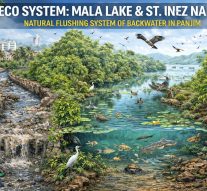
Panaji city consists of a small set of elements on the banks of lakes like Mala and Campal as well as drainage systems like the St Inez creek. Unfortunately, the natural flushing system is choked by ‘gilded buildings’ and concrete walls that have come up at the promenade at Campal which block natural flow of water.
THE mist rising over the vibrant ecosystem of Mala lake in Panjim was a frequent bewitching sight residents looked forward to seeing at one time. Today, that enchanting mist has been replaced by the pungent, sulfuric stench of rot. On April 11, 2026 the residents of Panjim woke up to a grey carpet of death, with an estimated 1,000 plus fish found floating — belly-up — in the stagnant waters of Mala, with chonak, kalundar and tilapia on toip of the list of death.
While authorities were quick to pinpoint heatwaves or some unforeseen incidents, the truth is much more chilling. This kind of mass coastal marine life mortality is more truthfully final gasping breaths of an ecosystem that has been systematically strangled by urban greed, blocked water pathways, and the unchecked overflow of sewage.
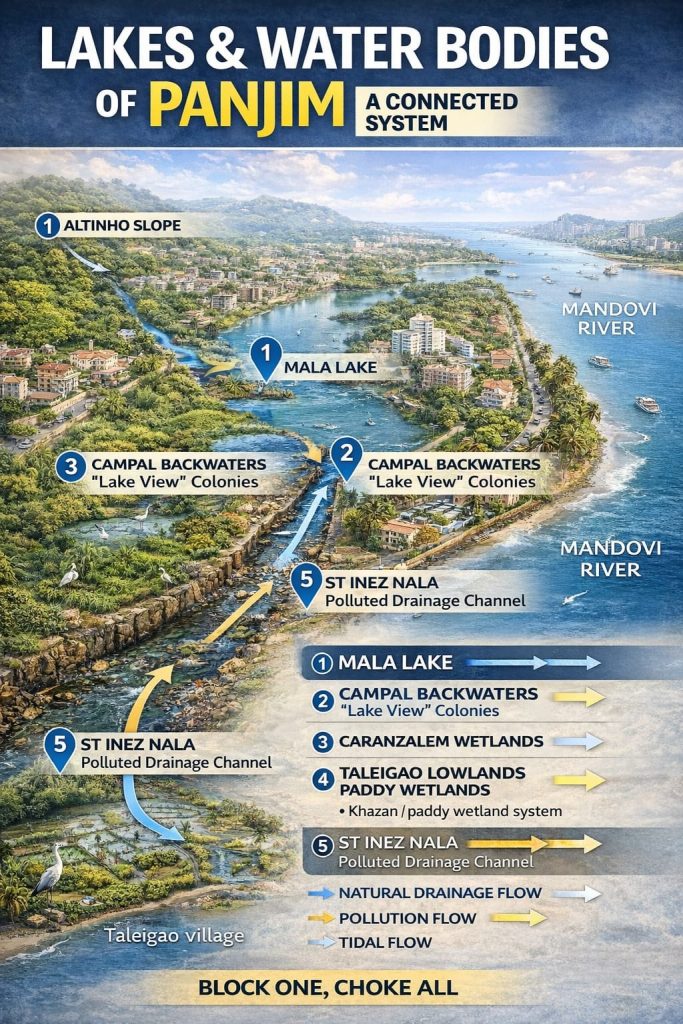
TO the casual observer, Mala, Merces, Santa Cruz, Campal, and Caranzalem are distinct neighbourhoods, but it is not so. They are in fact a single, pulsing eco-system. This entire belt is part of the Rue de Ourem and St Inez Creek waterways complex, incorporating a delicate network of low-lying khazan lands designed to breathe in and out with the tides.
Historically, this system relied on the manshyio (manus), which are traditional sluice gates and drainage channels. These were the “valves” of Panjim. When the tide rose in the Mandovi, oxygen-rich saline water pushed deep into the backwaters, refreshing the mangroves. As the tide receded, an “automatic flushing” took place. The retreating water acted as a natural broom, sweeping away organic debris and waste into the sea. Today, those valves have been surgically removed by concrete.
IN TWO DECADES
THE “development” of the last two decades has treated water as an obstacle rather than a life-force. By land-locking these water bodies for luxury complexes and “beautified” promenades, we have transformed a self-cleaning system into a series of terminal ponds. In Mala Lake, the inflow of untreated sewage from surrounding “gilded” residential complexes, provides a massive surfeit of nutrients. This triggers a “nutrient trap.” Algal blooms explode, then die, and in their decomposition, they consume every last molecule of oxygen. The fish do not just die, they suffocate in a liquid grave of our making. Without the tidal flush, heavy metals and fecal pathogens settle into a thick, black anoxic sludge, releasing toxic hydrogen sulfide into the residential air.
Following this disaster, the government’s response has been a masterclass in bureaucratic stalling. A high-level meeting on April 15, 2026 resulted in a 180-day deadline — not to fix the leaks, but to merely appoint a consultant.
The government’s “silver lining” is a proposed five-year masterplan to overhaul the entire St Inez and Mala network. But if you keenly observe how rapidly the mangroves are decaying, a five-year plan is a death sentence. The mayor Rohit Monserrate has himself warned that if the status quo remains, a total health disaster is only two to three years away. By the time the consultant’s “Detailed Project Report” (DPR) is printed, the ecosystem it intends to save will have already collapsed.
LEARN FROM `PRABHU VIOLETTA’
THE tragedy of the Prabhu Violetta complex case where 149 people were poisoned by sewage-contaminated water, is no longer an unfortunate incident you empathize with from afar — for the city of Panjim it is now a prophecy.
As we approach the monsoon, the stagnation crisis enters its most dangerous phase. In a healthy ecosystem, the rains would wash the backwaters clean. But in a blocked system, the water table rises vertically. The hydrostatic pressure will force the contents of overflowing, illegal sewage tanks from the complexes into the shallow groundwater. We are facing a scenario where a thousand cases of waterborne illness could erupt simultaneously.
Beyond the waterborne threat looms the biological one. The death of the tidal pulse has removed the natural predators of mosquito larvae. The nutrient-rich, still waters of Merces and Santa Cruz have become the world’s most efficient incubators for Anopheles and Aedes mosquitoes. By blocking the saline “flush” of the tides, we have created a year-round “fever factory”!
The stakes are visible at “Four Pillars” areas in Santa Cruz where the mangroves are rotting. Mangroves cannot survive in permanent stagnation. They need the moement of incoming and outgoing tides to wash salt and toxins from their roots. When the mangroves die the so called city of Panjim loses its only buffer against storm surges. We are dismantling our natural defenses and at the exact moment also poisoning our internal reservoirs.
The solution to this crisis is not more “beautification” or 180-day consultancy deadlines. We do not need more 3D-rendered walkways, we need the tides. Re-opening manshyio, immediately enforcing sewage treatment and shifting the focus from “Smart City” to “Hydrological Connectivity.” If a road blocks a manus, the road must be raised.
MIRROR OF DEVELOPMENT
THE mass mortality of prized fish witnessed in the waters of the Mala Lake is a mirror reflecting the ugly face of Goa’s development. It reflects a city that has traded its ancestral engineering — the manshyio — for motorways, and its biological health for “gilded gutters.”
The government asks for 180 days to find an expert. Is the “silver lining” the government wants you to see really beneficial for our ecosystem and biodiversity or is it just the inception of a million more Violettas? Panjim’s most recent tragedy is telling us we don’t have 180 days. If we do not allow our ecosystem to breathe again — and soon — the monsoon of 2026 will be remembered not for its rains, but for the sickness that will follow in the silencing of the tides. The drainage systems of old and the badly designed and covered gutters are chocked – who will pay the bill of such mindless development lacking in practical common sense?
 LETTER TO THE EDITOR FOR THE ISSUE DATED OCTOBER 10, 2026
 WHEN THE MACHINE OVERRIDES THE LAW!
 HAS GOA BECOME MORE PERMISSIVE? By Special Correspondent
 BILLIONAIRES MULTIPLYING AT THE COST OF THE MIDDLE CLASS!
 THE SHADOW OF VOTE THEFT: WHY CEC GYANESH KUMAR MUST RESIGN!By Dr Olav Albuquerque & Deborah Cordeiro
 ULTRA MODERN ‘MID-DAY’ OFFICE
 HI MUMBAI MERI JAAN BUT…
 TCS INVOLVED IN SIR MATCH FIXING!
 CEREBRAL PALSY: UNDERSTANDING ABILITY, ENABLING INCLUSION! By Dr Amit Dias
 WEEKED UPDATES
 LETTER TO THE EDITOR FOR ISSUE DATED OCTOBER 03, 2026
 GEN-Z BLOCKED FROM VOTING BY GYANESHWAR MODI!
 THE FORAL OF 1526 Five Hundred Years Later, What Does Goa’s Oldest Village Charter Really Mean?
 20 YEARS IN ‘HERALD’, 43 IN GOA!
 THE DEGRADATION OF JNU – MY ALMA MATER! By Arvind Pinto
Goa is abuzz with excitement as vintage bike and car owners, users, collectors and fans are decking […]