Goa is abuzz with excitement as vintage bike and car owners, users, collectors and fans are decking […]
Old is Gold
October 4, 2016
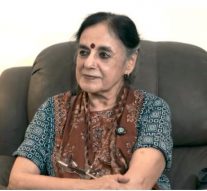
The educationist and former dean says the NEET paper leak highlights deeper problems in a system that privileges access to coaching and social advantage, raising concerns about equity and accountability.
In the latest episode of Frontline Conversations, Anita Rampal, Educationist and Former Dean, Faculty of Education, Delhi University, examines the NEET paper leak controversy, the growing power of the coaching industry, and the larger crisis surrounding India’s centralised entrance examination system.
She argues that NEET and the National Testing Agency (NTA) have transformed education into a high-pressure, deeply unequal system that privileges coaching, wealth, and social advantage over genuine understanding and aptitude. The discussion explores the emotional burden on students and families, the commercialisation of medical education, the rise of paper leak mafias, and the debate over online examinations.
The conversation also looks at why States like Tamil Nadu opposed NEET, how centralised testing affects federalism and school education, and whether India needs a complete overhaul of the way medical students are selected.
Edited excerpts:
To begin, I would like to ask you about the impact of a paper leak of this scale, given that so many lakh students had taken the exam, and there have been reports of students committing suicide. How do you see the impact?
For someone coming from education, the impact is truly devastating. It is not just about this one leak. What we have been seeing over the last couple of years is deeply troubling. Two years ago, I followed the matter closely—I even listened to the Supreme Court proceedings for two days. I was struck by the quality of information and data that some of our finest lawyers had placed before the bench, and deeply disappointed by the decision the bench ultimately took. I believe we let down not just the students, but the lakhs of families who invest everything in this exam. This is not simply an exam to get a job. It is an aspirational project for entire families. The chances of success are very low, but no one tells them that—so they attempt it, believing their lives might change. That, I think, is deeply problematic.
We are also seeing the impact on young children. The coaching industry has, in recent years, moved into smaller towns and villages. Earlier, it was mostly concentrated in cities, but now families in villages are being told that coaching is the only path forward. Class VIII children join coaching centres. I have spoken to some of those students, and the lives they lead are shocking. They study almost exclusively for JEE or NEET—nothing else. They receive proxy attendance from schools. And when the entire family is so heavily invested, a child cannot say they are uninterested or struggling. That is an enormous emotional burden on young children.
How do you look at the government’s response to the paper leak? A retest has been announced.
It is shocking and disappointing. When NTA was established, many of us in education opposed it. It was designed, by design, to avoid audits—it is not a statutory body and is not accountable in the way a public institution should be. I served on the governing body of CBSE as Dean of the Faculty of Education at Delhi University, and even then, questions were being raised about why CBSE was expanding into entrance testing beyond its mandate of secondary education. There were concerns that the academic team was not equipped for testing on such a scale. But CBSE was making significant money through these tests, and everyone was invested in that.
When NTA was created as a registered society rather than a statutory body, those concerns only deepened. You cannot conduct examinations that determine children’s futures through a body with no meaningful accountability. The second issue that has deeply troubled us is the Common University Entrance Test, or CUET. When a centralised exam for university admissions was introduced, we predicted it would reduce the diversity of students entering central universities. Students from different States have a right to attend central universities, but centralisation makes it harder for them in practice.
Women, in particular, were underrepresented in the first few years, because taking an online exam requires computer practice and resources that many students simply do not have—and that is exactly what happened. Over the last couple of years, I have heard from young colleagues invited to set questions for these exams—it is quite a difficult process. Even when academics from good universities are involved, the question of what we are actually assessing goes unasked. The worst is the reliance on multiple-choice questions. I keep saying that we lost something the day we decided to use multiple-choice questions to select research students. A single MCQ cannot tell you whether someone will be a good researcher. This format does not assess understanding, does not assess nuanced thinking, and certainly cannot assess whether a person has the attitudes or the commitment to become a good doctor.
And all the while, this system is feeding an industry now estimated at Rs. 60,000 crores, projected to reach Rs. 1.5 lakh crores by 2030. Anyone who cares about education, children’s rights, or the federal structure of the country—because centralised curricula and centralised tests marginalise State boards—should be deeply concerned.
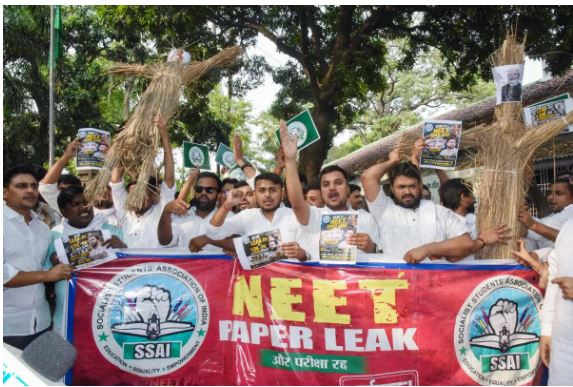
After irregularities were reported in NEET 2024, there was debate about the functioning of NTA. A committee was set up—the Radhakrishnan Committee—and it suggested certain reforms to the NTA and the manner in which NEET was being conducted. Do you think those reforms, had they been implemented, would have helped?
Not significantly, because the committee still operated within the framework of a large, centralised body conducting these tests. There is a deep myth in our society that a bigger, more competitive test is a better test — that a large, centralised examination is inherently superior. This needs to be challenged because no serious educational research supports that view. On the contrary, the evidence tells us that large competitive examinations test social advantage, not depth of understanding.
They measure the resources you have—coaching, books, money—not what you know or can do. So who is actually gaining from this system? Not the students. We are not selecting the best candidates for the courses we want to fill. Tamil Nadu made a very viable logic: if we want good doctors in our village clinics, these exams prevent village students from even being able to compete.
How, then, will we ever get them into medicine? That is a sound and important argument. We should be asking: who do we want as doctors? People committed to service, to patients, to community health, or people who can simply score marks and get a job? If families take on debt and spend enormous sums to access this system—and we know people have paid up to Rs. 5 lakhs to obtain question papers—then we should be clear about what we are selecting for. JEE is often cited as a comparison, but it is quite different.
It assesses technological and analytical understanding, it is computer-based, and crucially, it is not a one-time exam. No leading university in the world relies on a single one-time examination. People also cite the Chinese Gaokao, where around ten million students take the exam, but in that exam, students write essays. They do not simply tick boxes. And even the Gaokao is widely critiqued. The questions in NEET are not about understanding—they are about information recall. You are trained to recognise patterns, to work quickly, and to retrieve specific facts.
When the exam is called difficult, it is usually because the information being tested is obscure. That is not rigour. You can always look up obscure information if you know how to find it. As educationists, the direction this is taking is deeply worrying—and it is consuming people’s time, energy, and financial resources.
What should we do about the NTA? Should the body even continue to exist, or should we reform it?
It should not continue. As I have been saying, a body with no accountability and no educational vision cannot be trusted with this responsibility. What we need is a body that has genuine academics, that conducts research, not just manages exams. You need to be asking: Are we actually assessing what we intend to assess?
What happens to these students over time? You need longitudinal studies. You need an academic institution, not an examination management agency. And it must be accountable—to Parliament, to the country, to citizens. We are using enormous public resources for this. We should decentralise this function, and we should not hold a re-NEET right now. I know students had called for a retest in 2024, and even that did not happen. The Supreme Court did not act on it.
In 2024, the NTA said it did not want to disrupt the futures of lakhs of students by ordering a retest. And now the same NTA has promptly cancelled the exam.
Yes, because they know the scale at which this has happened. At the time, they were trying to contain the crisis and deny the extent of it. I was surprised when the Supreme Court bench suggested that students choose certain exam centres because the marking was more lenient. The Chief Justice did not appear to know that marking in this exam is entirely machine-based—there is no question of leniency. That level of misunderstanding at the highest level was deeply troubling. People were asking why so many students went to Sikar—at the time, studies showed that students from certain centres were securing seats at nearly six times the rate of those from elsewhere.
What is more worrying is that some who have done studies have said that roughly 550 cities and towns where NEET is administered, only around 225 have coaching centres. Studies also show that in areas with coaching centres, the success rate is approximately 89 per cent, compared to just 11 per cent in areas without them. The coaching industry is no longer a shadow industry. It is the hegemony of the coaching centres that is making money and profits, and binding students to this system for life. We saw in Rajasthan that a bill had been introduced about safety nets for students because of the number of suicide cases.
I cannot tell you the shock that I felt seeing this photograph in the newspaper showing that coaching centres had installed physical nets, wire grids, to prevent students from jumping to their deaths from the buildings. The response to the suicide crisis was a net. That is how dehumanising this has become. These institutions are so instrumental, they are stripping children, teachers, and the entire system of its humanity, and we are telling ourselves we are doing a good job, helping people to come into these.
We’re not telling them that the percentage chance of you coming in is probably half a per cent or one per cent. Imagine what that does to a child who has given years to this and to their family. People should be looking at people’s rights and not put them through this kind of nonsense.
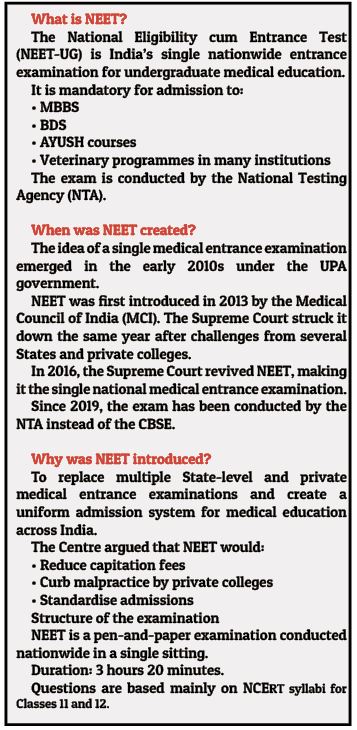
Is it the nature and format of the NEET exam itself that has given rise to this coaching industry—an industry that is now proliferating in an exploitative way, reaching into smaller cities and scouting for students?
Yes, the exam is superficial in its design—180 questions in 180 minutes. Anyone working in education would have to ask what is genuinely being assessed. What is even more shocking, when I examined the details two years ago, is that while even a school exam has a minimum passing threshold, such as 35 per cent. The qualifying marks for NEET change every year, but they can fall as low as 15 per cent for reserved categories, and in some years, even lower.
In 2022, a candidate who scored 107 marks out of 720 was deemed qualified for a seat. We set the bar at 15 per cent or 12 per cent, declare those candidates ready to be doctors, tell them they have been selected through an intensive process, and treat it as an achievement. What are we actually doing?
So, one aspect is the commercial aspect of the exam; the other is the entry of criminal elements into the system. We have this firmly entrenched paper leak mafia, which is operating with networks. How do you see that?
With complete impunity. According to reports from the CBI investigation, bookings were made eight months before this exam, and two candidates had reportedly been promised access to question papers for Rs. 10 lakhs each, eight months in advance. This is not a last-minute leak. It is a highly organised operation. People operate with the confidence that they will not face consequences, that they have access to the questions, and that there are coaching centres and students with the money to pay for it.
What is shocking is that only around half of all seats—roughly 40,000—are in government medical colleges accessible to general category students. The fee differential is stark: a government college may charge Rs.50,000 to Rs.1 lakh per year, perhaps Rs.3 to 4 lakhs for the full course, while a private college charges Rs. 1.5 crores or more—NRI seats can go up to Rs. 4 to 5 crores for a five-year course. As long as this differential exists, we are encouraging criminality.
The person without money will not get a government seat. So who does? Someone with huge amounts of money. And then the qualifying marks are set so low because, without that adjustment, private college seats would remain empty. Those seats are reserved for those who can pay. Why are we allowing that? So that is a problem which really needs to be seen as far as how the government is looking at this system.
Do you think this favours students from affluent families because they are the ones who can afford coaching?
They are also the ones who can buy the question papers well in advance, as the CBI reports are now revealing. We can’t say we’ll computerise it all because again we’ll be having the same multiple choice questions, which educationally are very superficial. You don’t really assess much through that. Coaching industries will remain very active if you have this kind of a format, whether you have it in computers or you have it in pen and paper.
This format is going to encourage the coaching industry, much more if it’s computerised, because you can’t do it at home as much, since you need that practice. So that is worse. But what are you achieving out of that? There was a study which showed that students from the EWS [Economically Weaker Section] category joined a deemed university where the fee was more than a crore. How can that be? So, you’re allowing these kinds of transgressions, these kinds of false corruptions, of everything, because you’ve built a system like that.
Computerisation has been projected by the government as a big solution to the problem of paper leaks. Do you think it will bring its own problems?
Yes. JEE is often used as the model here, but JEE tests a different kind of student, with a different kind of preparation, and it is not a one-time exam; it is administered in multiple shifts and sessions. More importantly, for those of us from education, this exam has devalued school education because your school marks are not counted.
So that’s why people go in after Class VIII, they’re going into this. So if you are to be assessed, you should have a long assessment. Your school marks should have value. And that is why Tamil Nadu—which had the Rajan Committee produce a detailed report on the issue—refused NEET for many years. They said that their children, who normally would come in through their board school marks, who are from smaller towns, from poorer homes, don’t come in through the NEET, will not even be able to appear in the NEET. So even the question of equity is very strong for a country like ours.
Tamil Nadu and Kerala have both demanded—
Yes, we need to return authority to the States and allow them to develop better assessment mechanisms. When the IITs were first established, professors sat down and worked out what questions to set and how to assess—that kind of process needs to be done.
The best universities operate in multiple stages: a screening round, a more in-depth assessment of analytical ability and reading comprehension, and then a conversation with candidates—a focus group or interview—to understand their values, their approach to healthcare, and what drives them. If you want to assess attitudes and certain kinds of skills, you cannot do it in a single three-hour MCQ paper. That is a no-no for assessing anyone. If you don’t want to assess abilities, then it’s a different thing.
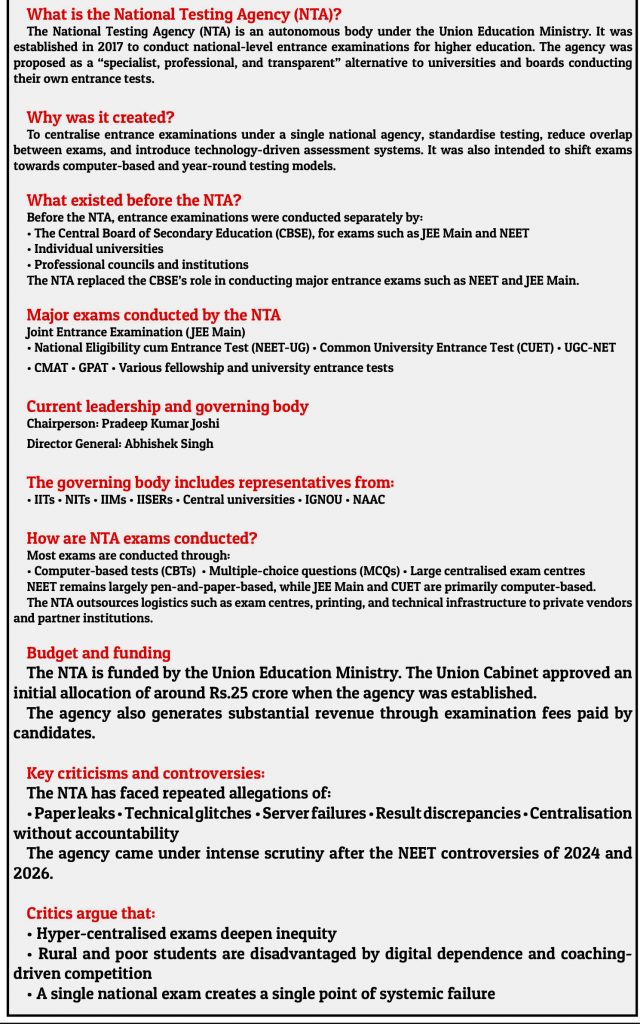
When you say that MCQs in one single sitting are not the solution, then what ideal examination format do you have in mind for an exam of this nature?
See, lakhs of students took our course, which was a Bachelor of Elementary Education or a B.Ed., because those are professional courses. You get a job after your course. So there were lakhs of students appearing for that, and we conducted it in Delhi University before this online thing happened. And we used to do it—one was a screening, which was a written test. You write some things, it’s not just multiple choice, there are some questions that are asked, there are some cases given to you, and based on that case, what is it that you understand.
So, what is your understanding of education or children’s learning? Then there was an interview. Before the interview, they also wrote something and came. So sitting there, they would write something and come. Based on what they had written, we would discuss with them. Also, you talk about what are the kind of books they read, what other things they know, you know. So you judge on that.
Even that might be a small component, but you get some idea. So I’m just saying that you have layers of this, and we’ve done it for a course which lakhs of people applied for. So you can always make that better, but at least the purpose of doing it and what you find as your goal—what is your goal? What are you really looking for?
Similarly, for medical colleges, I think they should be doing it; we know what is happening otherwise. I mean, students are going outside the country to do this course. We first heard about it in Ukraine when so many medical students were caught there, just because it was cheaper. It was good, but it was cheaper.
But then, when they came back, their hospital internship was not recognised. They had to take another exam in which the pass percentage is 20 per cent. So what happens to the 80 per cent? So I think someone has to have a pro-student, a pro-community, a purposeful study and understanding of what you are doing this assessment for? Are you choosing the best people? And what do you mean by best?
Should the government initiate a thorough, structured discussion on all of this?
Yes, and the Medical Council should be part of it too. Doctors are writing in the press now, saying this system does not serve the purpose of medical education. Bring in people who genuinely understand what medicine is, what it means to serve—people who are doing exactly that, and who teach the students who come through these tests.
Include people from education, from psychology, from fields that understand what these pressures do to children and families. We have more than enough knowledge and abilities in this country to build a system that is fair. That, above all, is what matters—that it should be fair.
Courtesy: Frontline. The Hindu
 LETTER TO THE EDITOR FOR THE ISSUE DATED OCTOBER 24, 2026
 THERANOS MULTI-BILLION US PATHOLOGY COMPANY EXPOSED!
 INDIA’S PATHOLOGY LABORATORY SCANDAL! By Our Special Correspondent
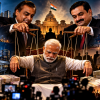 MUKESH, ADANI CONTROL MODI?By Our Special Correspondent
 “FRANCE KE SCHOOL THIK KARO”By Paris Correspondent
 INTEGRITY MUST BE CONDiTION FOR POWER!By Ranadhir Mukhopadhyay
 A PARADIGM SHIFT: POWER MOVES FROM POLITICS TO TECHNOLOGY AND TACTICS! By Arvind Pinto
 HI MUMBAI, MERI JAAN BUT…
 VILLAINOUS MUSK, ALTMAN, ZUCKERBERG, HOLMES!
 OPTOGENETICS AND THE RAY OF HOPE: LIGHT MEETS THE BRAIN! By Dr Amit Dias
 WEEKEND UPDATES
 LETTER TO THE EDITOR FOR THE ISSUE DATED OCTOBER 17, 2026
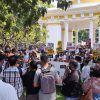 AZAD MAIDAN NO LONGER FREE!
 AZAD MAIDAN CRACKDOWN! Goa’s crackdown on protesters raises grave questions about democracy! By Our Special Correspondent
 INDIAN WOMEN ARE ON THE STREETS AGAIN. EVERYTHING HAS CHANGED BUT NOTHING HAS CHANGED!By Shilpa Phadke
Goa is abuzz with excitement as vintage bike and car owners, users, collectors and fans are decking […]