Goa is abuzz with excitement as vintage bike and car owners, users, collectors and fans are decking […]
Old is Gold
October 4, 2016
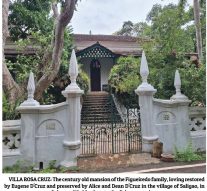
Here’s a niz Goenkar couple who care about preserving the green heritage and legacy of Goan homes in Goan villages….
It requires total commitment, dedication and hard work to nurture any Goan legacy. This I discovered during a recent visit to the booming village of Saligao and the house of Alice and Dean D’Cruz – at their over 100 years old family home called Villa Rosa Cruz.
Besides being a spacious house, it is also an outstanding example of fine restoration — in contrast to the mindless destruction which old buildings have been witnessing in recent years. Beautiful old stolid dwellings turned into ugly semi-modern structures with Roman pillars if you please, and that too against the backdrop of serene traditional Goan villages.
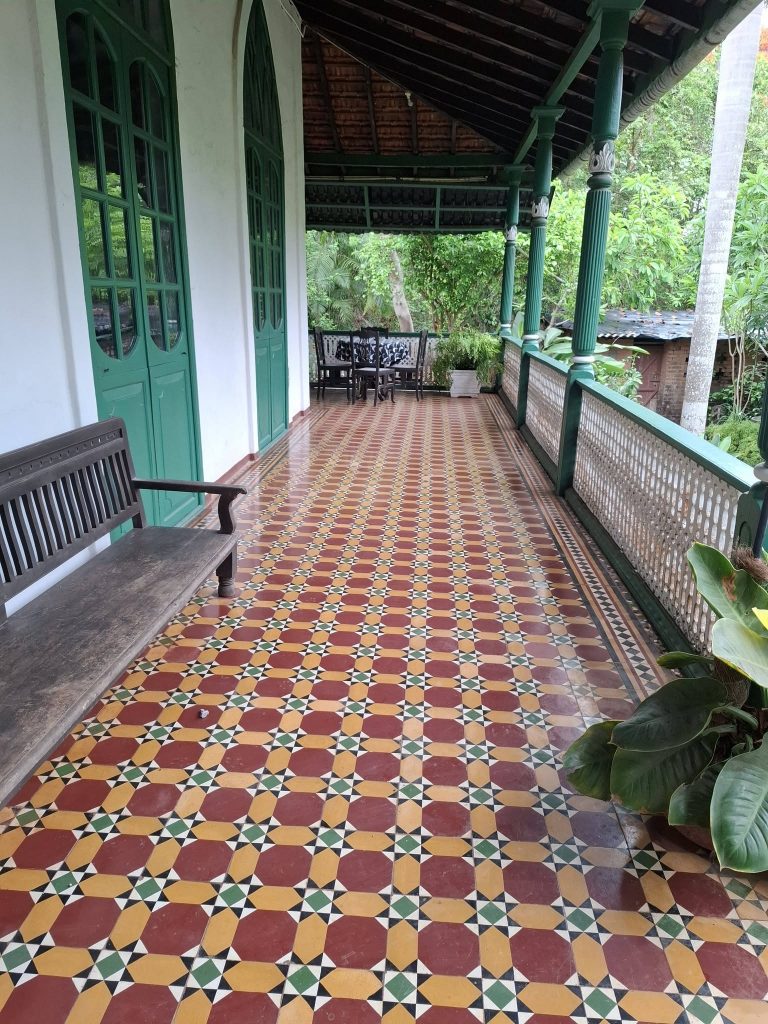
The D’Cruz home is situated in a narrow lane leading up to the Holy Cross chapel in the heart of Salmona waddo, and is accessed through a flight of 12 rustic stone steps, opening out to a broad verandah running around the house. Tall doors open into large sitting rooms, and living quarters. The dining room is a long corridor leading to a spacious skylit kitchen and back garden. The rooms have high ceilings and open out to smaller sit-outs against lush green garden grounds. The house is built at the base of a donger or hill, which is still densely forested.
The miracle is that this restored old mansion works like clockwork because it is cleaned and meticulously maintained so that the new fittings discretely incorporated in the restoration, actually work. The mod cons put in do not take away or interfere with the old world joys of living spaciously and graciously – the traditional fabric of the house has been preserved through the generations that have lived here. Indeed, this is the kind of home that every young Goan architect and builder, who is committed to preserving the Goan ethos, should visit and take an interest in – because like the Taj Mahal in Agra, the ancestral homes are a legacy of Goa.
To say the least, as guests of the D’Cruz family, we felt honored and privileged to have ourselves photographed by Dean, at the grand entrance to Villa Rosa Cruz! The original house was built in 1913 and its restoration commenced in the late-1970s.
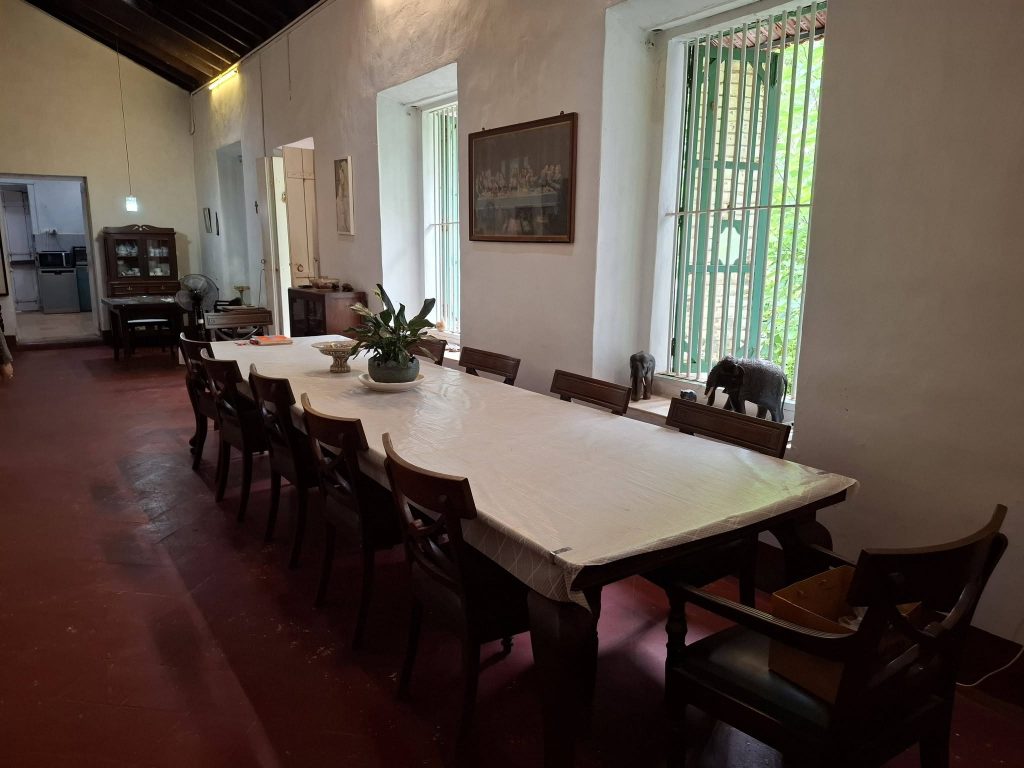
The D’Cruz family is one of the original vangod (communities) of Saligao. Indeed, there is even a Cruz waddo in the neighbourhood. Dean’s father, Eugene D’Cruz was an engineer in the famous infra company of Larsen & Toubro and it was he who bought and restored the old Figuereido house very lovingly in the 70s. Incidentally, Dean’s mother, Mrs Helen Rosario e D’Cruz (and so the name Villa Rosa Cruz)was a Syrian Catholic from Kerala who also happened to be working as secretary to the founder of Larsen & Toubro, a Danish engineer everyone addressed as Mr Larsen. In fact, the original boardroom table of the famous company sits in the dining room of the D’Cruz villa, a long teakwood table with 12 chairs , a proud piece of old world furniture. It is also a part of corporate history come, to think of it.
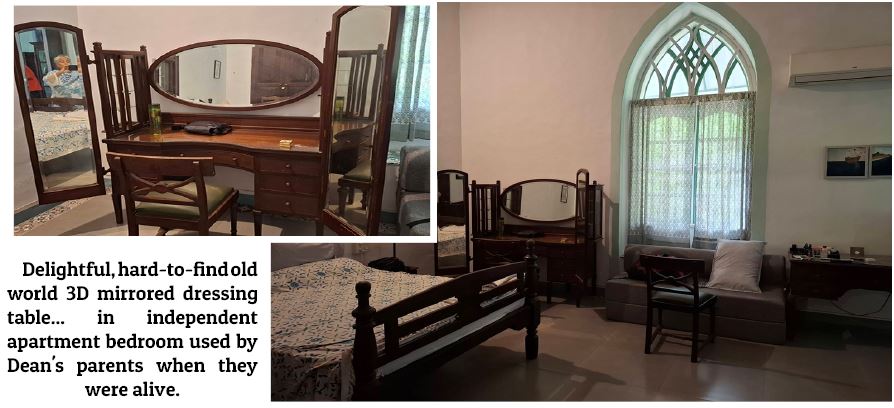
Son, Dean D’Cruz returned to his roots in Saligao in 1983, after completing his Bachelor’s degree in architecture from the JJ School of Architecture in Bombay (Mumbai). The family had a home in Mazagaon in Mumbai. His wife, Alice Barneto is the daughter of former Loutalim MLA, Roque Barneto and Patricia Mascaranhas of Saligao. She moved to the villa in 1988 when she and Dean got married. For Alice it was just a matter of going up the road from her mother’s house, barely a 100 meters away. Dean D’Cruz and Prof Alice Barneto D’Cruz — who retired as former Head of the Department of English, St Xavier’s College in Mapusa, have been living in Villa Rosa Cruz for the last 38 years, having celebrated their wedding reception in their new home itself.
It has been a very tough job to preserve the legacy of a traditional house not only so that the original character is maintained but also to develop the surrounding gardens. Alice has a passion for gardening. For both of them, life in Saligao has been and is an immersive experience and understanding of the natural ecology of the land around them,
one of the major concerns for Alice. As we chatted at her kitchen table, a pair of magpie robins flew in and out, urgently looking for a place to nest. Alice was in two minds about letting them build their home in some awkward spot indoors. She ushered them out, as her garden grounds were good enough. From 4am onwards there’s a veritable orchestra of bird calls in her garden where she has placed a large bird bath and feed pond for all the creatures that visit through the year!
I HAVE visited Saligao several times. The first was in the mid-80’s when my colleague, Norman Dantes, invited me to his ancestral house. There were no hotels or BnB (bed and breakfast) places in Saligao in those years. One could still hear the cries of the foxes in the “village of koles” as Saligao is often called. In the 90s I had several opportunities to visit one of the smartest of the “koles” – namely, Dr Wilfred d’Souza who has his mansion called White House, on the Saligao-Arpora road. Dr Wilfred d’Souza, a surgeon trained in London, along with his English wife Grace, who moved into his ancestral mansion sometime in the 1990s. But in recent times it has been heartrending to see what is happening to the old architectural legacy of heritage homes of Saligao.
When we went “soul travelling” – an expression coined by Heritage conservationist Heta Pandit, who also lives in a heritage home in Saligao –we discovered the kind of invasion which is taking place in this village, often courtesy greedy real estate brokers- local and others. At the Salmona spring (where Saligao begins) which is a part of the original heritage of Saligao, there was a bus load of Guju tourists. At one point Dean’s little Nano could not negotiate the narrow lane because it was blocked by a mega tourist vehicle also headed for a picnic at the Salmona spring site which has been heavily encroached upon by investers.
On our return trip we saw several old homes re-built into luxury hotels by Delhi entrepreneurs. The ITC group which runs Fortune Hotel in Panjim which has taken over Park Hotel at Cavelossim down south Goa, has also taken over one of the boutique hotels in Saligao. Among the local Goan realty predators is Dattaraj Salgaocar with his Villa Saligao which is managed by the Taj Group of Hotels. On the northern side of Saligao, among the more expensive Goan restaurants, Second House has come up in an old ancestral villa modified for hire or sale. There are also ugly structures built on paddy field bunds over the years by various members of the Panchayat of Saligao.
A green architect, Dean D’Cruz has been fighting for over two decades to protect not just the village legacy of Saligao, but also other villages in Goa. It may be remembered he is one of the founders of the Goa Bachao Abhiyan in 2006. The GBA was founded to protest against the Regional Plan 2011 drafted by Atanasio “Babush” Monserrate, who was the Town & Country Planning Minister in the Manohar Parrikar government. The backbone of the GBA were Dean D’Cruz and a team of other architects, including Reboni Saha. They went from village to village in Goa to demonstrate the damage that the RP 2011 would inflict on Goans and Goa in the short and long run. The RP 2011 facilitated the first auction of Goa’s paddy fields, hills, plateaus, water bodies, salt pans, sand dunes…to builders from Delhi.
I remember I felt privileged to have been present when the Goa Bachao Abhiyan was formed in the oratory of the Don Bosco School in Panjim in 2006, and Dr Oscar Rebello was elected as the convenor. The GBA agitation led to the defeat of the Manohar Parrikar government in the 2006 Goa assembly elections.
The successor Congress government led by Digambar Kamat agreed to scrap the RP 2011. Digambar went one step further and appointed a panel chaired by eminent Goan architect and town planner Charles Correia and Edgar Rebello to draft the new Regional Plan 2021. RP 2021 was the first regional plan to offer protection to the fragile ecology of coastal areas to hilly terrain in Goa.
Unfortunately, the RP 2021 was systematically destroyed by the present Dr Pramod Sawant government. Article 39A of the TCP Act was introduced to give the TCP minister total discretion to convert whatever lands he wanted, so much so there has been huge conversions of paddy fields and orchards, and even forests, into settlement and commercial zones.
The destruction of Goa continues as the Pramod Sawant government has refused the demands for scrapping of Article 39A. The Building Regulation Act was tampered with to permit the construction of high rise buildings, such as the re-construction of the Junta house on 18 June road, into a 12-storyed building featuring a casino on the top most floor. Construction has been permitted on hillslopes beyond the permissible gradient, on the claim that the original survey maps are incorrect in showing the hill gradients. Based on maps cooked up by architects from outside the state the builders got the benefit of the doubt and large scale hill cutting was the result – all permitted by the government of Goa.
The battle to preserve the legacy of Goa is an ongoing battle and now in the battle is former Chief Justice Ferdino Rebello with his Enough is Enough movement speaking out on behalf of the people of Goa. He is speaking out the truth but Goa’s politicians are thick-skinned and the stakes are enormous with property prices shooting up, there is money for everyone. Starting with political fixers in Delhi and Goa – also the builders, the bhatkar, the tenants, mundkars.
The temptation to make a quick buck is too big to resist and we are talking of a few lakhs or crores, we are talking of hundreds of crore, as for example in the case of the Abhinanda Lodha project in Karapur village in Bicholim which is reportedly spread over 100 hectares of land promising artificial beaches and artificial hills to make up for destroying the real beaches and hills.
To return to Alice and Dean d’Cruz, they soldier on as much as they can to preserve their legacy in Saligao, as part of the larger fight to hang on to all that makes Goa what it was and still is in a few places. The legacy of grand ancestral homes is mistakenly referred to as Portuguese mansions by real estate agents. The pillars flanking the main gate at Villa Rosa Cruz incorporate the lotus bud cobra head motifs, a reminder of the contribution of the local Goan artisans involved.
Goan homes even if bought by outsiders should be restored sensitively and should not be turned into ugly high rise concrete structures inspired by some notion of European architecture…this seems to be in fashion in projects coming up in the villages of Goa.
Perhaps the only way to preserve the heritage and legacy of Goan villages like Saligao, is to declare them as protected zones, as in the case of the Fontainhas area in the Latin Quarters of Panjim. It is the villages of Goa which are now under threat of vanishing just as Assagao, once a valley of flowers, has morphed into another Gurgaon in Goa. Let Gen Z come together to preserve whatever is left of green and heritage Goa. Truly, the government should subsidize the maintenance of such heritage zones because privately this is a very expensive matter. Just maintaining tiled roofs adds up to several lakhs. It’s a tribute to the architect in Dean D’Cruz and educated sensibility of Alice D’Cruz that they have steadfastly preserved the sentimental legacy of the original Figuereido family home, now Villa Rosa Cruz – and altogether for the larger cause of protecting Saligao village from becoming a mercenary township promoting an undesirable brand of development.
 LETTER TO THE EDITOR FOR ISSUE DATED SEPTEMBER 19, 2026
 ELEVATED HIGHWAY TO HELL!
 MEDICAL DEVICES LOOT!By GS Mudur
 HOSTILE ACT BY PAKISTAN: `PNS HUNAIN’ TRIED TO DISRUPT OUR NAVAL SURVEILLANCE! By Dr Olav Albuquerque & Deborah Albuquerque
 BLACK MONEY IN POLITIAL PARTIES: ADR’s Alarming Revelations By Arvind Pinto
 `KHANDVI MILLE-FEUILLE’ AT BRICS ALL VEG BUFFET!
 SATYA NIKETAN TRAGEDY: HOW GLOBAL STUDENT HOUSING MODELS COULD HELP INDIA FIX A BROKEN SYSTEM!By Sneha Swaminathan
 GANESH PANDALS HIJACKED BY ADANI, AMBANI
 WHY DOES A DEMENTIA DIAGNOSIS MATTER? By Dr Amit Dias
 WEEKEND UPDATES
 LETTERS TO THE EDITOR FOR ISSUE DATED SEPTEMBER 12, 2026
 GOAN TEACHERS ARE CONTRACT LABOR!
 THE COLOUR IS PRESTIGIOUS! THE PROCESS MUST BE EQUALLY SO!
 DOGS ATTACK GOANS, OWNERS GET ACQUITTED!By Dr Olav Albuquerque & Deborah Cordeiro
 CYBER FRAUD: A THREAT TO FINANCIAL SECURITY & MENTAL WELL-BEING! By Adv Vinayak (Mama) D Porob
Goa is abuzz with excitement as vintage bike and car owners, users, collectors and fans are decking […]