Goa is abuzz with excitement as vintage bike and car owners, users, collectors and fans are decking […]
Old is Gold
October 4, 2016
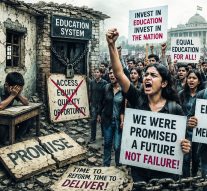
INDIA’S education system was once hailed as the engine of upward mobility, a ladder by which millions of families could climb out of poverty. Over the years, education has become an important value in Indian families. For education is seen as a means to move up the social ladder, to achieve financial security and be seen as “having made it in life.” Today, however, this system is increasingly seen as a trap — producing graduates without jobs, exams without integrity, and promises without delivery. Out of this disillusionment has emerged the Cockroach Janata Party (CJP), a satirical youth-led protest movement that mocks the establishment while channelling genuine anger.
For Goa, where education has long been a passport to Gulf jobs, banking careers and tourism entrepreneurship, the failures of India’s system are not abstract — they are lived realities. The rise of the CJP is a mirror being held up to reflect India’s broken promises. Goa’s youth too are amongst those most disillusioned.
INDIA’S EDUCATIONAL STRUCTURE
INDIA’S school education system is the largest in the world, spanning nearly 14.7 lakh schools, serving over 24 crore students, and employing more than 1 crore teachers. The structure follows the National Education Policy (NEP 2020) model of 5+3+3+4 stages. The first five years, are the foundational stage with three years of pre-primary schooling followed by students proceeding to Class 1 and 2. Then students move to the preparatory stage from classes three to five. Once complete, students move to the middle stage going from Standard 6 to 8. Here they are introduced to more subjects such as science and math. The Secondary stage is a four-year duration from Standards 9th to 12th .
AFTER school, students proceed to either University, professional or technical institutes. Even in the field of higher education, the numbers are impressive. The country has over 1,100 universities, there are 45,000 colleges; of the colleges, the number of engineering institutions are around 40%, followed by 35% being arts and commerce colleges, 15% science colleges and 7% medical or health science institutions. With 14.67 lakh educational institutions instructing 25 crore students, and 4.3 crore enrolled in institutions of higher education, the Indian educational system is probably the world’s largest in terms of student enrolment. The total number of teachers is 1.03 crore where more than 50% are women. The average, student- teacher ratio is 24:1 which is a fairly tolerable ratio. Around 95% of our schools have electricity and drinking water and 99% have girls’ toilets, in keeping with India’s digital push, 70% of our schools have computer access. Also encouraging is the fact that the dropout rate in primary and middle schools is around 3% while at the secondary level it rises to 7%.
On the educational scene Goa, has a high literacy rate of 87% of its population. As always, educational facilities are better in the urban centres of Margao, Panjim, Ponda and Mapusa, despite a high percentage of students being educated, with a small employment market, many of the educated, even professional youth, such as engineers, lawyers have to migrate outside the state or even abroad and shift into the gig market. While over the decades, India has developed a gigantic educational structure, it faces several challenges.
MAJOR FAULT LINES OF THE SYSTEM
FOR most students, their primary education in India, is a means to compete for the competitive examinations that would enable them to enter into the higher education streams and subsequently to sit for competitive examinations for the civil services or other banking or governmental jobs. The present CJP agitation is over the leakage of the 2026 NEET exam papers. This was the beginning of the agitation that is shaking the nation. While the main protests are at Jantar Mantar, Delhi; an echo of the protest is being seen in Goa, where students stage candlelight vigils at Panjim’s Azad Maidan. The selective paper leaks have ensured that those who pay to get prior information of the papers, have essentially paid to get through the system. Many Goan families who have invested lakhs in coaching now feel cheated, especially when their wards fail to make it while those who cheat the system are rewarded by getting through. Then there are student suicide cases linked to exam stress which have touched Goan households too, with tragic headlines in local papers.
WHILE education is available to all children, the quality differs radically. While private and international schools guarantee a superior and all-round education, many of our government schools are poorly run both in teaching, infrastructure and sometime have to do without basic amenities. Further, schools in urban centres are often superior to those in the rural areas. Students in private schools have, therefore, a greater opportunity of succeeding at examination for higher education and further the competitive examinations for employment. With the inferior education at the primary level, many of these boys and girls have little chance of even making it into institutions of higher education, leave alone competing for the public service examinations. India’s graduate unemployment rate is as high as 29%. This creates a sense of frustration and dissatisfaction among the youth in India.
This is the frustration that we now seeing being played out by the CJP primarily at Delhi’s Jantar Mantar, it has now spread throughout India. Even as India questions the quality of its education and the growing unemployment it is interesting to note that India’s education budget fell from 4.6% of GDP (2013–14) to 2.5% (2025–26).
Education is now a low priority for the government of the day.
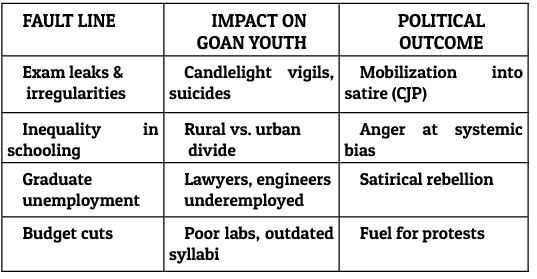
SATIRE AT PLAY
THE Cockroach Janata Party (CJP) began as a satire — students mocking the resilience of cockroaches compared to their own fragile future. Both the media and the common man took the CJP as a joke but what began as a joke, has gathered millions of followers and is now being taken seriously. The ongoing session of Parliament has been paralyzed. The international media is now portraying what is happening in Delhi. The Home Ministry intelligence agencies have begun to study the violent student agitations that brought down governments of neighbouring countries.
That scenario may be a distant dream in India, but one can never underestimate what could happen if the government does not agree to meet the CJP’s demands. The current agitation in Delhi is an indication of the disillusionment of the Indian youth with the very systems in place or not in place. Unless this is addressed, this movement could snowball and paralyze much of the functioning of government and the administration.
As I sit to write this, the government does not see the writing on the wall. Those who matter had decided to weather the storm, rather than sit and dialogue with the students. Unfortunately, the excessive use of force by the police on the instructions from the top has backfired. Videos of the excessive use of force is being flashed across the international media, making the Indian police being compared with totalitarian regimes.
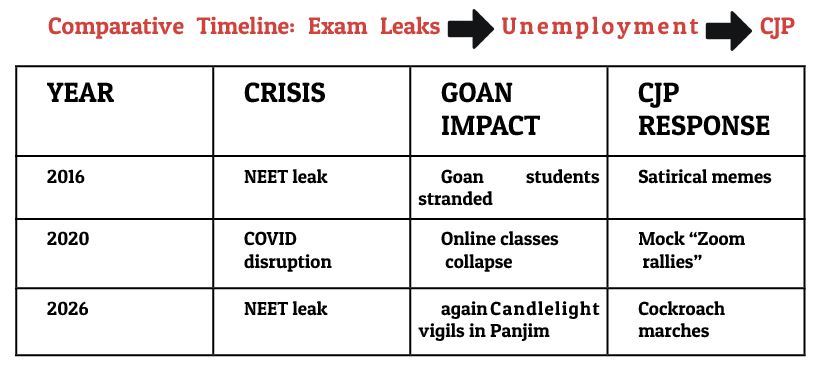
TASKS AHEAD
ONE of the urgent needs is to reform the examination system. The task of conducting this examination is indeed huge. There needs to be an independent Commission to supervise the examination system. Transferring the top bureaucrats is a short-term administrative decision that will not yield much results. In this digital age, the use of digital paper setting and correction of scrips to ensure transparency should be considered. Much of our educational skills concentrate of acquisition of mere subject knowledge, there is an urgent need of expansion of technical training and polytechnic programs to give students practical skills for a future career. Our educational system should cater to the economy. Often students graduate but have little practical job skills. Our educational programs should be tailored to the job market. On the governmental level, the spending on educational sector should increase. Education is an investment in the future, and spending on education should be a minimum of 4% to 5% of the GDP. Would this ever happen?
CONCLUSION: GOA AS A MICROCOSM
GOA’S story is India’s story in miniature. A state that once exported educated manpower to the Gulf now exports disillusionment. The rise of the CJP is not just satire — it is a warning. Unless India restores trust in education, invests in skills, and creates jobs, the cockroach will remain the symbol of survival, and satire will become the language of politics.
(Arvind Pinto is the Chairman, Citizencredit Cooperative Bank Limited)
 LETTER TO THE EDITOR FOR THE ISSUE DATED OCTOBER 17, 2026
 AZAD MAIDAN NO LONGER FREE!
 AZAD MAIDAN CRACKDOWN! Goa’s crackdown on protesters raises grave questions about democracy! By Our Special Correspondent
 INDIAN WOMEN ARE ON THE STREETS AGAIN. EVERYTHING HAS CHANGED BUT NOTHING HAS CHANGED!By Shilpa Phadke
 RBI TIGHTENS SCREWs ON ECONOMY!By Arvind Pinto
 SSR OVERRULED SIR IN GOA!
 HI MUMBAI MERI JAAN BUT…
 RAJENDRA ARLEKAR WILL REPLACE PRAMOD SAWANT?
 MENTAL HEALTH ACROSS THE LIFESPAN! By Dr Amit Dias
 WEEKEND UPDATES
 LETTER TO THE EDITOR FOR THE ISSUE DATED OCTOBER 10, 2026
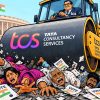 WHEN THE MACHINE OVERRIDES THE LAW!
 HAS GOA BECOME MORE PERMISSIVE? By Special Correspondent
 BILLIONAIRES MULTIPLYING AT THE COST OF THE MIDDLE CLASS!
 THE SHADOW OF VOTE THEFT: WHY CEC GYANESH KUMAR MUST RESIGN!By Dr Olav Albuquerque & Deborah Cordeiro
Goa is abuzz with excitement as vintage bike and car owners, users, collectors and fans are decking […]