Goa is abuzz with excitement as vintage bike and car owners, users, collectors and fans are decking […]
Old is Gold
October 4, 2016
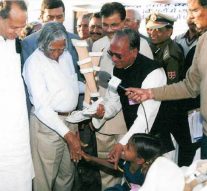
IN THE early 1990s, Dr APJ Abdul Kalam visited the Nizam’s Institute of Medical Sciences (NIMS), where he observed young children affected by polio and motor impairment, struggling to move. To stay upright, these children were forced to wear heavy, cumbersome leg calipers made of metal, leather and wooden structures weighing between three and four kilograms. You may imagine for a small child, moving each leg was an exhausting physical ordeal.
Deeply moved, Dr Kalam partnered with cardiologist Dr BN Prasad. He realized that the glass-filled polypropylene and carbon composites engineered for the nose cones and heat shields of Agni missiles possessed the exact mechanical balance these children needed: immense structural strength paired with feather light density. By applying missile defence material science to pediatric orthotics, Kalam’s team developed Floor Reaction Orthosis (FRO) calipers weighing a mere 300 to 400 grams. Tens of thousands of children were fitted with these lightweight braces, allowing them to walk, run, and ride bicycles freely.
A few years later, Dr Kalam applied that same cross-domain framework again, collaborating with Dr Somaraju Bhupathiraju to create the Kalam-Raju Stent — adapting high-grade DRDO missile steel to manufacture India’s first indigenous cardiac stent at a fraction of imported costs.
The Overarching Umbrella: Technology Transfer for Core Human Needs
DR KALAM’S work established a vital conceptual umbrella: Purpose-Driven Technology Transfer.
This asserted that the highest purpose of advanced engineering — whether in defence, aerospace, or industrial manufacturing — it is not to remain siloed in elite labs, nor merely to create high-tech consumer novelties. Instead, advanced technological breakthroughs should be systematically re-purposed to solve fundamental, everyday physical suffering.
The Modern MedTech Paradox
DESPITE the blueprint left by pioneers like Kalam and the creators of the world-famous Jaipur Foot, modern medicine continues to present a frustrating paradox.
We live in a golden age of digital health tech. Smartwatches capture continuous single-lead electrocardiograms (ECGs), track blood oxygen saturation, and detect silent cardiac arrhythmias. Artificial intelligence models analyze complex radiological scans in seconds, and robotic systems assist in sub-milimeter surgeries.
Yet, step out of the operating theater and into the everyday recovery of an orthopedic patient, and time seems to stand still. If an individual breaks an ankle, tears a tendon, or suffers a severe foot injury today, their discharge instructions for taking a daily shower typically boils down to a depressingly primitive ritual: wrap your limb in a plastic wrap or a garbage bag, seal it at the top with rubber bands or duct tape, and hope water doesn’t seep in.
We have successfully over-engineered high-margin “smart” diagnostic gadgets while severely under-engineering the basic physical utilities of daily recovery. Patients can monitor their heart rate on an OLED screen, but they cannot routinely buy a simple, inexpensive, durable, off-the-shelf waterproof foot cover that reliably keeps a dressing dry in the shower.
Rethinking Fracture Care: Modern Ortho Aids
THIS innovation gap extends directly to fracture immobilization. Traditional plaster and fiberglass casts have remained the standard for over a century. While chemically effective at holding bones rigid, their user experience is notoriously poor: they absorb sweat, trap skin cells, foster odour, cause itching, and disintegrate when exposed to water.
Under the umbrella of modern material science, new orthopedic aids are attempting to solve these core human friction points:
Re-Engineering Healthcare at the Human Scale
WHEN Dr Kalam re-purposed defence composites for polio-affected children, he wasn’t trying to build a complex digital widget. He was practicing human-centered design — identifying acute physical suffering and solving it with the best available material science under an umbrella of social necessity.
The future of medical equipment demands that same commitment. True medical progress should not be measured solely by how “smart” our diagnostic screens are, but by how comfortably and indignantly a human being can heal. It is time for healthcare engineering to bring simple physical recovery — from breathable 3D-printed casts and dynamic silicone orthotics down to a reliable, waterproof foot cover — under the same umbrella of high-tech innovation.
It’s time to ask ourselves, if superior, waterproof, and humane alternatives exist, why are simple medical aids like waterproof foot covers still clunky, and why hasn’t every clinic replaced plaster with 3D printers or silicone orthoses?
 LETTER TO THE EDITOR FOR THE ISSUE DATED OCTOBER 17, 2026
 AZAD MAIDAN NO LONGER FREE!
 AZAD MAIDAN CRACKDOWN! Goa’s crackdown on protesters raises grave questions about democracy! By Our Special Correspondent
 INDIAN WOMEN ARE ON THE STREETS AGAIN. EVERYTHING HAS CHANGED BUT NOTHING HAS CHANGED!By Shilpa Phadke
 RBI TIGHTENS SCREWs ON ECONOMY!By Arvind Pinto
 SSR OVERRULED SIR IN GOA!
 HI MUMBAI MERI JAAN BUT…
 RAJENDRA ARLEKAR WILL REPLACE PRAMOD SAWANT?
 MENTAL HEALTH ACROSS THE LIFESPAN! By Dr Amit Dias
 WEEKEND UPDATES
 LETTER TO THE EDITOR FOR THE ISSUE DATED OCTOBER 10, 2026
 WHEN THE MACHINE OVERRIDES THE LAW!
 HAS GOA BECOME MORE PERMISSIVE? By Special Correspondent
 BILLIONAIRES MULTIPLYING AT THE COST OF THE MIDDLE CLASS!
 THE SHADOW OF VOTE THEFT: WHY CEC GYANESH KUMAR MUST RESIGN!By Dr Olav Albuquerque & Deborah Cordeiro
Goa is abuzz with excitement as vintage bike and car owners, users, collectors and fans are decking […]