Goa is abuzz with excitement as vintage bike and car owners, users, collectors and fans are decking […]
Old is Gold
October 4, 2016

Goans have won many battles to save Green Goa and to protect the secular identity of Goa. Starting with the Opinion Poll and the battle to make Konkani the official language, I have been witness to the battle to scrap the highly polluting Nylon 66 factory, the GBA agitation to scrap RP 2011 and the ongoing agitation against section 39A of the TCP Act. Politicians only listen to people just before the election. It is time for us to unite and save Goa.
THE government listens and responds to the voice of the people only in the run up to the elections. The corollary is that all the people of Goa cutting across caste, community or even political affiliations should raise their voice to their highest pitch to save Goa. To save the paddy fields and the hills and the lakes and the sand dunes of Goa. More importantly fight to retain the idea of Goa. The idea of Goa as a fiercely secular oasis. The only mohabbat ka dukan left in the country. It is time that the double-engined governmentt the Centre and the states listened to the roar of Goans.
Goans have fought many battles winning almost all of them. During my 40 plus years in Goa I have had the privilege of supporting these battles to preserve the Goan identity. Among the earliest of these battles was the one against mechanized trawlers which were threatening the livelihood of the local Ramponkar fisher folk. You can still the Rampon (large heavy fishing nets) being cast in the sea and being pulled by dozens of fishermen laden with fish. I first visited Goa in the late 70s. A church organization called BUILD was agitated over huge mechanized trawlers displacing traditional fishing. I was tasked with bringing a group of journalists from Mumbai including the then resident editor of the Times of India, Bombay Darryle d’Monte to draw attention to the plight of the fisher folk of Goa. This was the time when the beaches of Goa were virgin. There were no domestic or foreign tourists except for the hippies. We saw at first hand how trawlers were destroying the livelihood of the traditional fisher folk. We even met the then chief minister Sashikala Kakodkar who was in league with the trawler owners. She had no sympathy for the fisherwomen. In a shrill voice she screamed “the fisherwomen who sell the fish are cheats, look at the gold they are wearing!” Fisher women do not trust the bank or their husbands who are a little fond of feni. They convert their earnings into gold and wear on their body to safeguard it.
Fishing on an industrial scale is linked to nylon nets. This is probably what provoked the American multinational Dupont to collaborate with an Indian industrialist Gautam Thapper to start a Nylon 66 plant in Goa. The production process is highly polluting of the environment. A medical doctor, an ordinary general practitioner, Dr Dattaram Dessai, took a stand. Dr Dessai educated and mobilized the locals in Ponda where the plant was to be located. The then Rane government tried to brutally suppress it. In the police firing a young man, Nilesh Dessai, lost his life. This enraged the locals and the movement intensified. Dupont hired a very high profile Bombay-based public relations firm headed by Roger Pereira to do some trouble shooting. Then the only paper opposing the project was the OHeraldo which I was editing. Roger Pereira invited me for dinner with American team at the now defunct seafood place Martin’s Beach Corner at Caranzalen. The American Dupont team offered me and presumably other editors and ownersof media groups and all expenses paid trip to the United States, ostensibly to see theDupont plant but actually meant to be a holiday as the itinerary stressed New York and Disneyland. I indignantly refused and wrote about the crude attempt to bribe the media in Goa. The Dupont people realized that the local Goans would not permit the highly polluting Nylon 66 plant. The project was scrapped by the Goa state government.
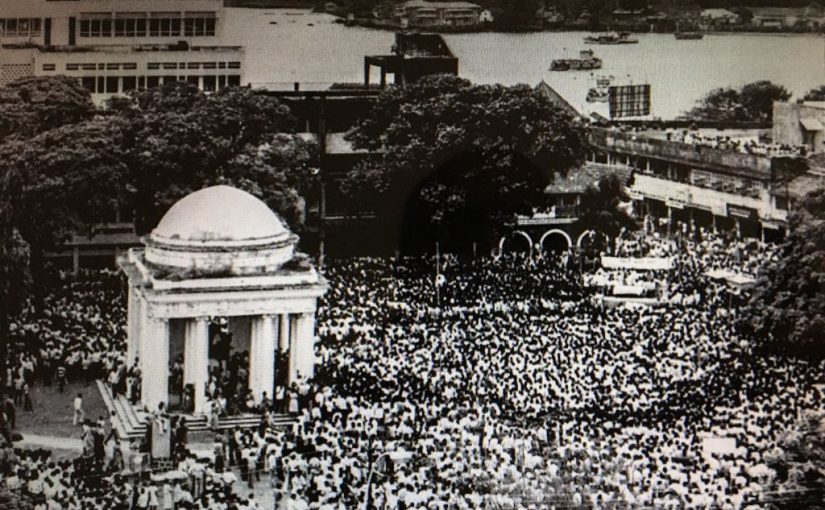
The next battle came in mid-1985. The Konkani Projhe Awaaz was formed by a group of Konkani writers headed by Pundalik Naik. It included both writers of Romi and Nagri Konkani. They launched the battle for recognition of Konkani as the official language of the then Union territory of Goa. The requirement was a prerequisite for granting Goa statehood status. The Marathi centric Pratapsingh Raoji Rane was firmly opposed to Konkani becoming the official language. The turning point was a resolution moved by an Opposition MLA Luizinho Faleiro for recognition of Konkani as the official language. The Congress-led assembly did not even allow him to table the resolution. Sensing that there was outrage over this I asked the cartoonist Alexis to draw a caricature showing Konkani mai in a coffin with the words “Konkani Mai Mailem” This evoked a fantastic response marking the beginning of a two year battle which helmed by the OHeraldo under my editorship. Every day I wrote front page editorials thundering that Goa’s mother tongue should be Goa’s official language. The battle cry was Utt Goenkara (Wake Up Goans!) and this turned into a mass movement. With all the big politicians predominantly the Catholics like Dr Wilfredd’Souza, LuizinhoFaleiro and Churchill Alemao mobilizing lakhs of Goans in support of Konkani. Rane and theMGP countered with a mass movement led by Ramakant Khalap,then president of the MGP. But as during rhe Opinion Poll Goans and Goa prevailedand the then prime minister Rajiv Gandhi directed Pratapsingh Rane to bring forward a bill to confer exclusive official language status to Konkani. It is another matter that the Marathi lobby imposed Konkani in the Devanagari script as the official script.
In 2002 Manohar Parrikar formed the first BJP coalition government in the state. Parrikar was totally dependent on the then Taleigao MLA Babush Monseratte who demanded and brought the very lucrative Town & Country Planning department. He promptly drew up the RP 2011 which sought to sell Goa to the builders. A small group of architects headed by Dean d’Cruz sounded the alarm. About a dozen people got together at the Don Bosco school in Panjim to form the Goa Bachao Abhiyan. Dr Oscar Rebello was elected the convenor. Dean and his team went from village to village making graphic presentations of how the plan would destroy paddy fields, lakes, hills, plateaus and forests in Goa. The panchayats passed resolutions against the RP 2011. The angry residents of Goa voted the BJP Parrikar government out of power on the RP 2011 issue. The successor government led by Digambar Kamat of the Congress party scrapped the 2011 regional plan. A high powered committee of town planners and architects headed by the late Charles Correa and Edgar Rebeiro was formed to formulate the an ecofriendly sustainable new RP 2021
It is this new RP 2021 which has been systematically mutilated by Vishwajit Rane. Section 39A was introduced to give discretionary powers to the minister to convert any piece of land from forest to orchards to salt pans… to settlement and commercial zones. The building regulation rules were mutilated to permit the wholesale cutting of hills to build huge concrete complexes on top of hills, and all along the slopes — so that people from Delhi and Bengaluru could get sea views from their condominiums. The floor area ratio was mutilated to increase the height of buildings from the traditional 11 meters, the height of a coconut tree, to over 800 meters — to accommodate 12-storied constructions.
Six months ago the residents of Chimbel came together under the leadership of Govind Shirodkar to prevent the encroachment of the Tollem lake in Chimbel. The residents of Santa Cruz came together to halt the filling up of their local lake. The residents of St Andre came together under the leadership of Viresh Borkar to stop the permissions under 39A in the constituency. Swapnesh Sherelakar is still battling against the Abhinandan Lodha mega project in Kharapur villatgein Bicholim.
The Pramod Sawant government has been forced to bow down to the people again and again. It backed down in Chimbel. It backed own in Santa Cruz. It backed down in Morjim. The Pramod Sawant government reversed the decision to convert 56 Goan villages into urban areas at the insistence of villagers and village panchayats. Not surprisingly the move was initiated by Babush Monserratte who claims that the panchayat controlled by his family in Taleigao has opted for urban status.
The government of Pramod Sawant has climbed down on imposing penalty on excess load of electricity used by domestic consumers. Indeed, the authorized load has been increased from 3KVA to 10 KVA and the penalty amount of Rs43 crore is to be refunded. It is time to go in for the kill. Give notice that 39A be scrapped. Give notice that not only hill cutting be stopped but the hills restored. Give notice that there shall be no construction in the vicinity of water bodies like lakes and rivers, ponds and wells. Give notice that the Coastal Regulation Zone rules would be strictly enforced. Give notice that Goans will not tolerate the dumping of garbage or sewage in rivers or any water bodies, be it hotels or commercial business houses. Give notice that Goans will not tolerate love jihad. Let it be known that Goans will fight to their last breath and last drop of blood to retain whatever is left of the unique and distinct identity of Goa.
In its 25th year of staying alive the Goan Observer publication will continue to voice the aspirations and hopes of niz Goenkars. We hope Goans in Goa and abroad and corporate houses wishing to preserve Goa, will support us in our crusade to keep Goa safe from land sharks and religious fanatics and lunatics. We want to be part of Goa’s journey into the future as we always have been through the last 25 years in print and online. As Rajan Narayan I have been part of every struggle to protect and preserve the Goan identity for the last 43 years, since I first came to Goa in 1983.
 LETTER TO THE EDITOR FOR ISSUE DATED OCTOBER 03, 2026
 GEN-Z BLOCKED FROM VOTING BY GYANESHWAR MODI!
 THE FORAL OF 1526 Five Hundred Years Later, What Does Goa’s Oldest Village Charter Really Mean?
 20 YEARS IN ‘HERALD’, 43 IN GOA!
 THE DEGRADATION OF JNU – MY ALMA MATER! By Arvind Pinto
 THE WOMEN WHO LOOK BACK! By Prema Viswanathan
 GOA IS CELEBRITY STATE!
 HI MUMBAI MERI JAAN BUT…
 WEEKEND UPDATES
 LETTER TO THE EDITOR FOR ISSUE DATED SEPTEMBER 26, 2026
 DIVIDED EVEN IN DEATH!By Rajan Narayan
 IF YOU CLAIM THE CREDIT, TAKE THE RESPONSIBILITY!By Joquim Goes
 8 EMAILS IN 7 DAYS, BUT VALID GOA VOTERS STILL LEFT OUT: EC’S FLAWED SYSTEM!By Ritika Chopra
 MAKE IN INDIA: UNITED PAYMENTS INTERFACE India’s digital local leap to global benchmark…By Arvind Pinto
 BRING BACK THE FLATBREADS OF INDIA!
Goa is abuzz with excitement as vintage bike and car owners, users, collectors and fans are decking […]