Goa is abuzz with excitement as vintage bike and car owners, users, collectors and fans are decking […]
Old is Gold
October 4, 2016
CRYPTOCURRENCY is a broad term for digital or virtual money that uses cryptography (advanced encryption) to secure transactions. Unlike traditional currencies such as the Indian rupee, cryptocurrencies are typically decentralized, meaning they are not controlled by governments or central banks. They operate on a technology called blockchain, which records all transactions on a public ledger shared across a network of computers. Some well-known cryptocurrencies include: Bitcoin (BTC),Ethereum (ETH),Ripple (XRP)Litecoin (LTC). In simple terms, cryptocurrency is the category, and Bitcoin is just one member of that category. Let’s talk of just one of these, Bitcoin.
When Bitcoin first appeared in 2009, introduced by the mysterious Satoshi Nakamoto, it was little more than a digital curiosity — an experiment in decentralized technology born in the aftermath of the global financial crisis. Today, it stands as one of the most discussed financial innovations of the 21st century, praised as a revolution in money and criticized as a speculative bubble. In Goa — as elsewhere in India — Bitcoin provokes curiosity, excitement, confusion, and caution in equal measure. For the uninitiated, one requires to enter with care. Many in India have experimented with this type of crypto currency. For possessing bitcoins is not illegal, but they are not officially recognized.
This article seeks to demystify Bitcoin for the everyday reader, exploring what it is, how it works, why it matters, and what risks and opportunities it presents —especially in the context of an evolving Indian economy.
What Exactly Is Bitcoin?
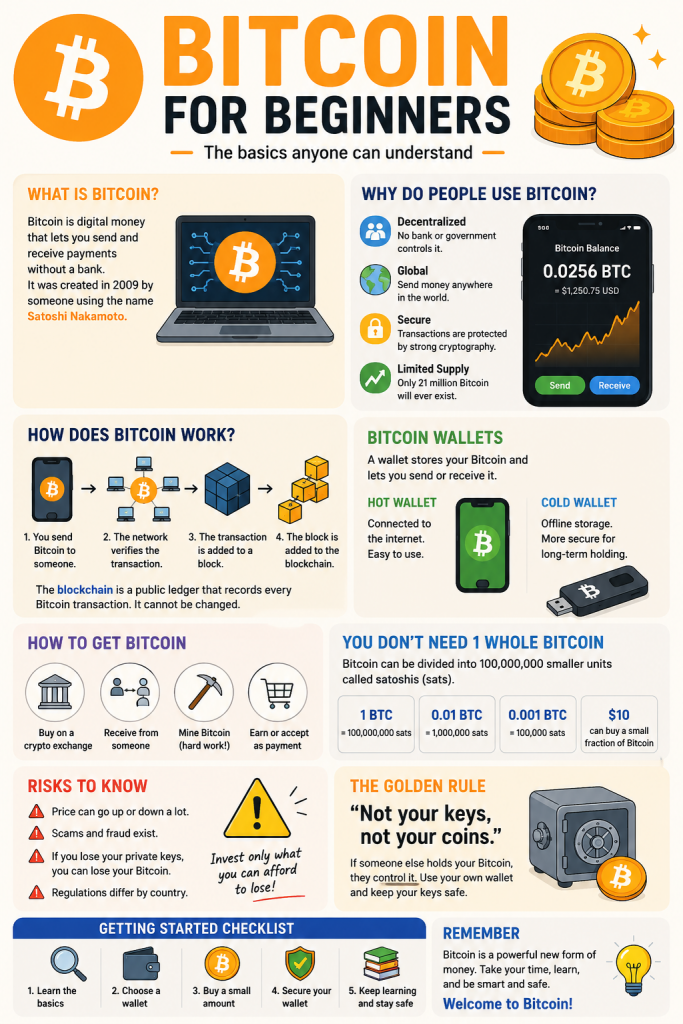
At its core, Bitcoin is a digital currency — a form of money that exists entirely online. Unlike the Indian rupee or the US dollar or the Euro, it is not printed by a central bank or regulated by a government institution. Instead, it is created, transferred, and maintained through a decentralized network of computers worldwide.
Bitcoin operates on a technology called the blockchain, which is essentially a public, digital ledger of all transactions. Every time someone sends or receives Bitcoin, that transaction is recorded permanently in the blockchain, making it transparent and tamper-resistant.
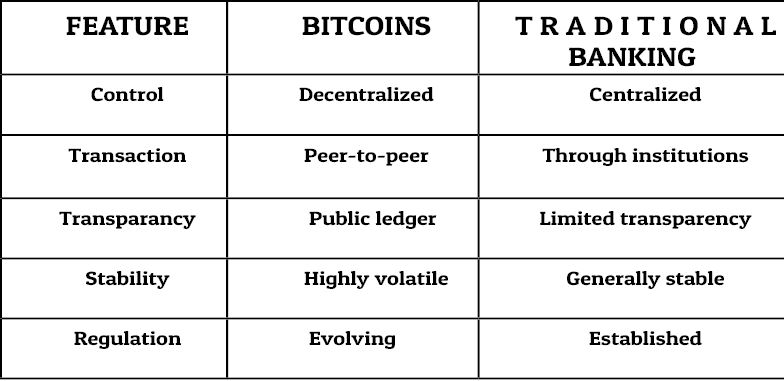
Unlike traditional bank transactions, there is no intermediary—no bank, no payment gateway—just peer-to-peer exchange. This feature is what many enthusiasts believe makes Bitcoin revolutionary.
How Does Bitcoin Work?
UNDERSTANDING Bitcoin requires some familiarity with its underlying technology and processes: The blockchain is a continuously growing chain of “blocks,” each containing a list of transactions. Once a block is verified, it is added to the chain and cannot easily be altered. This ensures security and transparency. New Bitcoins are introduced into circulation through a process known as mining. Powerful computers solve complex mathematical problems to validate transactions and secure the network. Miners are rewarded with newly minted Bitcoins. To use Bitcoin, one needs a digital wallet, which can be an app or a hardware device. Each wallet has a public key (like your bank account number) and a private key (like your ATM PIN). The private key must be kept secure, as losing it means losing access to your Bitcoins permanently. One of Bitcoin’s defining features is that only 21 million Bitcoins will ever exist. This scarcity is often compared to precious metals like gold and is one reason it is sometimes called “digital gold.” Thus unlike paper money where certain governments print notes in times of economic crisis, there is a cap to the number of bitcoins that are in supply.
Why Has Bitcoin Become So Popular?
BITCOIN’S rise to global prominence is not accidental. Several factors have contributed to its growing appeal. In a world where commerce and computers have connected people, the need of a medium of reliable exchange and a store of value in something transferable has increased. Bitcoin’s transcend national boundaries. Many supporters’ value Bitcoin’s resistance to central control. In a world where governments can print money and influence interest rates, Bitcoin offers an alternative system governed by mathematical rules. In countries experiencing inflation or currency instability, Bitcoin is often seen as a store of value. Its limited supply stands in contrast to fiat currencies that can be expanded by central banks.
Anyone with internet access can participate in Bitcoin, making it attractive in regions with limited banking infrastructure. For many, Bitcoin is less about daily transactions and more about investment. Its price has seen dramatic rises, drawing investors looking for high returns.
The Situation in India
In India, the Bitcoin story has been complex. While the government has not recognized it as legal tender, neither has it imposed a full ban. Instead, Bitcoin operates in a regulated grey zone, with taxation rules and compliance requirements gradually evolving. The Reserve Bank of India (RBI) has repeatedly cautioned users about cryptocurrencies. However, the Supreme Court overturned a previous ban on banking support for crypto exchanges, allowing the ecosystem to function. Crypto transactions in India are currently subject to taxation, including a flat tax on gains and deductions at source (TDS). This reflects the government’s attempt to monitor and regulate the sector without formally endorsing it. Since there is no specific ban on bitcoins, the holding of bitcoins is not illegal, one is free to use bitcoins to pay for goods or services as receive them in your wallet. The gains made from gains are treated as capital gains and tax is deductible on such transactions. In short bitcoin is not illegal in India, but it is also not legal tender. Thus one can buy, sell, and hold it. However, one must follow tax rules. Remember It is not officially accepted like rupees, since there are limited players in this restrictive universe.
The Goan scene
Goa, with its strong tourism sector and tech-savvy youth, presents a unique microcosm. Conversations about Bitcoin are common among entrepreneurs, freelancers, and digital nomads. While it has not yet become mainstream for transactions—say, in beach shacks or local markets—it is increasingly part of investment discussions.
Bitcons ,are gradually finding its way into real conversations and even practical use in Goa, particularly among entrepreneurs, freelancers, and the growing community of digital nomads. Below are a few illustrative case studies that reflect how Bitcoin is being explored locally.
Rohan (name changed), a freelance graphic designer based in Panaji, works with international clients. For him, Bitcoin offered a practical solution to a longstanding problem: delays and high fees in receiving foreign payments.
“Earlier, I used traditional banking channels, and payments from Europe or the US would take several days, with charges eating into my earnings,” he explains. “With Bitcoin, I can receive payments within minutes, and the cost is often lower.”
However, Rohan is careful. He typically converts most of his Bitcoin into rupees soon after receiving it to avoid volatility. His experience highlights Bitcoin’s utility as a payment route, rather than merely an investment.
In North Goa, a small boutique guesthouse briefly experimented with accepting Bitcoin payments from international tourists. The owner noticed that a few guests—especially from Europe—were eager to pay using cryptocurrency. “It was more of a novelty at first,” the owner says. “But it aligned with the tech-savvy image we wanted to project.” While the number of such transactions remained limited, the experiment revealed a potential niche—Goa’s tourism sector could, in time, adopt digital currencies as an additional payment option, particularly for international visitors.
A group of young tech entrepreneurs in Porvorim regularly meet to discuss blockchain and cryptocurrency. For them, Bitcoin is less about quick profits and more about innovation and future applications. One member, Anita (name changed), is working on a blockchain-based solution for supply chain transparency. “Bitcoin was my entry point,” she says. “It made me curious about how decentralized systems can solve real-world problems.”This community represents a shift in perception—from viewing Bitcoin purely as a speculative asset to seeing it as part of a broader technological ecosystem.
Is Bitcoin Worth it?
BITCOIN has several potential advantages that makes it appealing: For those without access to banking services, Bitcoin offers a way to participate in global finance. Many in India, often wish that they had access to foreign market, playing bitcoin is an easy method of participating in an international scheme, since bitcoins are held by people in different parts of the world. All transactions are recorded on a public ledger, reducing the risk of hidden manipulations. Unlike physical currencies where individual holders do not know the total size of the total basket, bitcoin is an open system. Bitcoin can enable faster and cheaper cross-border payments compared to traditional banking systems. The decentralized nature of blockchain makes it difficult for hackers to compromise the system as a whole.
Are there Risks in Buying Bitcoins
DESPITE its promise, Bitcoin is far from risk-free. Potential users and investors must be aware of its pitfalls. For the uninitiated holding an asset that one does not fully know is indeed risky. Bitcoin’s price is famously unpredictable. It can rise or fall dramatically within short periods, making it a risky investment. Buying bitcoin and storing it as an intangible asset is risky. Governments worldwide are still figuring out how to handle cryptocurrencies. Changes in regulation can significantly impact Bitcoin’s value and usability. While the blockchain itself is secure, individual users can fall victim to hacks, scams, or loss of private keys. Bitcoin mining consumes significant energy, raising questions about sustainability. Of course this is hypothetical since computing today has becoming an international preoccupation not limited to a single nation Despite growing awareness, Bitcoin is still not widely accepted for everyday transactions, particularly in smaller economies and rural areas.
Bitcoin vs Traditional Banking
BITCOIN offers an alternative to traditional financial systems, but the two are not identical. Rather than replacing banks, Bitcoin may coexist with them, offering complementary functions.
The Ethical and Social Debate that Bitcoins has spurred
BITCOIN is not just a technological innovation; it also raises broader ethical and social questions: On of the issues that come up is whether, money should be free from government control? Most believe that one of the functions of government is the control and supply of currency. To envisage a system of transactions that do not emanate from the government coffers, requires a paradigm shift in popular thinking. Another aspect that many would moralize is whether speculation in digital assets is socially beneficial or harmful. In conservative Goa, where even casinos are not socially acceptable, bitcoins appear to be another form of gambling. Critics argue that Bitcoin facilitates illegal transactions and financial bubbles. Supporters counter that it empowers individuals and challenges outdated financial systems.
The Future of Bitcoin
MANY ask whether Bitcoins are a passing fancy or are they here to stay. Predicting Bitcoin’s future is difficult, as it depends on multiple factors: While presently most governments are in the process of regulatory frameworks, there is need of clear and consistent regulation that could bring greater legitimacy and stability to Bitcoin.
Innovations in blockchain technology may improve efficiency, scalability, and environmental impact. Unless there is increased acceptance by businesses and institutions Bitcoins will remain just another speculative asset rather than a widely used currency. Other cryptocurrencies and central bank digital currencies (CBDCs) may challenge Bitcoin’s dominance.
A Goan Perspective: Opportunity with Caution
FOR Goans, Bitcoin presents both opportunity and risk. Its potential to connect local entrepreneurs with global markets is appealing, especially in a state known for tourism and international engagement. Freelancers, digital creators, and small businesses could benefit from faster international payments. However, caution is essential. The lack of consumer protection, combined with price volatility, means that Bitcoin should not be seen as a guaranteed path to wealth. Financial literacy is key.
In conclusion
BITCOIN represents a bold experiment in the evolution of money. It challenges traditional notions of finance, offering a decentralized alternative that is accessible, transparent, and innovative. At the same time, it remains a highly volatile and poorly understood asset that carries significant risks. The risks — especially price volatility — are very real and have affected local investors. Goa’s global exposure through tourism and digital nomads gives it a unique position in India’s emerging crypto landscape. Finally the word is caution, learn about it before one enters into using bitcoin.
 LETTER TO THE EDITOR FOR ISSUE DATED OCTOBER 03, 2026
 GEN-Z BLOCKED FROM VOTING BY GYANESHWAR MODI!
 THE FORAL OF 1526 Five Hundred Years Later, What Does Goa’s Oldest Village Charter Really Mean?
 20 YEARS IN ‘HERALD’, 43 IN GOA!
 THE DEGRADATION OF JNU – MY ALMA MATER! By Arvind Pinto
 THE WOMEN WHO LOOK BACK! By Prema Viswanathan
 GOA IS CELEBRITY STATE!
 HI MUMBAI MERI JAAN BUT…
 WEEKEND UPDATES
 LETTER TO THE EDITOR FOR ISSUE DATED SEPTEMBER 26, 2026
 DIVIDED EVEN IN DEATH!By Rajan Narayan
 IF YOU CLAIM THE CREDIT, TAKE THE RESPONSIBILITY!By Joquim Goes
 8 EMAILS IN 7 DAYS, BUT VALID GOA VOTERS STILL LEFT OUT: EC’S FLAWED SYSTEM!By Ritika Chopra
 MAKE IN INDIA: UNITED PAYMENTS INTERFACE India’s digital local leap to global benchmark…By Arvind Pinto
 BRING BACK THE FLATBREADS OF INDIA!
Goa is abuzz with excitement as vintage bike and car owners, users, collectors and fans are decking […]