Goa is abuzz with excitement as vintage bike and car owners, users, collectors and fans are decking […]
Old is Gold
October 4, 2016

The social media and even mainline television channels are full of promotions for stable money investment through an app. Leading film stars like Amitabh Bachchan are promoting it. How safe it is to invest money in an app based financial portal?
WITH the digital footprint growing in India, so are various digital income and investment schemes. For today, your mobile has become not only your grocery store or your restaurant from whom you can order your favourite meal or dessert, it has also become your bank, a wallet for your income, your investment and many more facilities. You phone has been become your radio, your movie screen as also your camera. No wonder for most people, the phone has become a second self, a gadget without whom they are lost. Let’s look at some of these app-based applications.
For most of GenX, their phone is their bank. Type in the user id and the password and pronto! Opens their bank account, the statement of transactions, their term deposits, the debit and credit card details and for some bank, their investment portfolio. Sitting in the comfort of their homes or offices, a person pays his electricity and phone bill. Gone are the days when one rushes to the bank to draw money or put cheques into one’s account. Gone are the days when opening an account meant form filling and innumerable signatures on forms that most have little time to read or even understand.
Let’s have a look at some of the apps which are available in India today that have made life so simple for GenX.
Stable Money
LAUNCHED in 2023, this is India’s digital investment platform focussing on fixed income assets. It is designed for users who prefer a fixed income and stability of returns rather than the volatility of the stock market. This platform acts as a bridge between various financial institutions allowing one to compare and book investments without needing to open separate bank accounts for each other. Investments are insured up to Rs5 lakh under the Investment Guarantee Corporation (DICGC). Stable Money compares term deposit rates from more than 200 banks and non-banking financial institutions. Further the app also allows its users the facility of investment in debt mutual funds and other fixed deposits schemes. Stable Money is a company that gives investors a new world of investing.
Key features of this app are that it has an FD laddering – a tool that helps you spread investment across different tenures to manage any liquidity issues and interest rate changes. The App also has an FD switch, a calculator that tells you if it is financially beneficial to break an existing low interest FD to reinvest in a new high interest deposit. The best part is that the process is entirely paperless and can be completed in a matter of minutes. Gone are the days when you were required to keep these certificates in a locker or safe place and remember to take them to the bank to redeem them. This app has been partnered by Small Finance Banks like Unity, Suryoday, Ujjivan and Utkarsh and non-banking financial corporations such as Bajaj Finance, Shriram Finance and Mahindra Finance.
ONE of the many questions that are being asked is whether this app is safe for small time investors. To be sure stable money is not a bank. Rather it is a digital aggregator that connects you to RBI-regulated institutions. When you decide upon an investment, your funds are transferred to the particular bank that issues the fixed deposit receipt. Most of this is either on the app or by way of an email.
Like Stable Money which is an app suitable for conservative investors, there are different apps in the market. Jupiter Money is another app that focusses on Neo Banking. A neo bank is a digital only financial institution — often called a challenger bank — that delivers banking style services entirely through mobile apps or websites, without physical branches. Unlike traditional banks, most neo banks do not hold their own banking license, instead they partner with licensed banks to store deposits and provide FDIC/DICGC insurance.
What are the core characteristics of these neo banks. In the first place, they operate entirely online. There is no concept of a branch, no investment in real estate or moveable assets. This is indeed a cost saving for these types of banks, since the only office they have is of the app aggregator. The neo banks offer a bouquet of services, saving accounts, term deposits, payments transfer of funds, debit cards and also loan facilities and credit bank. Thus, this concept is acceptable to GenX, the generation whose bank exists only on their mobile phone. These neo banks, since they do not hold an RBI banking licence, are not regulated entities as governed by the RBI. However, as digital platforms they partner with licenced banks of NBFC which are licenced to hold deposits and provide regulatory compliances. Presently, RBI treats these entities as intermediaries that in future may be given a licence.
Similar to Stable Money there is INDmoney that offers not only term deposits, but also bonds, mutual funds, as also investing in Indian and US stocks. These apps have several analytics such as goal tracking and portfolio analysis which assist the user seeking to grow his or her portfolio. Further with the apps on the mobile there is a real time tracking of the market.
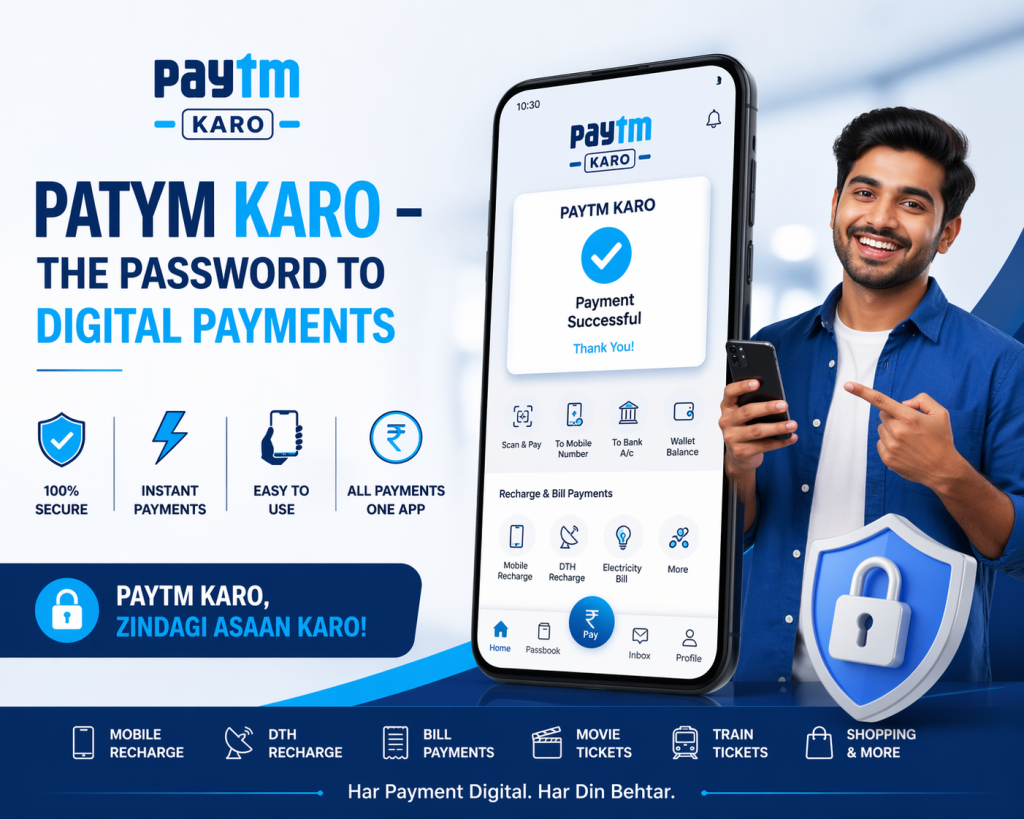
PATYM KARO – THE PASSWORD TO DIGITAL PAYMENTS
ONE of the oldest digital apps is Paytm, found in 2010 by Vijay Shekar Sharma. The institutional umbrella was One97 Communications, a company than went public subsequently. The initial offering was limited to mobile recharge and bill payments via the app and their website. Subsequently it expanded into a Paytm Wallet and could be used for online shopping and cab services. In 2016, the demonetization of high value currency, made the public in search for means to pay for everyday transactions such as groceries, transport and buying their daily necessities. It was at this juncture, that Paytm positioned itself as a payment gateway by their distribution of millions of QR codes to small shops, roadside vendors and other traders who once only accepted cash as payment. Within weeks the Patym user base jumped from 100 million to over 200 million with transaction volumes. During this time, Patym ran high voltage campaigns to make “patym karo” synonymous of cashless convenience.
Today Patym appears to have lost steam, with technical outages, poor customer service and regulatory scrutiny by the RBI. Still Patym is a dominant player in the merchant QR code payments. Walk into any shop in Panjim or Margao market and most traders have the Paytm QR code standee on their table counter. Today, however, Paytm has competition from PhonePe or Google Pay, which offer similar services.
Today’s users have a choice of several such services. Among the more popular are Google Pay Bharat Pe or Amazon Pay. The online selling giant Amazon has its Amazon Pay for making payment for purchases from Amazon as also for e-commerce. Amazon is also enticing users to use Amazon pay for other digital services by offering a certain cash back on using its payment system.
THE PITFALLS
WHILE these payment systems offer users a facility of immediate and quick settlement as also the ease of transacting, there are certain pitfalls associated with these gateways. A big threat is cyber frauds. Most of you would have heard of cases where a call from nowhere, informing you of the non-payment of a bill, keeps the receiver mesmerized, allowing the caller to enter into Google Pay or any other payment app without the realization that one’s bank account is being emptied within the time that the caller has finished the conversation. Cases like phishing, OTP scams and fake UPI scams, are making even the educated wary of using many of these facilities.
Then there are issues due to poor connectivity. Further the usage of these digital payment’s app are mainly urban facilities; most people in our rural areas still prefer to rely on either cash or paper transactions.
As India moves into the digital age, with the increased use of digital transactions, there will be an increase in the digital space, especially in monetary and fiscal transactions. But this growth also increases the risks and frauds that cyber criminals use to prey on innocent folk to take away their hard-earned savings and investments!
 LETTER TO THE EDITOR FOR THE ISSUE DATED OCTOBER 17, 2026
 AZAD MAIDAN NO LONGER FREE!
 AZAD MAIDAN CRACKDOWN! Goa’s crackdown on protesters raises grave questions about democracy! By Our Special Correspondent
 INDIAN WOMEN ARE ON THE STREETS AGAIN. EVERYTHING HAS CHANGED BUT NOTHING HAS CHANGED!By Shilpa Phadke
 RBI TIGHTENS SCREWs ON ECONOMY!By Arvind Pinto
 SSR OVERRULED SIR IN GOA!
 HI MUMBAI MERI JAAN BUT…
 RAJENDRA ARLEKAR WILL REPLACE PRAMOD SAWANT?
 MENTAL HEALTH ACROSS THE LIFESPAN! By Dr Amit Dias
 WEEKEND UPDATES
 LETTER TO THE EDITOR FOR THE ISSUE DATED OCTOBER 10, 2026
 WHEN THE MACHINE OVERRIDES THE LAW!
 HAS GOA BECOME MORE PERMISSIVE? By Special Correspondent
 BILLIONAIRES MULTIPLYING AT THE COST OF THE MIDDLE CLASS!
 THE SHADOW OF VOTE THEFT: WHY CEC GYANESH KUMAR MUST RESIGN!By Dr Olav Albuquerque & Deborah Cordeiro
Goa is abuzz with excitement as vintage bike and car owners, users, collectors and fans are decking […]