Goa is abuzz with excitement as vintage bike and car owners, users, collectors and fans are decking […]
Old is Gold
October 4, 2016
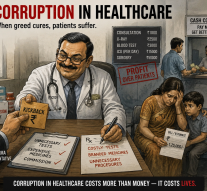
WHAT should be a sacred space of healing in India is increasingly being exposed as a sprawling marketplace of corruption. From unnecessary surgeries and organ trafficking to insurance fraud and corporate collusion, India’s healthcare system — once hailed for its resilience and reach—is now under the scanner for a deeply entrenched web of deceit. And while the victims are millions of unsuspecting patients, the enablers are disturbingly spread across hospital corridors, pharma boardrooms, insurance lobbies, and even within the halls of Parliament.
Fake Surgeries, Real Profits
ACCORDING to a recent investigation by Zee News, a shocking 44% of surgeries in India are either fake, fraudulent, or medically unnecessary. That’s nearly 1 in 2 procedures being conducted not for patient benefit, but to line the pockets of hospitals and doctors.
The numbers are even more damning:
• 55% of heart surgeries
• 48% of hysterectomies
• 47% of cancer surgeries
• 45% of C-sections
These aren’t just statistics — they represent lives subjected to trauma, often without need.
This deliberate over-treatment isn’t just unethical — it’s incentivized. A study by BMJ Global Health found that top doctors in corporate hospitals are paid salaries up to Rs1 crore per month. The more procedures they push — needed or not — the higher their pay.
Life After Death: The Unthinkable Scams
THE rot goes deeper. A Times of India exposé revealed that several hospitals continue to show dead patients as alive to prolong treatment and inflate bills. In one horrifying case, a 14-year-old boy who had already passed away was kept on a ventilator for over a month — all for profit. When the family complained, the hospital offered Rs5 lakh as compensation, brushing off a month of unimaginable trauma.
There are reports of hospitals rushing deceased patients into fake surgeries, only to later declare them dead during the procedure — again, to claim full fees for the operation.
Insurance Betrayal: When Coverage Doesn’t Cover
INDIA’S 68% insurance coverage rate should have been a safety net. Instead, it has become another battlefield. Claims are routinely denied, disbursed partially, or held back over vague technicalities.
Worse, over 3,000 hospitals have been blacklisted by insurers for fraudulent claims. During the COVID-19 pandemic, numerous hospitals were caught inflating patient counts and fabricating positive reports to cash in on insurance payout.
Organ Trafficking: A Dark Underworld
IN a story that reads like a crime thriller, Sangeeta Kashyap from Kanpur narrowly escaped being a victim of an international organ trafficking racket. After being lured to Delhi with a job offer, she was admitted to Fortis Hospital for a “mandatory health check.” There, she overheard doctors referring to her as a “donor” and fled. Her tip-off helped police uncover a multi-crore organ racket involving doctors, hospital staff, and even law enforcement.
The Referral Racket
CORPORATE hospitals like Apollo, Fortis, Kokilaben, and others have turned patient referrals into a pay-per-head business. Some offer up to Rs2.5 lakh per year to doctors referring 75 patients. It doesn’t matter if the patient needs hospitalization — the goal is numbers, not care.
Lab & Diagnosis Scam: Cash for Fake Tests
THE diagnosis scam is another booming racket. Income Tax raids on Bengaluru labs revealed Rs100 crore in cash and 3.5 kg of gold — all used to bribe doctors. Patients are prescribed multiple tests, of which only a fraction are actually performed. The rest are entirely fabricated, with doctors receiving 40–50% commission.
With over 2 lakh diagnostic labs in India but fewer than 1,000 certified, fake testing has become one of healthcare’s biggest rackets.
Big Pharma’s Dirty Tricks
MAJOR pharmaceutical companies spend an estimated Rs1,000 crore annually on bribing doctors to push their drugs. From cash and luxury holidays to foreign trips and lavish stays, doctors are openly incentivized to write prescriptions based on rewards — not on what the patient needs.
During COVID-19, Dolo tablets became a national controversy after it was revealed the company spent Rs1,000 crore on doctor incentives alone. Similarly, USV Ltd offers doctors either Rs3 lakh in cash or luxury travel packages in exchange for prescribing its drugs.
MRP Scam: Drugs Sold at 10x the Cost
HOSPITALS and pharma companies have also colluded to scam patients through inflated medicine prices. A cancer drug, Temicure, bought by hospitals for Rs1,950, is billed to patients at Rs18,645 — a 900% mark up. This MRP scam is rampant across the country and goes unchecked.
MCI: Watchdog or Lapdog?
THE Medical Council of India (MCI) — tasked with regulating the sector — was slammed by a Parliamentary Committee in 2016. The committee found that the MCI prioritized opening more colleges and minting new doctors, while completely ignoring regulation, ethics, and accountability.
Violations of MCI rules are routine:
• Doctors must prescribe generic medicines, but push branded ones.
• Patients must be informed of costs before treatment, yet most are kept in the dark.
• Medical records must be maintained for 3 years, yet disappear overnight.
• Unethical practices go unpunished, as MCI fails to act.
• Government Scheme Frauds: Stealing in Broad Daylight
In perhaps the most institutionalized scam, hospitals enrol patients — like ex-servicemen or pensioners — under government health schemes even for minor illnesses. Fake diagnoses and fake treatments follow, allowing hospitals to siphon lakhs from the government with forged paperwork.
Issues That Need Immediate Attention (From My Side)
(Uday Barad, consultant, author, freelance journalist and commentator on current political affairs.)
 LETTER TO THE EDITOR FOR ISSUE DATED SEPTEMBER 26, 2026
 DIVIDED EVEN IN DEATH!By Rajan Narayan
 IF YOU CLAIM THE CREDIT, TAKE THE RESPONSIBILITY!By Joquim Goes
 8 EMAILS IN 7 DAYS, BUT VALID GOA VOTERS STILL LEFT OUT: EC’S FLAWED SYSTEM!By Ritika Chopra
 MAKE IN INDIA: UNITED PAYMENTS INTERFACE India’s digital local leap to global benchmark…By Arvind Pinto
 BRING BACK THE FLATBREADS OF INDIA!
 EARLIER YOU KNOW, THE MORE YOU CAN DO Dementia diagnosis matters… By Dr Vailanki Nazira Raposo
 YOUNG LOVE IS A CRIME IN BIHAR!
 THE BOAT BECKONS, THE UNICORN WATCHES! By Prema Viswanathan
 WEEKEND UPDATES
 LETTER TO THE EDITOR FOR ISSUE DATED SEPTEMBER 19, 2026
 ELEVATED HIGHWAY TO HELL!
 MEDICAL DEVICES LOOT!By GS Mudur
 HOSTILE ACT BY PAKISTAN: `PNS HUNAIN’ TRIED TO DISRUPT OUR NAVAL SURVEILLANCE! By Dr Olav Albuquerque & Deborah Albuquerque
 BLACK MONEY IN POLITIAL PARTIES: ADR’s Alarming Revelations By Arvind Pinto
Goa is abuzz with excitement as vintage bike and car owners, users, collectors and fans are decking […]