Goa is abuzz with excitement as vintage bike and car owners, users, collectors and fans are decking […]
Old is Gold
October 4, 2016
Imagine receiving a phone call that changes everything.
For one family, it is the devastating news that a loved one has been declared brain dead. For another, it is the miracle they have been praying for: “We have found a matching organ.”
Between these two families lies one extraordinary act of generosity.
ORGAN donation is perhaps the greatest gift one human being can give another — the gift of life itself. Every year on August 3, India observes National Organ Donation Day, commemorating the country’s first successful deceased-donor heart transplant performed on this day in 1994. The day reminds us that even after life ends, hope can continue through the lives we save.
A Silent Crisis
INDIA has made remarkable progress in organ transplantation over the past decade. Organ transplants have increased nearly fourfold — from fewer than 5,000 in 2013 to almost 20,000 transplants in 2025. Today, India performs the third-highest number of organ transplants in the world, yet the demand far exceeds the supply.
The reality is heartbreaking.
Nearly 90,000 people in India are currently waiting for a life-saving organ transplant.
India’s deceased organ donation rate is only 0.81 donors per million population, among the lowest in the world.
Every donated organ represents another person who gets to return home, hug their family, and continue living.
The tragedy is not that medicine has failed.
The tragedy is that awareness has not yet reached everyone.
What can be donated?
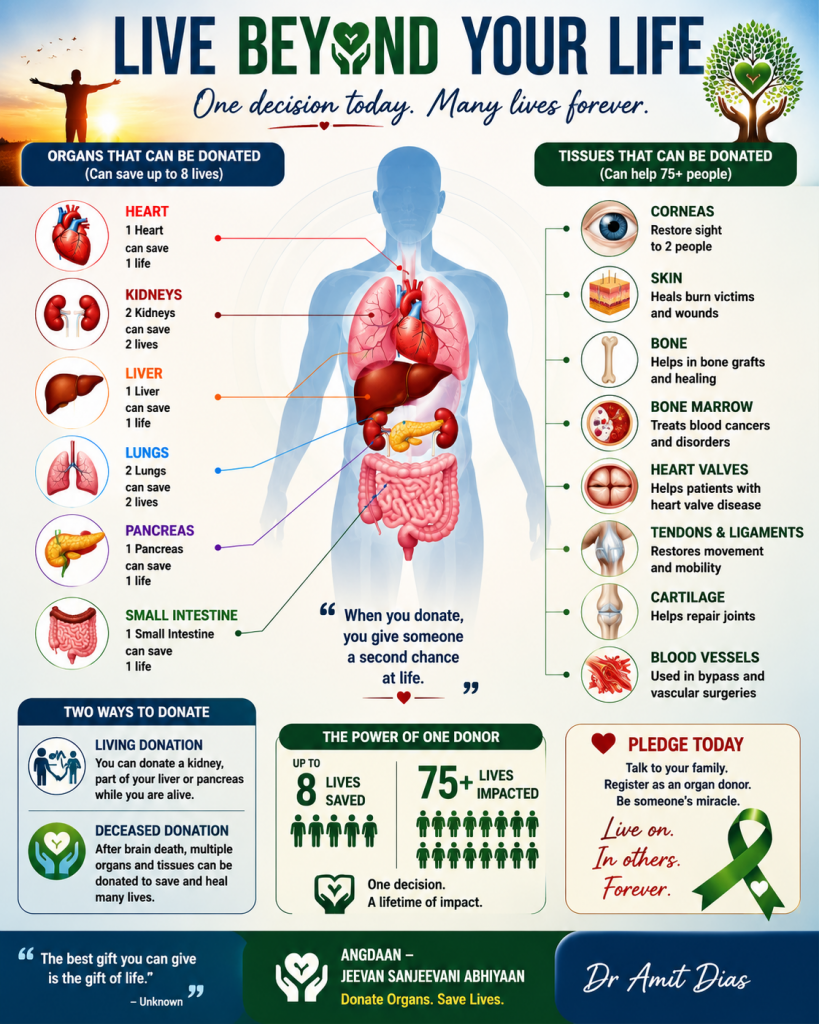
ONE organ donor has the remarkable potential to save up to eight lives and improve the lives of more than 75 others through tissue donation. Organs that can be donated include the heart, kidneys, liver, lungs, pancreas and small intestine. In addition, several tissues can be donated, including the corneas (to restore sight), skin (for burn victims), bone, bone marrow, heart valves, tendons, ligaments, cartilage, and blood vessels.
While some organs can be donated only after brain death, many tissues such as the corneas and skin can be donated even after natural death within a specified time. Through one generous decision, a donor can leave behind a legacy of life, hope and healing for dozens of people.
A Legacy That Never Dies
MOST of us wonder how we will be remembered.
Some build monuments. Some leave wealth. Some write books.
An organ donor leaves something even more precious — a heartbeat, a pair of eyes, healthy lungs, a functioning liver, and the chance for someone else to celebrate another birthday.
One deceased donor can save up to eight lives through organ transplantation and improve the lives of many more through tissue donation. Corneas restore sight. Skin heals burn victims. Bone and heart valves transform lives.
Few acts of kindness can equal this.
From Medical Miracle to National Movement:
MODERN organ transplantation began in 1954 when Dr Joseph Murray performed the world’s first successful kidney transplant between identical twins. His pioneering work transformed medicine and later earned him the Nobel Prize.
India has also made remarkable advances. The establishment of the National Organ and Tissue Transplant Organisation (NOTTO) and the nationwide Angdaan – Jeevan Sanjeevani Abhiyaan have strengthened organ donation awareness, transplant coordination and equitable organ allocation across the country. More than 4.8 lakh Indians have already pledged to donate their organs.
What We Learnt in Goa
OUR research at Goa Medical College & Hospital conducted with Aman Rajadhyaksha and colleagues, explored why many people hesitate to donate.
The barriers were rarely medical.
They were myths.
Many believed organs could be bought or sold. Others feared doctors would not try hard enough to save registered donors. Some worried that the body would be disfigured or that they were “too old” or “too sick” to donate.
None of these fears are true.
Brain death is diagnosed independently under strict legal protocols. Organ donation never interferes with medical care. The body is treated with dignity and respect. There is no cost to the donor’s family. Organ allocation follows transparent medical criteria — not wealth, influence or social status.
Perhaps most importantly, every major religion regards organ donation as an act of compassion and charity.
Two Ways to Save Lives
Living Donation Healthy adults may donate:
One kidney
Part of the liver
In selected situations, part of the pancreas
Deceased Donation: Following certification of brain death, several organs and tissues —including the heart, lungs, kidneys, liver, pancreas, intestines, corneas, skin, bone and heart valves —may be donated, offering hope to many recipients simultaneously.
Myths That Cost Lives
EVERY myth delays another transplant.
“Doctors won’t save me if I’m an organ donor.” The first duty of every doctor is to save life. Organ donation is considered only after death has been declared according to strict legal standards.
“I’m too old.” Age alone is not a barrier. Medical suitability — not age — determines whether organs or tissues can be donated.
“My religion does not permit it.” All major religions support organ donation as a selfless act of love and generosity.
“My body will be disfigured.” Organ retrieval is performed respectfully, preserving the body’s appearance for funeral rites.
“Only rich people receive organs.” Allocation is governed by medical urgency, compatibility and waiting time — not financial status.
How You Can Make a Difference?
PLEDGING your organs takes only a few minutes.
More importantly, tell your family.
Their understanding and support are often the deciding factor when the moment comes.
Every conversation today could become someone’s second chance tomorrow.
Answer the Call
“ANSWERING the Call”— is more than a slogan.
At this very moment, thousands of patients are waiting.
A young father hoping to see his daughter grow up.
A college student waiting for a new heart.
A mother praying for a kidney.
A child waiting for lungs that will allow him to breathe freely again.
For them, the phone call announcing the availability of an organ is nothing short of a miracle.
That miracle begins with someone saying “Yes.”
When your journey on earth ends, your heart can continue beating.
Your eyes can continue seeing.
Your hands can continue creating.
Your life can continue giving hope.
You may leave this world — but you never truly leave the lives you save.
Live beyond your life. Pledge to donate your organs.
 LETTER TO THE EDITOR FOR ISSUE DATED SEPTEMBER 19, 2026
 ELEVATED HIGHWAY TO HELL!
 MEDICAL DEVICES LOOT!By GS Mudur
 HOSTILE ACT BY PAKISTAN: `PNS HUNAIN’ TRIED TO DISRUPT OUR NAVAL SURVEILLANCE! By Dr Olav Albuquerque & Deborah Albuquerque
 BLACK MONEY IN POLITIAL PARTIES: ADR’s Alarming Revelations By Arvind Pinto
 `KHANDVI MILLE-FEUILLE’ AT BRICS ALL VEG BUFFET!
 SATYA NIKETAN TRAGEDY: HOW GLOBAL STUDENT HOUSING MODELS COULD HELP INDIA FIX A BROKEN SYSTEM!By Sneha Swaminathan
 GANESH PANDALS HIJACKED BY ADANI, AMBANI
 WHY DOES A DEMENTIA DIAGNOSIS MATTER? By Dr Amit Dias
 WEEKEND UPDATES
 LETTERS TO THE EDITOR FOR ISSUE DATED SEPTEMBER 12, 2026
 GOAN TEACHERS ARE CONTRACT LABOR!
 THE COLOUR IS PRESTIGIOUS! THE PROCESS MUST BE EQUALLY SO!
 DOGS ATTACK GOANS, OWNERS GET ACQUITTED!By Dr Olav Albuquerque & Deborah Cordeiro
 CYBER FRAUD: A THREAT TO FINANCIAL SECURITY & MENTAL WELL-BEING! By Adv Vinayak (Mama) D Porob
Goa is abuzz with excitement as vintage bike and car owners, users, collectors and fans are decking […]