Goa is abuzz with excitement as vintage bike and car owners, users, collectors and fans are decking […]
Old is Gold
October 4, 2016
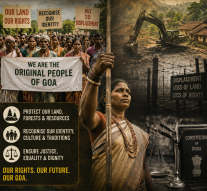
GOA’s tribal communities have lived on and depended on the state’s forests and natural resources for generations. Yet many of them have historically been treated as encroachers on land that was part of their traditional way of life.
The Gawda, Kunbi and Velip communities have faced this injustice both before and after Liberation. The struggle for tribal rights is not simply about ownership of land. It is also about livelihood, culture, identity and the right to remain connected with traditional territories. Those from these tribal communities have entered the police force and even secured promotions so that some of these persons with the surname of Gawda or Velip have risen to the rank of police inspector.
The allegation made is these tribals have been automatically promoted without being able to compete with those from the general category so that, to some extent, the efficacy of the Goa Police may have been affected. Such allegations have to be verified but the fact remains that the centuries of deprivation cannot justify shoddy investigations, if proved.
The Forest Rights Act was introduced to address some of these long-standing problems. It seeks to recognise the rights of Scheduled Tribes and other traditional forest dwellers, including rights over land and homesteads in forest villages.
For Goa’s tribal communities, the law provides an important framework for securing land rights and protecting traditional livelihoods. But putting the law into practice has not been easy. The verification and recording of claims remains a complicated process, requiring documentation and coordination between government agencies and tribal organisations.
A question of land and livelihood
FOR tribal families, forests are more than just parcels of land. They provide sources of livelihood and are closely connected with community life and cultural traditions.
The recognition of forest rights is therefore important not only because it can provide legal ownership of homes and cultivated land, but also because it can protect access to forest resources on which traditional communities depend.
The challenge is ensuring that these rights are actually recognised on the ground. A law can provide protection on paper, but communities need an accessible and effective system through which they can establish and exercise their rights.
The courts and tribal rights
THE judiciary has played an important role in strengthening the legal protection available to tribal communities in India.
Over the years, courts have interpreted constitutional guarantees of equality, liberty, livelihood and the right to life in ways that have helped protect tribal people from displacement and exploitation. The growth of public interest litigation also opened the doors of the courts to communities that often lacked the resources or ability to pursue conventional legal action.
Several important Supreme Court judgments have strengthened this protection.
In the Samata judgment of 1997, the court restricted the transfer of tribal land and held that government authorities could not simply bypass protections designed for tribal communities.
In the Niyamgiri judgment of 2013, the Supreme Court recognised that forest rights extend beyond the narrow question of property. The judgment acknowledged the importance of customary rights and the cultural and spiritual relationship between tribal communities and their traditional territories.
Earlier, in the Banwasi Seva Ashram case, the court recognised livelihood as an important constitutional concern and held that development cannot come at the expense of fundamental rights.
These decisions underline an important principle: development cannot mean taking away the land, livelihood and identity of vulnerable communities without adequate protection.
Development and displacement
ACROSS India, tribal communities have often carried a disproportionate burden of development projects. Mining, industries, infrastructure and other projects have frequently affected areas where tribal populations live.
Displacement can mean far more than losing a house. It can separate families from agricultural land, forests, community networks and cultural traditions. Compensation and rehabilitation may not fully replace what is lost.
This is particularly important in places where natural resources are concentrated in tribal-dominated areas. Governments, private interests and local communities may have competing claims over the same land and resources. Such conflicts can leave tribal communities in a particularly vulnerable position.
Goa’s unfinished task
FOR Goa, the Forest Rights Act offers an opportunity to correct a history of marginalisation faced by the Gawda, Kunbi and Velip communities. But legislation alone cannot solve the problem.
Many tribal people still face difficulties arising from limited education and awareness of their legal rights. Differences in language, culture and social conditions can also make it difficult for communities to deal with government institutions and the wider society.
At the same time, tribal leadership is evolving. Educated members of these communities are increasingly helping people understand their rights and organise around common concerns. New forms of community self-governance are also emerging.
The next step must be to ensure that legal rights are translated into real rights on the ground. Claims over land and forest resources need to be processed fairly and efficiently. Tribal communities must be given a meaningful voice in decisions affecting their homes, livelihoods and traditional territories.
Goa’s tribal rights movement is ultimately about recognition and dignity. The Gawda, Kunbi and Velip communities are not newcomers to the lands they inhabit. Their history, culture and livelihoods are deeply rooted in them.
The combination of forest rights legislation, constitutional protection, judicial intervention and growing community awareness provides hope. But justice will depend on how effectively these protections are implemented.
For Goa, recognising tribal rights is not merely a legal obligation. It is also a question of fairness, history and respect for communities that have been part of the state’s social fabric for generations.
 LETTER TO THE EDITOR FOR ISSUE DATED SEPTEMBER 26, 2026
 DIVIDED EVEN IN DEATH!By Rajan Narayan
 IF YOU CLAIM THE CREDIT, TAKE THE RESPONSIBILITY!By Joquim Goes
 8 EMAILS IN 7 DAYS, BUT VALID GOA VOTERS STILL LEFT OUT: EC’S FLAWED SYSTEM!By Ritika Chopra
 MAKE IN INDIA: UNITED PAYMENTS INTERFACE India’s digital local leap to global benchmark…By Arvind Pinto
 BRING BACK THE FLATBREADS OF INDIA!
 EARLIER YOU KNOW, THE MORE YOU CAN DO Dementia diagnosis matters… By Dr Vailanki Nazira Raposo
 YOUNG LOVE IS A CRIME IN BIHAR!
 THE BOAT BECKONS, THE UNICORN WATCHES! By Prema Viswanathan
 WEEKEND UPDATES
 LETTER TO THE EDITOR FOR ISSUE DATED SEPTEMBER 19, 2026
 ELEVATED HIGHWAY TO HELL!
 MEDICAL DEVICES LOOT!By GS Mudur
 HOSTILE ACT BY PAKISTAN: `PNS HUNAIN’ TRIED TO DISRUPT OUR NAVAL SURVEILLANCE! By Dr Olav Albuquerque & Deborah Albuquerque
 BLACK MONEY IN POLITIAL PARTIES: ADR’s Alarming Revelations By Arvind Pinto
Goa is abuzz with excitement as vintage bike and car owners, users, collectors and fans are decking […]