Goa is abuzz with excitement as vintage bike and car owners, users, collectors and fans are decking […]
Old is Gold
October 4, 2016
GROWING older is not a disease to be cured. It is a journey to be lived — with dignity, purpose, relationships and joy.
Watching Lorna and Remo sing at concerts this year was inspirational. Reading Rajan Narayan’s “Stray Thoughts” gets you thinking. Every wrinkle carries a story. Every grey hair represents an experience. Every older person is a repository of memories, skills, traditions and wisdom that can enrich families and communities.
World Senior Citizens Day, observed on 21 August, is an opportunity to celebrate older people — not merely by caring for them, but by listening to them, learning from them and creating opportunities for them to remain active participants in society.
It is worth remembering that the United Nations’ official International Day of Older Persons is observed on October 1. The August 21 observance is widely used as World Senior Citizens Day to highlight the contribution and well-being of older adults.
The art of ageing gracefully
AGEING gracefully does not mean pretending that ageing does not bring challenges. It means adapting to change while continuing to find meaning, connection and enjoyment in life.
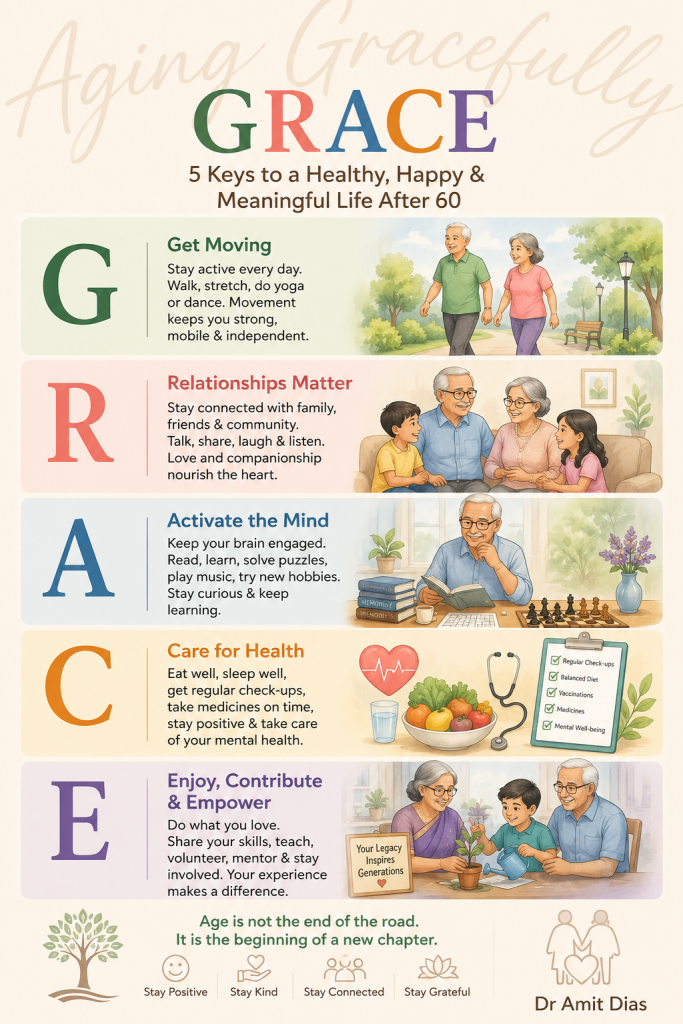
A useful way to remember the essentials in the word GRACE:
G – Get moving
Movement is medicine at every age.
Walking, stretching, yoga, dancing, gardening or simple strength and balance exercises can help older adults maintain mobility and independence. Exercise should be adapted to one’s health and abilities, but the goal should be to keep moving safely rather than becoming unnecessarily sedentary.
R – Relationships matter
Loneliness can be as damaging as many physical health problems.
Make time for family, friends, neighbours and community groups. A daily phone call, an evening walk with a friend, participation in a senior citizens’ club or a weekly gathering can make an enormous difference.
Sometimes the most valuable intervention is simply sitting down and listening.
A – Activate the mind
The brain, like the body, benefits from being challenged.
Read a book. Learn a musical instrument. Solve puzzles. Play cards. Learn to use a smartphone. Paint, sing, rite, cook a new recipe or learn a new language.
But cognitive stimulation should not become a test of intelligence. The objective is engagement and enjoyment — not examination.
C – Care for health
Healthy ageing includes regular health checks, appropriate vaccination, good nutrition, adequate sleep, medication review, dental and eye care, and attention to hearing and mental health.
Older adults should not automatically accept symptoms such as persistent pain, breathlessness, falls, memory problems, depression or loss of appetite as “just old age.”
Good healthcare should focus not only on diseases, but also on what matters to the person — function, independence and quality of life.
E – Enjoy, contribute and empower
Retirement from employment should not mean retirement from life.
Volunteer. Mentor a younger person. Teach a grandchild a traditional skill. Join a choir. Grow vegetables. Start writing, learn an instrument, participate in a community project. Share your professional experience. Attend a Memory Café session or senior citizens’ group.
The question should not always be, “What can we do for older people?”
We should also ask:
“What can older people continue to do for themselves, their families and society and age gracefully?”
THE WHO’s Decade of Healthy Ageing emphasises that older people should have a meaningful voice in decisions affecting their lives. Older adults are not simply recipients of services — they are contributors, volunteers, caregivers, workers, mentors and agents of change.
Don’t just keep seniors busy — make life meaningful.
One of the mistakes we make is assuming that older people simply need to be “kept occupied.”
Meaningful engagement is different from entertainment.
A senior may enjoy teaching children traditional games, documenting family history, helping in a community garden, advising a young entrepreneur, participating in local governance, singing in a choir or sharing stories of Goa’s past.
Give them a role, not merely a chair. The Memory Café in Goa is one such creative attempt in helping elders age gracefully. Recently, these services were shifted to Porvorim as well, courtesy the efforts MLA Rohan Khaunte.
Intergenerational activities are particularly valuable. Grandparents can teach children cooking, music, crafts, local history and stories. Younger people can help older adults navigate smartphones, digital payments, telemedicine and social media.
This creates a two-way exchange:
–Wisdom flows one way; technology and new perspectives flow the other.
–Ageing is also about the environment.
–Healthy ageing is not solely the responsibility of an individual.
An older person who wants to walk needs a safe footpath. Someone with poor vision needs accessible information. A person with mobility problems needs ramps and accessible transport. Someone living alone needs social connection and support.
Age-friendly communities therefore matter. Seniors communities and homes for safe and cost effective living are the need of the hour.
The WHO describes healthy ageing in terms of maintaining functional ability—the ability to do what matters to a person and live a life of well-being. This depends not only on physical and mental capacity but also on the environment in which people live.
Protecting dignity and safety
OLDER adults can be vulnerable to financial exploitation, neglect, abuse, abandonment and social isolation.
Families should encourage older people to remain involved in decisions concerning their finances, healthcare and living arrangements for as long as they are able to do so.
Digital literacy is increasingly important too. Seniors should be encouraged to learn how to identify online scams, protect passwords and OTPs, recognise fraudulent calls and seek help before making large financial transactions.
And importantly, asking for help is not a sign of weakness.
Elderline 14567 – help is just a call away
In India, the National Helpline for Senior Citizens – Elderline (14567) provides a valuable support system for older adults.
In an immediate emergency, 112 is India’s unified emergency number. Or in Goa, just call 108.
Sometimes, however, an older person does not need a service.
They simply need someone to talk to.
Elderline specifically includes emotional support — recognising that loneliness, anxiety and family difficulties are important aspects of healthy ageing.
What can each of us do?
THIS World Senior Citizens Day, try something simple.
Call an older person you know.
Don’t ask only:
“Did you take your medicines?”
Ask:
“What have you been doing?”
“What would you like to do?”
“What can I learn from you?”
Take them for a walk. Listen to an old song together. Look through family photographs. Teach them something digital — and allow them to teach you something in return.
Invite them to a community event.
Celebrate their birthday.
Ask about their childhood.
Record their stories.
And if they are no longer able to do many things independently, don’t take away everything they can still do.
Support independence rather than replacing it.
Growing older should mean growing richer in experience
We often measure ageing by the number of years lived. Perhaps we should also measure it by the number of relationships nurtured, stories shared, people helped, lessons learned and lives touched. The goal is not simply to add years to life, but to add life to those years — a principle at the heart of the global movement for healthy ageing.
So, on August 21, let us not merely celebrate senior citizens with flowers and greetings.
Let us build families that listen to them, communities that include them, healthcare systems that respect them and societies that value their contribution.
Because ageing gracefully is not about growing old without difficulties.
Perhaps the greatest gift we can give an older person is not another year of life —
but a reason to look forward to tomorrow.
Because ageing gracefully is not about growing old without difficulties.
Perhaps the greatest gift we can give an older person is not another year of life —
but a reason to look forward to tomorrow.
So, on August 21, let us not merely celebrate senior citizens with flowers and greetings.
 LETTER TO THE EDITOR FOR ISSUE DATED SEPTEMBER 26, 2026
 DIVIDED EVEN IN DEATH!By Rajan Narayan
 IF YOU CLAIM THE CREDIT, TAKE THE RESPONSIBILITY!By Joquim Goes
 8 EMAILS IN 7 DAYS, BUT VALID GOA VOTERS STILL LEFT OUT: EC’S FLAWED SYSTEM!By Ritika Chopra
 MAKE IN INDIA: UNITED PAYMENTS INTERFACE India’s digital local leap to global benchmark…By Arvind Pinto
 BRING BACK THE FLATBREADS OF INDIA!
 EARLIER YOU KNOW, THE MORE YOU CAN DO Dementia diagnosis matters… By Dr Vailanki Nazira Raposo
 YOUNG LOVE IS A CRIME IN BIHAR!
 THE BOAT BECKONS, THE UNICORN WATCHES! By Prema Viswanathan
 WEEKEND UPDATES
 LETTER TO THE EDITOR FOR ISSUE DATED SEPTEMBER 19, 2026
 ELEVATED HIGHWAY TO HELL!
 MEDICAL DEVICES LOOT!By GS Mudur
 HOSTILE ACT BY PAKISTAN: `PNS HUNAIN’ TRIED TO DISRUPT OUR NAVAL SURVEILLANCE! By Dr Olav Albuquerque & Deborah Albuquerque
 BLACK MONEY IN POLITIAL PARTIES: ADR’s Alarming Revelations By Arvind Pinto
Goa is abuzz with excitement as vintage bike and car owners, users, collectors and fans are decking […]