Goa is abuzz with excitement as vintage bike and car owners, users, collectors and fans are decking […]
Old is Gold
October 4, 2016
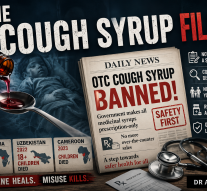
As we celebrate Doctors’ Day on the July 1, I would like to share the story of one of the commonest medicines found in almost every Indian household —a medicine that looks harmless, tastes sweet, and is often given without a second thought.
The humble cough syrup.
For decades, it has occupied a permanent place in our medicine cabinets. At the first sign of a cough, many of us instinctively reach for that familiar bottle of cough syrup. Parents administer it lovingly to children, adults recommend it to friends, and until recently, it could be bought from almost any pharmacy without a prescription.
But what if I told you that this seemingly innocent medicine has been responsible for addiction, misuse, and even the death of children?
As a young resident doctor, I noticed a few patients who visited the outpatient department every few weeks carrying an empty bottle of cough syrup. Curiously, none of them had a cough. They looked perfectly healthy, yet they insisted on getting another prescription for exactly the same medicine.
Initially, I thought they were anxious patients who believed the syrup made them feel better.
I was wrong. They were doing it as they were addicted to the cough syrup — probably dependent on the codeine in it.
Codeine is an opioid — a close chemical cousin of morphine. In small doses, it suppresses coughing effectively and has a legitimate place in medicine. But repeated, unsupervised use can lead to dependence.
That experience stayed with me. It reminded me that medicines deserve respect. There is no such thing as a completely harmless medicine.
Sadly, the dangers of cough syrups extend far beyond addiction.
In 2022, the world was horrified when more than 70 children in the Gambia died after consuming contaminated cough syrups manufactured in India. Investigators found that the syrups contained diethylene glycol (DEG) and ethylene glycol (EG) — industrial chemicals used in anti-freeze and solvents instead of pharmaceutical-grade ingredients.
These chemicals are highly toxic. Once ingested, they damage the kidneys, liver and nervous system. Children developed vomiting, reduced urine output and acute kidney failure. Many could not be saved.
TRAGEDIES AND CATASTROPHE
BEFORE the world had recovered from that tragedy, another catastrophe struck. At least 18 children in Uzbekistan died after consuming another contaminated Indian-manufactured cough syrup. Similar incidents were subsequently reported in Cameroon, and altogether more than 140 children worldwide have lost their lives in these outbreaks.
More recently, contaminated medicinal syrups have also been linked to child deaths in Madhya Pradesh, reminding us that drug quality is not merely an export issue — it is an Indian public health concern.
These tragedies were not caused by cough syrups themselves, but by contaminated ingredients and failure in manufacturing quality control. Nevertheless, they forced regulators to ask an important question: Are we doing enough to ensure medicines are used safely? Do we know when to take cough syrups ?
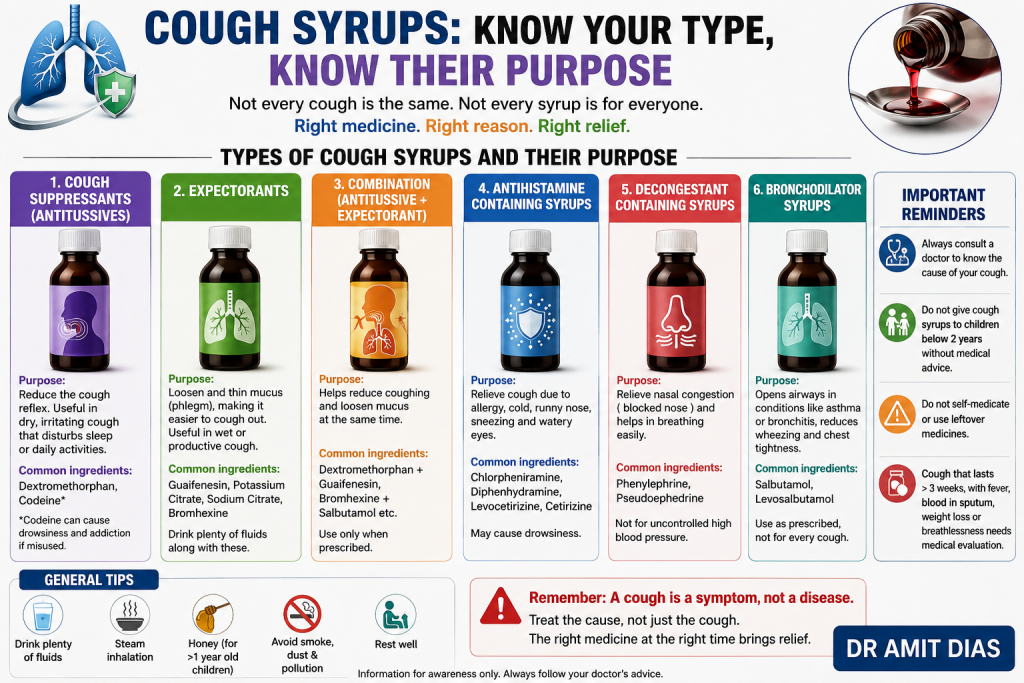
Cough syrups and their purpose:
Recently, the government of India has amended the Drugs Rules, 1945 to bring medicinal syrups — including cough syrups — under stricter regulation. These medicines can no longer be sold over the counter. They now require a valid prescription from a registered medical practitioner. This decision was not taken merely because of contamination. There were several equally important reasons.
First, self-medication:
A cough is not a disease. It is a symptom.
It may be caused by a simple viral cold that settles within a week. But it could also be the first sign of tuberculosis, asthma, pneumonia, heart failure, gastro-oesophageal reflux, chronic lung disease or even lung cancer.
Suppressing the cough without identifying the cause is like switching off a fire alarm while ignoring the fire itself.
Second, misuse:
Many cough syrups contain medicines such as codeine or dextromethorphan. When used appropriately, they are safe and effective. When taken in excessive quantities, however, they can produce euphoria, drowsiness and hallucinations, making them liable to abuse, especially among adolescents and young adults.
Doctors across India have seen patients quietly develop dependence on these medicines, often without realising it themselves.
Third, children deserve special protection:
Scientific studies have shown that cough and cold medicines offer very little benefit in young children, yet they may cause drowsiness, breathing difficulties, irregular heart rhythms and accidental overdose.
For this reason, Indian health authorities advise that cough and cold medicines should not be routinely used in children below two years of age unless specifically prescribed by a doctor. Similar recommendations exist in many developed countries.
Many people are surprised to learn that there is no single cough syrup.
Some contain medicines that suppress coughing. Others loosen mucus. Some contain antihistamines that make you sleepy. Others include decongestants that may increase blood pressure. Many combine several drugs into one bottle, exposing patients to medicines they may not even need.
That is precisely why the same syrup cannot be suitable for everyone.
So, what should you do when you develop a cough?
The first step is not to ask, “Which cough syrup should I take?”
Instead, ask, “Why am I coughing?”
If the cough is mild, associated with a common cold and improving, adequate rest, warm fluids, steam inhalation and honey (for children above one year) are often sufficient. But if the cough persists beyond three weeks, is accompanied by blood, breathlessness, chest pain, unexplained weight loss or high fever, medical evaluation is essential.
The recent restrictions on over-the-counter cough syrups are therefore not a ban on cough medicines. They are a reminder that medicines should be used thoughtfully, not casually. As doctors, we prescribe medicines every day. But perhaps our greatest responsibility is not merely to prescribe — it is to teach patients when not to take medicine.
This Doctors’ Day, let us remember that good medicine is not measured by the number of prescriptions we write, but by the wisdom with which we use them.
The next time you see that familiar bottle of cough syrup on the pharmacy shelf, remember this: it is not just a sweet syrup—it is a powerful medicine.
Use it when needed.
Use it correctly.
And most importantly, use it under medical advice.

 LETTER TO THE EDITOR FOR ISSUE DATED OCTOBER 03, 2026
 GEN-Z BLOCKED FROM VOTING BY GYANESHWAR MODI!
 THE FORAL OF 1526 Five Hundred Years Later, What Does Goa’s Oldest Village Charter Really Mean?
 20 YEARS IN ‘HERALD’, 43 IN GOA!
 THE DEGRADATION OF JNU – MY ALMA MATER! By Arvind Pinto
 THE WOMEN WHO LOOK BACK! By Prema Viswanathan
 GOA IS CELEBRITY STATE!
 HI MUMBAI MERI JAAN BUT…
 WEEKEND UPDATES
 LETTER TO THE EDITOR FOR ISSUE DATED SEPTEMBER 26, 2026
 DIVIDED EVEN IN DEATH!By Rajan Narayan
 IF YOU CLAIM THE CREDIT, TAKE THE RESPONSIBILITY!By Joquim Goes
 8 EMAILS IN 7 DAYS, BUT VALID GOA VOTERS STILL LEFT OUT: EC’S FLAWED SYSTEM!By Ritika Chopra
 MAKE IN INDIA: UNITED PAYMENTS INTERFACE India’s digital local leap to global benchmark…By Arvind Pinto
 BRING BACK THE FLATBREADS OF INDIA!
Goa is abuzz with excitement as vintage bike and car owners, users, collectors and fans are decking […]