Goa is abuzz with excitement as vintage bike and car owners, users, collectors and fans are decking […]
Old is Gold
October 4, 2016
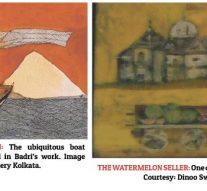
THERE is a boat in many of the works Badri Narayan painted, and it is almost always empty. It waits at the edge of a river, or beneath a sky full of cheerful orange clouds, ready to carry someone towards an unnamed destination.
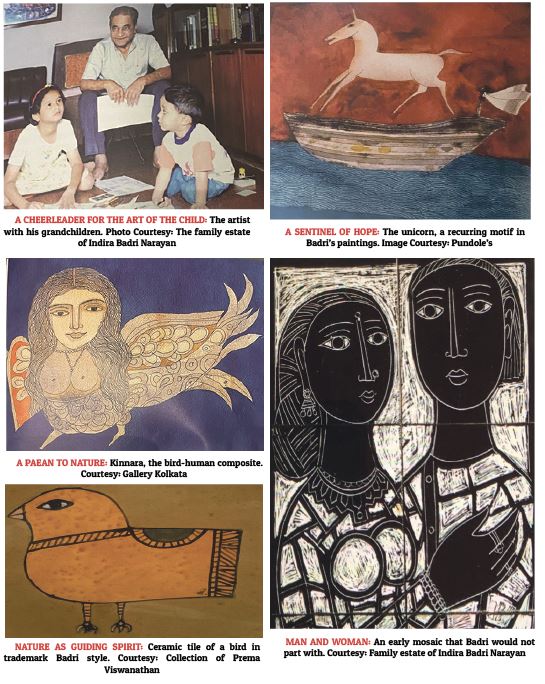
“The boat represents a journey where the destination is unknown,” Badri once said to this writer, “but the questing mind forges ahead with courage and passion, driven by the spirit of inquiry.” He might have been describing the boat. Or he might have been describing himself.
Badri lived his whole life a little like that boat — waiting, watching, wanting almost nothing for himself. He would arrive at The Times of India office in Bombay through the 1980s to deliver his articles and sketches, clad in a khadi kurta, a tin of paan masala in his pocket to share with whoever was around.
People who knew him only that way — modest, easy, undemanding — knew only half of him. The other half wanted one enormous thing: to paint with passion. Everything else he gave away, sometimes too readily: paintings to strangers, loans to whoever appeared needy. His was a career built with almost no instinct for self-promotion. It made him beloved of many. It may also have cost him dearly.
BORN in Secunderabad in 1929, Badri was drawing rangolis on the floor of his grandmother Nacharamma’s garden before he was a teenager. The patterns would recur across six decades of work: the boat, the ladder, the swan, the unicorn.
His mother, Indira, loved the cinema and took him to see Fearless Nadia swing in Hunterwali. She died of tuberculosis when he was 13 years old, only 34 years herself. The loss never left him. It surfaces repeatedly in his paintings in the figure of the mother and child, a yearning for a mother’s love endlessly unresolved.
There was little money and less encouragement at home. His father, a journalist, was buried in debt and often away. What Badri had instead was a library: his grandfather’s books and reproductions of Cézanne, which taught him, he said, “that it was possible to say through the visual vocabulary what may not be possible to articulate through words.”
He walked two or three miles barefoot each day to the Asafia State Library in Hyderabad, where he read anthropology, mythology and history because no one had told him not to.
At 16, with nothing but a school certificate, he walked out of his uncles’ house. They told him he would be back. “I said, I won’t,” he recalled. “And I didn’t.” He took a clerk’s job, stretched khadi over frames with gum because he could not afford canvas, and by 19 was being published in The Illustrated Weekly of India.
Everything he later painted, he had first read his way into. The Mahabharata and Ramayana, the Jataka tales, the Bible, the Book of Hours, Sufi poetry — he moved between them as if they were neighbouring rooms in the same house. The ladder, swan, elephant, fish, mermaid and winged messenger entered his visual vocabulary. Above them all was the unicorn, which appeared in Homage to Birth, painted when his granddaughter was born in 1990, and became his emblem of intuition and transcendence.
HE was drawn to women who refused the roles handed to them. His Savitri is not the submissive wife of tradition but death’s intellectual equal, defeating Yama through argument and logic. In his paintings of Chandidas and Rami, the Brahmin poet-priest and the washerwoman whose love crossed a forbidden caste line are separated by ominous blue-black mountains. Yet the sky remains incandescent, Rami’s dupatta drifts across the water, and the boat beckons.
Badri arrived in Bombay in the mid-1950s, when the city was becoming the centre of Indian modernism. His first solo show at Jehangir Art Gallery in 1955 sold paintings for 50 or 75 rupees apiece. It was a relief when Kali Pundole, and later his son Dadiba, took over the marketing of his work, leaving the artist free to focus on his true vocation – painting.
HE knew Husain, Souza, Ara and Gade; Raza spent weekends at Gade’s house in the suburb of Chembur, where Badri settled after his marriage in 1958. He admired the Progressive Artists’ Group without joining it, content to paint what he saw rather than what a manifesto required.
That independence can look like integrity, but also like self-marginalisation. Badri’s refusal to affiliate himself with avant-garde movements contributed to his being pushed to the periphery of the artistic world. His neglect, his friends believed, had less to do with the quality of his work than with a critical establishment uncomfortable with his spiritual, mythic worldview.
Recognition came only in his final years. Friends urged him to go to Europe. He never did. India was the ground his imagery grew out of, and he did not want to explore any other soil. Admirable, perhaps — though one might also ask whether the same refusal kept him further from the audiences and markets that could have secured his reputation earlier.
For decades his studio was Flat No 84 in Chembur, a single room that also housed a family of four. His wife used to wake at three in the morning to the sound of the typewriter or pots and pans knocked over in the dark, and find him at the kitchen table, painting or writing.
For 16 years Badri taught at the Bombay International School, sitting cross-legged on the floor at the children’s height because he believed the distance between teacher and taught was the first thing that had to go.
He would tell a story and let the children draw whatever it opened up in them, without correcting colour or shape. “The process of expressiveness in a child’s drawing or painting is itself the goal,” he said.
He took the job without asking what it paid. His wife scolded him, not without reason. A few weeks in, a child told him, “I love you very much. You’re like my father.” That, he said, was salary enough.
He let children teach him back. When his granddaughter asked why he never used bright colours, he tried them — and the vermilions, ochres and orange-reds of paintings such as Devi Gayatri and Nayikas became part of his later vocabulary. He gave free lessons to young offenders and children with thalassaemia, long before “art therapy” became familiar in India. He also gave away paintings with astonishing ease, to those who couldn’t afford to buy them, such as the watermelon seller or the paanwallah.
When his daughter developed an allergy to turpentine, Badri gave up oil painting and turned to watercolour, eventually preferring it. “Oil is a turgid medium,” he said, “whereas watercolour flows and has a translucence.”
The medium suited his imagery: boats and rivers, trailing garments and fluid lines set against mountains and trees rendered almost still.
Parkinson’s, two heart attacks and bone cancer marked his final years. His walk slowed and his memory grew unreliable, but he kept working.
“My legs may be weak,” he said, “but at least God has spared my hands, so I can paint.”
He was painting only hours before he was taken to hospital with a slight fever. He died there on September 23, 2013, at 84 years.
ART history likes a manifesto, a movement, a loud gesture that announces itself. Badri offered none. It may genuinely have cost him the wider recognition his contemporaries earned more easily.
He thought of painting as a calling rather than a career — a sadhana — and believed a life in art could not be reduced to a ledger of successes and failures. It is a beautiful way to live, though perhaps a difficult way to build a lasting public reputation.
He believed, quietly and completely, in a world where caste and faith made no difference, in a child’s intuition as something worth protecting, and in simple living married to a mind that never stopped reading. He took what he needed from Matisse’s colour and Maurice Denis’s symbolism and set them beside the Indian miniature and the Ajanta fresco as if East and West had never been separate rooms.
Picasso once said that every child is an artist, and the difficulty is staying one after growing up.
Badri managed it.
Even at 84 years, with his body failing him, the child who once drew rangolis on his grandmother’s floor was still wide awake — still waiting, like the boat, for whatever came next.
(Prema Viswanathan is the author of `Badri Narayan: Portrait of the Artist as Storyteller’ (Marg / Pundole’s, 2020).
 LETTER TO THE EDITOR FOR ISSUE DATED SEPTEMBER 26, 2026
 DIVIDED EVEN IN DEATH!By Rajan Narayan
 IF YOU CLAIM THE CREDIT, TAKE THE RESPONSIBILITY!By Joquim Goes
 8 EMAILS IN 7 DAYS, BUT VALID GOA VOTERS STILL LEFT OUT: EC’S FLAWED SYSTEM!By Ritika Chopra
 MAKE IN INDIA: UNITED PAYMENTS INTERFACE India’s digital local leap to global benchmark…By Arvind Pinto
 BRING BACK THE FLATBREADS OF INDIA!
 EARLIER YOU KNOW, THE MORE YOU CAN DO Dementia diagnosis matters… By Dr Vailanki Nazira Raposo
 YOUNG LOVE IS A CRIME IN BIHAR!
 WEEKEND UPDATES
 LETTER TO THE EDITOR FOR ISSUE DATED SEPTEMBER 19, 2026
 ELEVATED HIGHWAY TO HELL!
 MEDICAL DEVICES LOOT!By GS Mudur
 HOSTILE ACT BY PAKISTAN: `PNS HUNAIN’ TRIED TO DISRUPT OUR NAVAL SURVEILLANCE! By Dr Olav Albuquerque & Deborah Albuquerque
 BLACK MONEY IN POLITIAL PARTIES: ADR’s Alarming Revelations By Arvind Pinto
 `KHANDVI MILLE-FEUILLE’ AT BRICS ALL VEG BUFFET!
Goa is abuzz with excitement as vintage bike and car owners, users, collectors and fans are decking […]