Goa is abuzz with excitement as vintage bike and car owners, users, collectors and fans are decking […]
Old is Gold
October 4, 2016
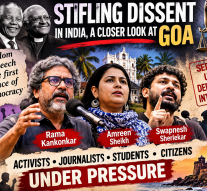
OVER a 60 year media journey starting in 1966 in Mumbai I am familiar with all kinds of attempts to stifle dissent. For the first seven years of my life in my 20s I worked for “The Financial Express” where we were barred from saying anything negative about the Tatas and the Birlas. As a junior employee I had no say in the matter. Though I discovered how much self-censorship existed in the media even way back in the early 70s before the Emergency.
My then editor VK Narasimaha very painstakingly explained the process of seeming to be totally neutral while writing editorials. The editorials of those days were in retrospect “idiotorials.” They said a lot of things but refrained from any judgement. Narasimhan thought me the art of using conditional clauses. “Be that as it may be,” “Nevertheless,” “Notwithstanding that,” and “But there are extenuating circumstance.” Horrifyingly even while commenting on the Bhopal tragedy which killed and maimed thousands of people the newspaper editorials found adjectives to exonerating the chairman of Union Carbide India, Keshub Mahindra.
AT `ONLOOKER’
THE first time I had to take a call on dissent in a position of authority was when I was assistant editor of the “Onlooker” fortnightly during the Emergency. On the day the Emergency was declared on June 17, 1975 I was walking to my office near the Stock Market from Churchgate Station. There was a huge hoarding outside Churchgate station with a photograph of the latest “Onlooker” cover with the heading “Is this the end of Indira Gandhi?” I saw policemen in plain clothes trying to scrape off the heading with their umbrellas and batons. I was outraged as I had written the story which was being scrapped off. After the Emergency was declared we had to refer every article and photograph to a prim old woman in the Censor Board headed by a retired journalist called Vinod Rao.
Ironically, a major bone of contention was a semi-nude picture that “Onlooker” used to carry even before the launch of the “Debonair” monthly. Emergency censorship had a puritanical streak. We were ordered to drop the cheesecake picture in the “Onlooker.” This had a dramatic impact on circulation as we discovered that over 60% of “Onlooker” readers bought the magazine for the titillating semi-nude picture of a model or filmstar.
DHIRUBHAI DADAGIRI
I EXPERIENCED corporate dadagiri when I was deputy editor of “Business India” fortnightly. I wrote a hard-hitting investigative report on Dhirubhai Ambani, on how he manipulated government policy with senior Union ministers like TA Pai who was the Commerce Minister. Dhirubhai Ambani boasted that he had a golden slipper and a silver slipper. That everyone has his or her price. The story goes that Dhirubhai facilitated a big loan to Girilal Jain, the legendary editor of “The Times of India” to buy Reliance shares.
Dhirubhai came to know about the forthcoming cover story as he had spies everywhere. He called up Ashok Advani , my then publisher. We had an arbitration meeting in the then presence of the Congress heavyweight Rajni Patel. Both Ashok Advani and I stood by the story. Of course thereafter Business India did not get a single Reliance advertisement.
AT `OHERALDO’
WITHIN a week of my taking over as the editor of the “OHeraldo” in Goa in October 10, 1983 I learned the power of the then Chief Minister Pratapsingh Rane. It was a petty issue in every sense. The then director of the Kala Academy Damu Kenkre, a senior theatre artiste, lamented about the interference of the CM’s imperial wife Vijaya Devi Rane. The Kala Academy Indian music department had been asked to present some items at the first all-India meet of the Hotel Federation at the Cidade de Goa. Damu Kenkre had designed and choreographed the performance. Vijaya Devi, who came to one of the rehearsals, insisted that the girls should wear orange sarees and green blouses to look like the national flag. Damu Kenkre was shocked at this desecration. Damu sobbed out the story to me over a couple of drinks at the Clube Vasco da Gama in Panjim. I carried a story titled “When the color of a saree destroyed a dream.” The very next day my then publisher AC Fernandes was summoned by Chief Minister Pratapsingh Raoji Rane. Who is this “outsider who is insulting my wife?” To his credit AC Fernandes told Rane “I pay his salary and not you. You cannot tell me what my editor can write and not write.”
There have been other instances of the stifling of dissent. Ironically, by the judiciary which is supposed to support the right to dissent and freedom of speech. In the Letters page of the “OHeraldo” around 1985 we happened to feature the frustration of Prof Anne Menezes of St Xaviar’s College with a sarpanch of Saligao. This was a dispute over a property matter. We carried the letter for which one of the sub-editor’s gave the heading “Justice Goan Style.”
High court judge Dr Gustave Couto who was a hangover from the Portuguese times, who did not understand colloquial English, was very upset. Couto called me up at the “OHeraldo” for contempt of court. Why are you implying that Goan justice is inferior to justice anywhere in the country or the world? My then lawyer was Ferdino Rebello, retired chief justice of the Allahabad high court, Ferdino could not convince Dr Couto that we meant no offence to the judiciary and had the highest respect for him and all the other judges. He let off Anne Menezes pointing out that she was a lay person. But he gave a long judgement calling me “Rajan Narayan, a habitual contemnor.” This is still on record in the high court library archives. Fortunately, I got off with an apology and did not have to go to jail.
 WHO’S DREAMING OF A BLUE WAVE IN GOA?What will it take? Asks PhD researcher and architect… Tahir F de Noronha
 FREEDOM OF SPEECH AND EXPRESSION! By Cleofato Almeida Coutinho
 AI HITS IT JOBS VERY HARD!
 THE TATA TUSSLE: BOARDROOM BATTLES! By Arvind Pinto
 MISSING AUTORIKSHAS AND ‘PANI-PURI’ OF MUMBAI!
 DIALOGUES AT THE ICG…
 BEFORE IT STRIKES: EARLY ACTION ON DIABETES! By Dr Amit Dias
 A CENTURY IN MEDIA AND STILL BATTING!
 WEEKEND UPDATES
 LETTER TO THE EDITOR FOR ISSUE DATED OCTOBER 31, 2026
 COMMERCE MINISTER PIYUSH GOYAL, CA TO DB BUILDERS, AWARDED CONVENTION DEAL?
 DONA PAULA CONVENTION CENTRE!By Our Special Correspondent
 THE SWAN TELECOM–2G SPECTRUM CASE!By Our Special Correspondent
 ALDEIA DE GOA: THE LAND, PLANNING PERMISSIONS AND THE 2022 HIGH COURT JUDGEMENT!By Our Special Correspondent
 RE-DEVELOPMENT DREAMS OR RE-DEVELOPMENT NIGHTMARES?By Arvind Pinto, Our Legal Consultant
Goa is abuzz with excitement as vintage bike and car owners, users, collectors and fans are decking […]