Goa is abuzz with excitement as vintage bike and car owners, users, collectors and fans are decking […]
DONA PAULA CONVENTION CENTRE!By Our Special Correspondent
In the News, Oct 31- Nov 06, 2026 October 30, 2026The latest lease deal: 70 acres for 60 years to a company formerly known as DB Realty
ALLOTTED TO DB REALTY: The original plot intended for Rajiv Gandhi IT Habitat has now been allotted to Valor, a company which is part of the DB Realty group,
As of 27 October 2026, the most important development is that the Goa government has executed a concession agreement with Valor Estate Ltd, formerly DB Realty Ltd, for the proposed International Convention Centre, convention hotel and associated commercial facilities at Dona Paula.
The agreement was signed on 28 July 2026, following a Letter of Award dated 18 March 2026. The project involves approximately 70 acres of government land, an upfront fee of Rs108 crore and a proposed investment of Rs5,790 crore. Bazaar Watch
The central investigative question is whether Goa has secured an adequate return for granting a private company such extensive development rights over valuable public land for six decades.
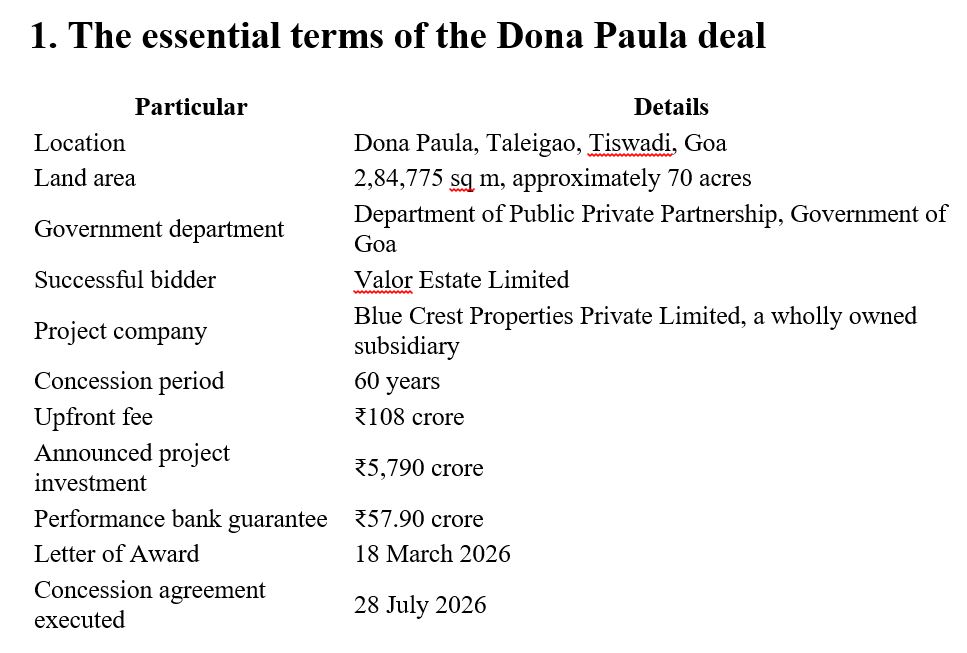
- The essential terms of the Dona Paula deal
The company disclosed the award, subsidiary structure, performance guarantee and execution of the concession agreement in its stock-exchange filings. The definitive agreement governs the detailed concession rights and obligations. Bazaar Watch
Important distinction: The Rs108 crore is the reported upfront fee. It should not automatically be described as the total consideration payable over 60 years. To establish the full financial terms, we need the signed concession agreement, including any additional payments, revenue-sharing arrangements, escalation clauses and other financial obligations.
The company’s official investor disclosure page is available here: Valor Estate investor disclosures - What will the private company be permitted to build?
The revised project is considerably larger than a conventional convention centre.
The proposed facilities include:
• International Convention Centre: Capacity for at least 5,000 delegates.
• Convention hotel: At least 300 rooms.
• Exhibition facilities: Separate air-conditioned exhibition hall and open-air exhibition space.
• Multiplex: Four screens, with a combined minimum seating capacity of 800.
• Concert and events ground: Proposed capacity of up to 30,000 people.
• Additional commercial development: Other permissible facilities, subject to planning regulations and the required approvals.
The government has presented the project as a means of developing Goa’s meetings, incentives, conferences and exhibitions (MICE) tourism sector. The commercial significance, however, extends beyond the convention centre itself to the associated hospitality, retail, entertainment and other permitted developments.
That raises a fundamental public-interest question: How much of the 70 acres is actually necessary for the convention centre, and how much is intended for commercially exploitable development?
The answer requires the approved master plan, survey-wise land-use breakdown, permitted floor-area ratio (FAR), built-up area and development permissions. - The financial controversy: Rs 108 crore against an alleged land value of Rs 5,100 crore
This is the most important issue emerging today, 27 October 2026.
The Congress has alleged that the land is worth approximately Rs 5,100 crore and that granting the concession for an upfront payment of Rs 108 crore would cause a revenue loss of Rs 4,992 crore.
Congress president Girish Chodankar has demanded greater disclosure of the land valuation, commercial development rights, environmental implications and public consultation. He has also questioned the allocation of approximately 3.46 lakh sq m under the broader Dona Paula development proposal.
However, the Rs 4,992 crore figure is an opposition allegation, not an independently established loss to the state exchequer.
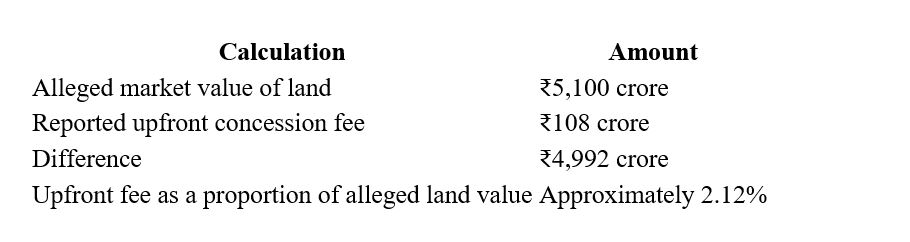
A proper valuation must distinguish between the market value of the land, the value of the rights granted over 60 years, the private developer’s investment obligations, the government’s future receipts and the terms on which the land reverts to the state.
Nevertheless, the gap is sufficiently large to justify an independent examination of the valuation and tender.
The questions the government must answer
- Who valued the land at the time of the tender?
- What valuation methodology was used?
- Was the valuation independently reviewed?
- Was the Rs108 crore upfront fee the principal financial consideration, or are additional payments due over the concession period?
- Is the developer required to share revenue or profits with the government?
- Can the developer commercially exploit the property beyond the mandatory convention facilities?
- What happens if the project is not completed, or if the developer defaults?
- What land and buildings revert to the government after 60 years, and in what condition?
Without the signed agreement and supporting valuation documents, it would be premature to conclude that the land was underpriced by precisely Rs 4,992 crore. - The DB Realty connection
The successful bidder is not an unrelated company with no development history.
Valor Estate Limited is the renamed entity of D B Realty Limited. The project is to be implemented through its wholly owned subsidiary, Blue Crest Properties Private Limited.
For an investigative report, three separate issues need examination:
• Corporate ownership: Who ultimately controls Valor Estate and Blue Crest Properties?
• Tender process: Which companies submitted bids, which qualified technically, and how did their financial offers compare?
• Commercial rights: What precisely can the successful bidder construct, operate, lease or monetise on the government land?
The available reporting states that two of the three bidders technically qualified and that Valor Estate’s Rs 108 crore upfront offer was accepted as the highest financial bid. The Times of India
The fact that Valor Estate won the tender does not itself establish wrongdoing. The relevant question is whether the bidding conditions and valuation protected Goa’s interests and whether the award complied with the applicable procedures.
- How the Dona Paula land reached this stage
The land was originally associated with the Rajiv Gandhi IT Habitat, administered through the Info Tech Corporation of Goa.
A Goa Legislative Assembly reply dated 7 February 2024 stated that plots allotted under the Rajiv Gandhi IT Habitat had been cancelled or abolished under the 2012 legislation governing cancellation and regulation of plot allotments. The land vested in the Info Tech Corporation of Goa free from the specified claims and encumbrances. The same reply said that the earlier convention-centre award had been cancelled because the selected bidder failed to meet its conditions.
The convention-centre proposal then went through unsuccessful bidding rounds before the government issued a fresh request for proposals in late 2025.
The new tender was issued under reference 82/DPPP/ICC/RFP/2025. The official tender listing identifies the Department of Public Private Partnership as the procuring authority. eProcure Goa
The chronology raises a question that deserves a documentary answer: what changed between the original IT-habitat purpose, the earlier convention-centre proposals and the current arrangement allowing extensive downstream commercial development?
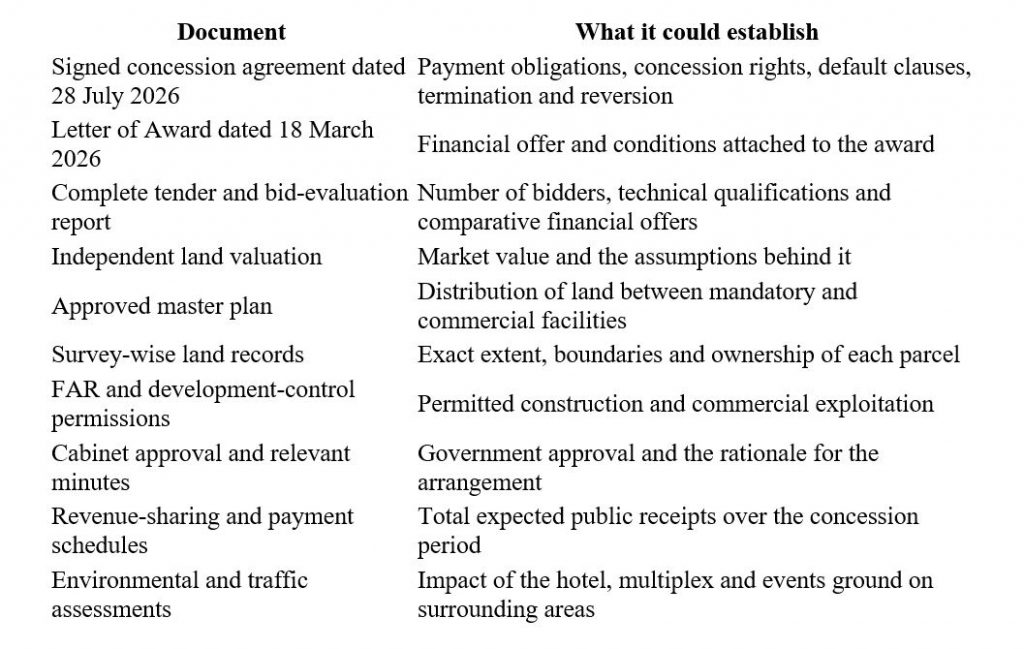
The answer must be established from the land-transfer orders, planning records, cabinet decisions and tender documents, rather than inferred from the sequence alone. - The documents needed to establish whether the deal favours the developer
The following records are crucial to an exhaustive investigation.
The government’s official PPP Secretariat downloads page provides access to the convention-centre tender materials. The company’s stock-exchange disclosures provide the dates and corporate details of the award and agreement.

My assessment
The most consequential issue is not simply that a private developer has received 70 acres of public land. It is whether the state has transparently valued and tendered the entire package of development rights for 60 years.
The government should publish the signed concession agreement, the valuation report, the comparative bids and the complete master plan. Until these are examined, neither the government’s claim of public benefit nor the opposition’s precise estimate of revenue loss can be independently verified.
The next decisive step is to obtain the full concession agreement and compare its financial clauses against the land valuation and the development rights granted. That is the evidence needed to determine whether this is a commercially justified public-private partnership or an arrangement that gives away too much of Goa’s public land value.